

Risk management
What Is Margin in Forex? Used Margin, Free Margin and Examples
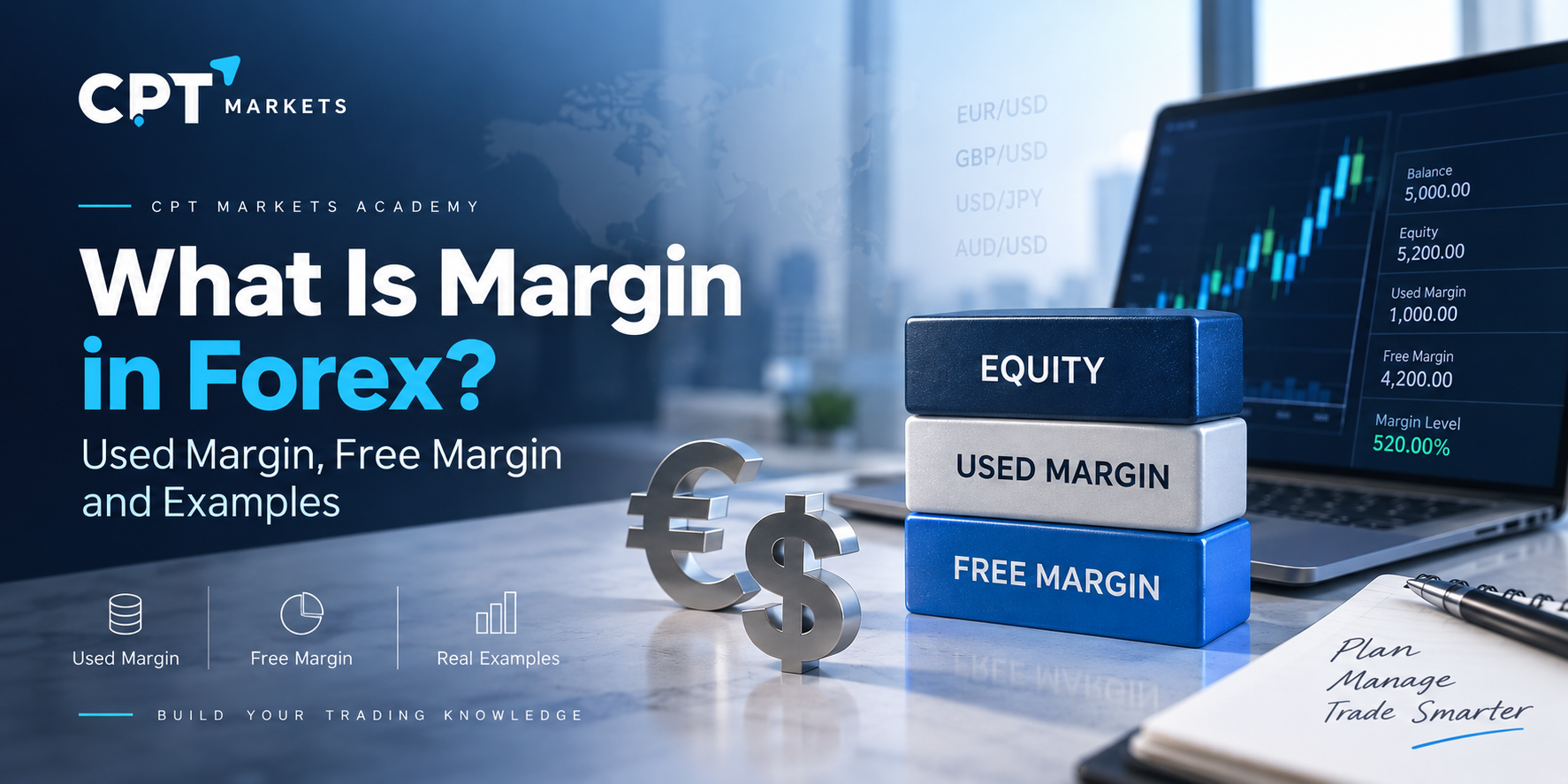
Forex margin is the amount of funds a broker requires you to maintain in your trading account to open and support a leveraged position. It is not a trading fee or a down payment that gives you ownership of the full currency position. Instead, margin acts as collateral for the trade. Used margin is the total margin currently required to support open positions.
What Is Margin in Forex?
Margin is a key concept in leveraged Forex trading. It determines how much account equity is required to open a position of a particular size.
When trading a currency pair through a leveraged product, you do not necessarily need to deposit the full notional value of the position. Instead, the broker applies a margin requirement, expressed as a percentage of the position’s notional value or calculated using the applicable contract specifications.
For example, if a hypothetical trade has a notional value of $100,000 and a margin requirement of 2%, the required margin would be $2,000. The position’s full market exposure remains $100,000, so losses are not limited to the margin reserved.
If the market moves against the position, losses reduce account equity. Depending on the product, account terms and applicable rules, losses may exhaust available funds and could exceed the initial deposit.
How Does Forex Margin Work?
Margin and leverage are closely related, but they describe different things.
- Margin is the amount of equity required to support a position.
- Leverage describes the relationship between the position’s notional value and the margin required to hold it.
A lower margin requirement generally allows a trader to control a larger position relative to the required margin. However, this also means that a relatively small market movement can have a substantial effect on account equity.
Margin and leverage formula
For a straightforward example where the margin requirement is a fixed percentage of the position’s notional value:
Required Margin = Notional Value × Margin Rate
The corresponding leverage ratio is:
Leverage = 1 ÷ Margin Rate
For example, a 2% margin requirement corresponds to 50:1 leverage under this simplified calculation.
|
Margin requirement |
Equivalent leverage |
|
10% |
10:1 |
|
5% |
20:1 |
|
2% |
50:1 |
|
1% |
100:1 |
|
0.5% |
200:1 |
These are mathematical illustrations, not CPT Markets account terms or statements of the leverage available in any jurisdiction. Actual requirements may vary by instrument, account, position size and applicable rules.
What Is Used Margin in Forex?
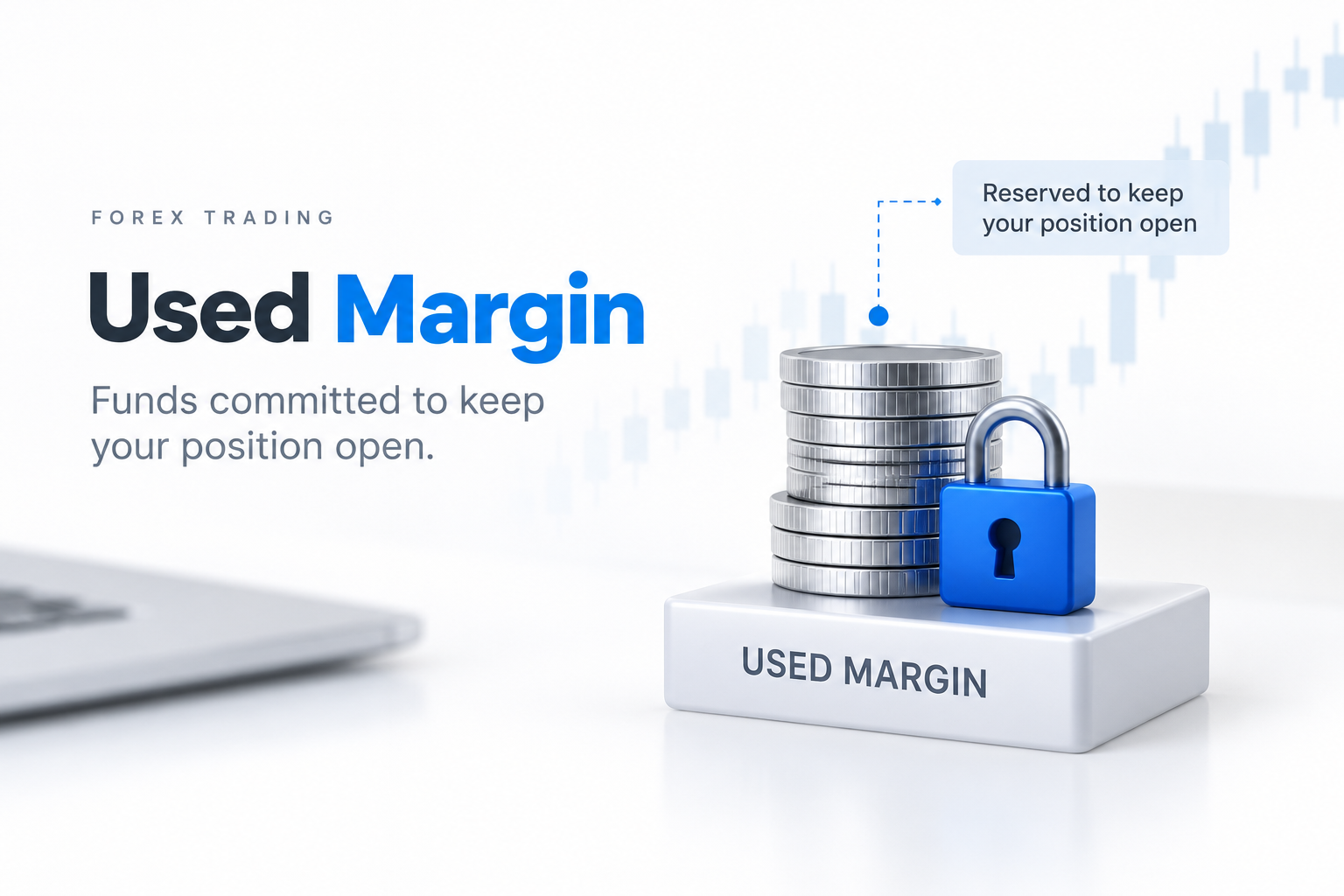
Used margin is the total amount of margin currently required to support open positions. When a trader opens a leveraged position, the platform typically reserves the required margin according to the broker’s margin calculation.
This amount is not necessarily a fee paid to the broker. Instead, it is committed as collateral while the position remains open.
For example, imagine a trader has $5,000 in account equity and opens a position requiring $1,000 in margin. If there are no other open positions, the trader’s used margin is $1,000.
The trader still has exposure to the full position’s market movements. Consequently, a loss on the trade reduces account equity even though the required margin remains reserved.
How to calculate used margin
For a single position with a fixed margin rate:
Used Margin = Notional Value × Margin Rate
For multiple positions, used margin is generally based on the margin requirements of the open positions. However, the exact calculation depends on the broker’s margin methodology. Some systems may apply different requirements or account for offsetting positions.
Therefore, traders should refer to the platform’s displayed margin figures and the applicable contract specifications because margin calculations may differ between providers and products.
What Is Free Margin in Forex?
Free margin is the portion of account equity that is not currently being used to support open positions. It provides a measure of the funds available to absorb further losses or support additional positions.
A positive free margin does not mean the account is risk-free. Market movements can reduce equity and free margin, potentially bringing the account closer to a margin-related close-out threshold.
Free margin formula
Free Margin = Equity − Used Margin
Account equity generally includes the account balance plus or minus the unrealised profit or loss on open positions, with the exact treatment of fees and other adjustments depending on the platform.
For example, suppose an account has:
- Balance: $5,000
- Unrealised profit: $200
- Used margin: $1,000
Equity is $5,200, so free margin is:
$5,200 − $1,000 = $4,200
If the position instead has an unrealised loss of $200, equity falls to $4,800 and free margin becomes $3,800, assuming no other account adjustments.
This demonstrates why free margin changes as market prices move, even when the trader does not open or close a position.
Used Margin vs Free Margin vs Equity
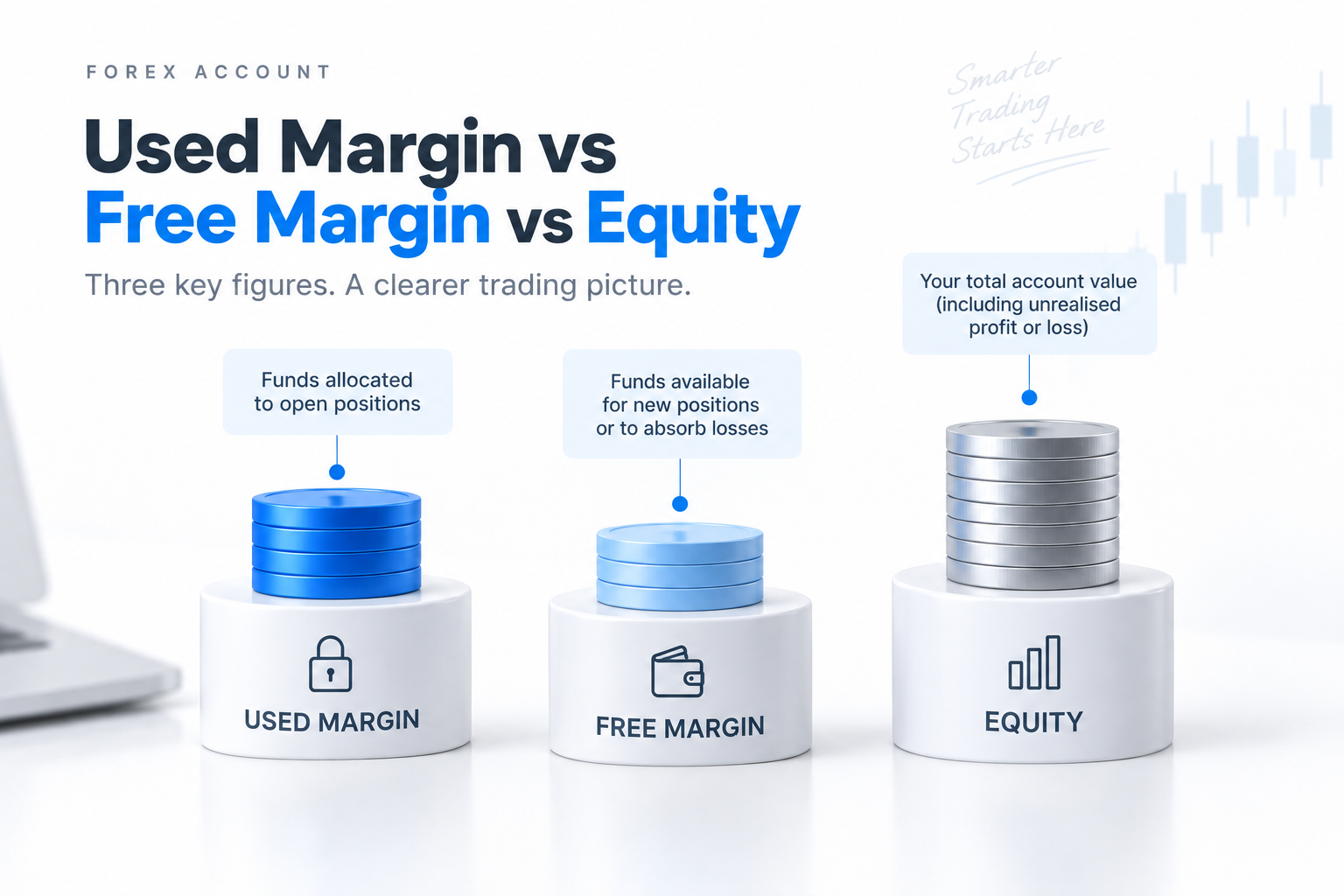
Used margin, free margin and equity show how a trading account’s funds are allocated and how much capacity remains to support open positions. Understanding how they relate helps traders interpret account information and assess how much room remains before margin pressure increases.
|
Term |
Meaning |
|
Balance |
Account funds after closed-trade results and booked account adjustments. |
|
Equity |
Balance adjusted for unrealised profit or loss and applicable account adjustments. |
|
Used margin |
The total margin currently required to support open positions. |
|
Free margin |
Equity remaining after used margin is deducted. |
|
Margin level |
Equity expressed as a percentage of used margin. |
As unrealised losses increase, equity and free margin generally decrease. Used margin may remain unchanged, unless margin requirements or position exposure change. This relationship helps explain why an account can come under margin pressure even when no new positions are opened.
What is margin level?
Margin level is a percentage used by many trading platforms to indicate the relationship between account equity and used margin.
Margin Level = (Equity ÷ Used Margin) × 100
For example, if equity is $5,000 and used margin is $1,000, the margin level is 500%.
If equity falls to $2,000 while used margin remains $1,000, the margin level falls to 200%.
A lower margin level indicates that the account has less equity relative to its margin requirement. However, the level at which a broker issues a margin call or closes positions depends on the applicable account terms and rules.
Forex Margin Calculation: A Hypothetical Example
Consider a hypothetical trader with a USD-denominated account who opens a EUR/USD position. The following example uses simplified assumptions to demonstrate how margin, equity and free margin interact.
Assume:
- Account balance: $5,000
- EUR/USD exchange rate: 1.1000
- Position size: 1 standard lot, equivalent to €100,000
- Margin requirement: 2%
- No other open positions or account adjustments
Step 1: Calculate the position’s notional value
The position is €100,000. At an exchange rate of 1.1000 USD per EUR, its USD notional value is:
€100,000 × 1.1000 = $110,000
Step 2: Calculate required margin
$110,000 × 2% = $2,200
The position therefore requires $2,200 in margin under the example’s assumptions.
Step 3: Calculate free margin
At the moment the position opens, assume there is no unrealised profit or loss and no additional costs.
|
Account metric |
Amount |
|
Balance |
$5,000 |
|
Equity |
$5,000 |
|
Used margin |
$2,200 |
|
Free margin |
$2,800 |
|
Margin level |
227.27% |
The trader has $2,800 in free margin. However, this does not mean the trader can lose only $2,200. The position’s market exposure is $110,000, and losses are reflected in account equity.
Step 4: See what happens when the market moves
Suppose EUR/USD moves against the position by 50 pips, from 1.1000 to 1.0950.
For a €100,000 EUR/USD position, a 0.0050 price movement corresponds to a $500 loss, before costs and other adjustments.
|
Account metric |
Amount |
|
Balance |
$5,000 |
|
Unrealised loss |
-$500 |
|
Equity |
$4,500 |
|
Used margin |
$2,200 |
|
Free margin |
$2,300 |
|
Margin level |
204.55% |
The loss has reduced equity and free margin by $500. Used margin remains unchanged in this simplified example.
Key point: The margin requirement determines the collateral needed to support the position. It does not determine how much the position can lose.
Actual platform calculations may differ because of currency conversion, contract specifications, margin rules, spreads, commissions, financing charges and other account adjustments.
Explore account information
Review account details, terms, and risks on the official CPT website.
What Is a Margin Call in Forex?
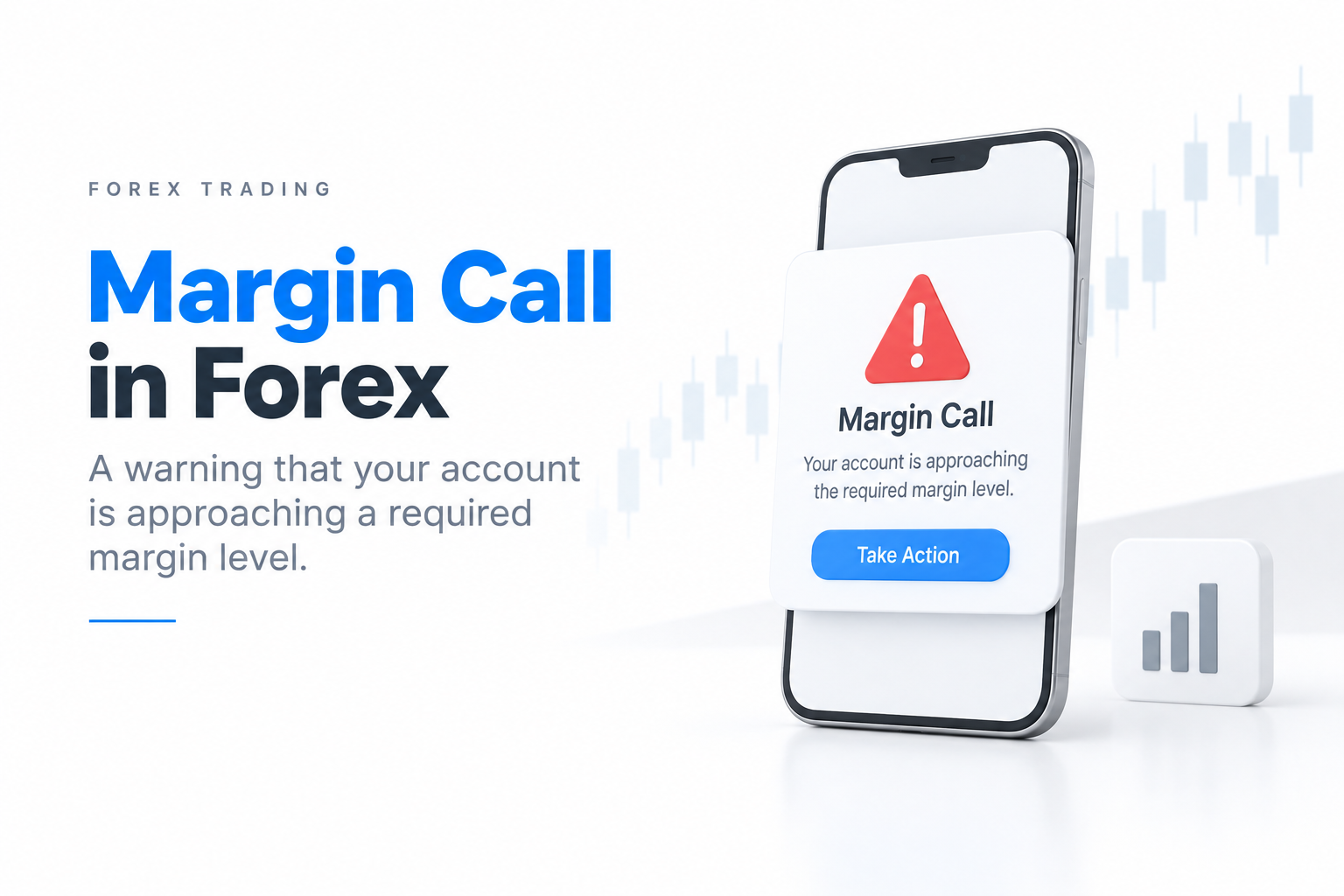
A margin call occurs when an account reaches a specified margin threshold under the provider’s terms. Depending on the broker and account terms, this may result in a warning, restrictions on further trading, a requirement to add funds or reduce exposure, or other action.
In some leveraged trading arrangements, a broker may close one or more open positions when the account’s margin level reaches a specified threshold. The exact trigger, notification process and close-out method vary by provider and jurisdiction.
A margin call does not necessarily mean that the account has a negative balance. It indicates that the account has reached a margin-related condition that requires attention under the applicable terms.
What can trigger a margin call?
Common factors include:
- Unrealised losses: When the market moves against open positions, account equity and free margin decline.
- Increased margin requirements: A change in the margin rate can increase the amount required to support a position.
- Additional positions: Opening more positions may increase total used margin.
- Account adjustments: Applicable charges or other deductions may reduce equity.
For instance, if a trader holds a leveraged position during a period of market volatility, a rapid price movement may reduce equity before the trader has time to respond.
Therefore, traders should understand their provider’s margin-call and close-out policies before opening positions. A warning may not always be issued before positions are closed, and there may be limited time to respond.
What Is a Stop-Out Level?
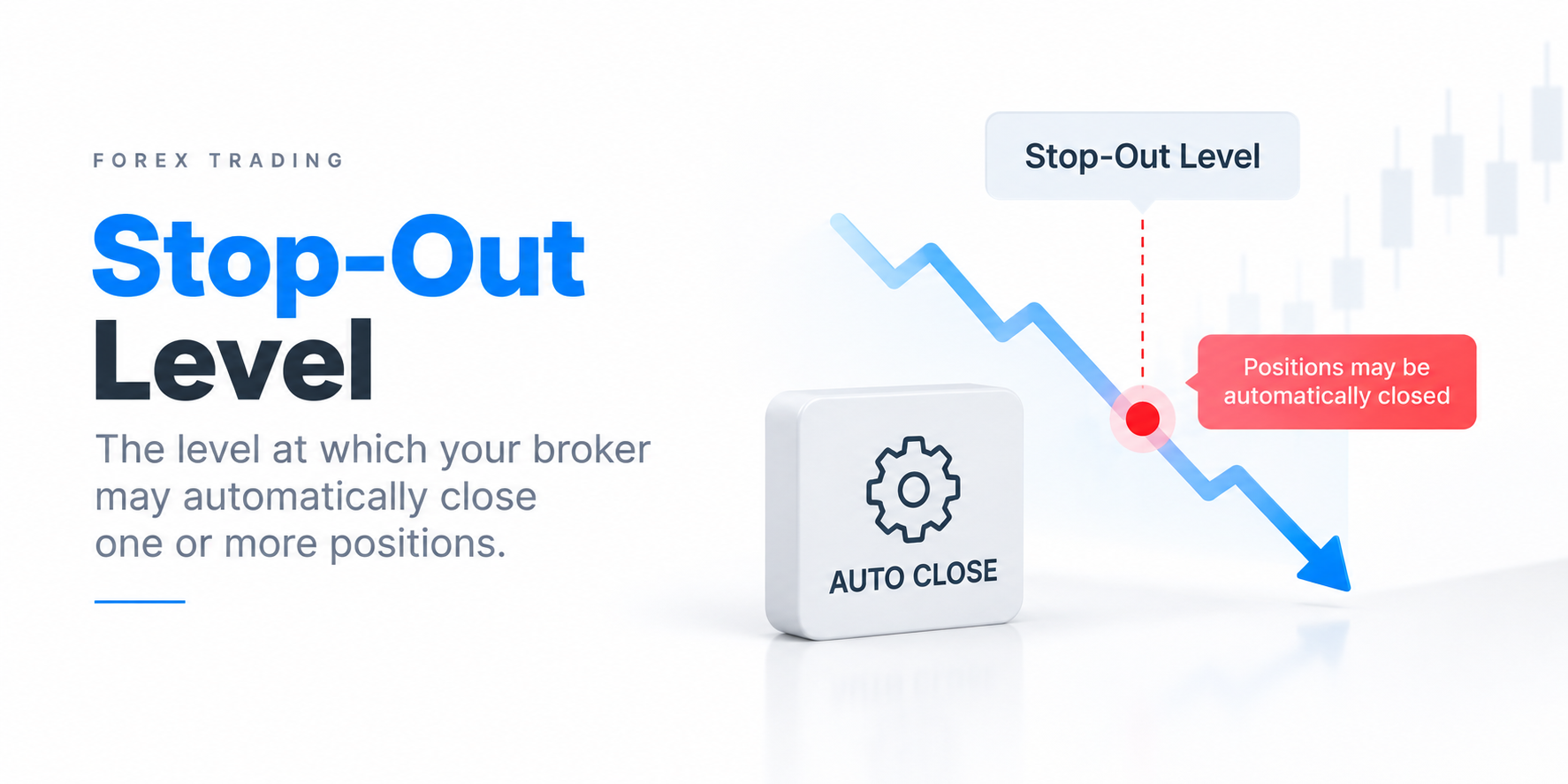
A stop-out level is a margin threshold at which a provider may begin closing open positions under its account terms.
It is different from a margin call level. A margin call may serve as an earlier warning or action threshold, while a stop-out level may trigger position liquidation.
However, there is no single stop-out percentage that applies to every Forex account. Thresholds and procedures depend on the broker, product, account type and applicable regulatory framework.
Before trading, check:
- The margin-call threshold, if applicable.
- The stop-out threshold and how the platform calculates it.
- Whether positions close individually or according to another procedure.
- Whether the provider can close positions without prior notice.
- How negative balances, fees and remaining positions are handled.
A stop-out mechanism should not be treated as a guaranteed loss limit. Fast markets, gaps, slippage and execution conditions can affect the final closing price and resulting account balance.
How to Manage Forex Margin Risk
Understanding margin also involves examining how position size, leverage and market volatility affect account equity and available margin.
1. Understand the full position exposure
Before opening a trade, calculate the position’s notional value and required margin. Then consider how much the account could lose if the market moves against the position.
A position that requires a relatively small margin deposit can still carry substantial market exposure.
2. Consider how much free margin remains
Free margin indicates how much equity remains after used margin is deducted. Opening positions that consume most of the available free margin leaves less room to absorb adverse price movements or changes in margin requirements.
The amount of free margin available does not eliminate market risk, but it helps illustrate how changes in equity may affect an account’s margin position.
3. Monitor equity and margin level
Account balance alone does not show the full effect of open positions. Monitor equity, free margin, used margin and margin level together.
For example, an account may show a positive balance while unrealised losses have already reduced equity significantly.
4. Consider volatility and correlated exposure
Currency prices can move sharply around economic releases, central bank announcements and geopolitical developments. In addition, several positions may be exposed to the same currency or underlying market driver.
Consequently, holding multiple positions does not necessarily mean risk is diversified. Several trades can generate losses at the same time and place additional pressure on free margin.
5. Understand the broker’s margin and liquidation terms
Margin rates, close-out procedures and account protections are not universal. Review the relevant product specifications, client agreement and risk disclosures before trading.
Traders should review the margin requirements, account terms and applicable client protections for the relevant CPT Markets entity before trading.
Is Forex Margin the Same as Leverage?
No. Margin and leverage are related, but they are not interchangeable.
Margin is the collateral required to support a position. Leverage describes how much market exposure a trader controls relative to the margin or capital committed.
For example, a $2,000 margin requirement supporting a $100,000 notional position represents 50:1 leverage under a simplified calculation.
The important distinction is that leverage affects both potential gains and losses. A small margin requirement does not make a position less risky simply because less money is required to open it.
Is Margin a Fee?
Margin itself is generally not a trading fee. It is an amount allocated to support an open position.
However, Forex trading may involve other costs, including spreads, commissions and overnight financing or swap charges, depending on the product and account terms. These costs can affect account equity and therefore influence free margin and margin level.
For this reason, traders should distinguish between the margin required to hold a position and the costs incurred from trading it.
A product advertised as commission-free, for example, should not automatically be assumed to have no trading costs. The pricing structure and applicable charges should be checked in the provider’s official documentation.
Key Takeaways
- Forex margin is collateral required to support a leveraged position, not a limit on potential losses.
- Used margin represents the margin required to support open positions.
- Free margin is equity minus used margin.
- Equity changes as unrealised profits and losses change.
- Margin level shows equity as a percentage of used margin.
- Margin-call and stop-out thresholds depend on the provider’s terms and applicable rules.
- Leverage can magnify both gains and losses, so understanding position exposure is essential.
Margin calculations help explain how open positions affect an account, but they do not remove market risk or guarantee a particular closing price.
FAQs
1. How much margin do I need to trade Forex?
The required margin depends on the position’s notional value, the applicable margin rate and the broker’s calculation method. For example, a hypothetical $10,000 position with a 2% margin requirement would require $200. Actual requirements may vary by currency pair, account type, position size and jurisdiction.
2. Can I lose more than my Forex margin?
Yes. Margin is collateral, not a limit on potential losses. If the market moves against a leveraged position, losses reduce account equity and may exceed the margin initially reserved. Whether losses can exceed the deposited amount depends on the applicable account terms and protections. Traders should review the relevant risk disclosures before trading.
3. What happens when free margin reaches zero?
When free margin reaches zero, account equity equals used margin under the standard calculation. The account may have little or no capacity to absorb further losses or support additional positions. If equity declines further, the account may reach a margin-call or stop-out threshold, depending on the provider’s terms.
4. Does closing a Forex trade release used margin?
Generally, closing a position releases the margin allocated to that position. However, the final amount available may differ because of realised profit or loss, applicable charges, remaining open positions and any changes in margin requirements. Check the platform’s updated account figures after a position closes.
5. Is higher leverage always better for Forex trading?
No. Higher leverage can reduce the margin required to open a position, but it also allows a trader to take on greater market exposure relative to account equity. This can magnify losses as well as gains. The amount of leverage available does not determine whether a trade is suitable or how much risk it carries.
6. Where can I check my Forex margin requirements?
Margin requirements are typically provided in a broker’s contract specifications, trading platform or account documentation. The exact location and calculation method vary by provider and product. Before trading, confirm the margin rate, margin-call policy, stop-out threshold and any applicable account-specific conditions with the relevant provider.
Explore account information
Review account details, terms, and risks on the official CPT website.
Related articles
- Forex essentials
Base Currency vs Quote Currency: How Forex Pairs Are Read
A currency pair shows the value of one currency relative to another. The base currency is the first currency in the pair, while the quote currency is the second. The exchange rate tells you how many units of the quote currency are needed to buy one u
12 min read · estimated↗ - Trading essentials
What Is a Trader? Types, Skills, and How Trading Works
A trader is an individual who buys and sells financial instruments or takes positions in financial products to seek profits from changes in market prices. Traders operate across markets such as foreign exchange (forex), shares, indices, commodities,
13 min read · estimated↗ - Digital assets
What Is Litecoin (LTC)? How It Works, Uses, and Risks
Litecoin (LTC) is a decentralised cryptocurrency designed to enable peer-to-peer transactions without requiring a central authority to process them. Launched in 2011, it uses a public blockchain and a proof-of-work consensus mechanism to record trans
12 min read · estimated↗