
Trading essentials
What Is a Trader? Types, Skills, and How Trading Works
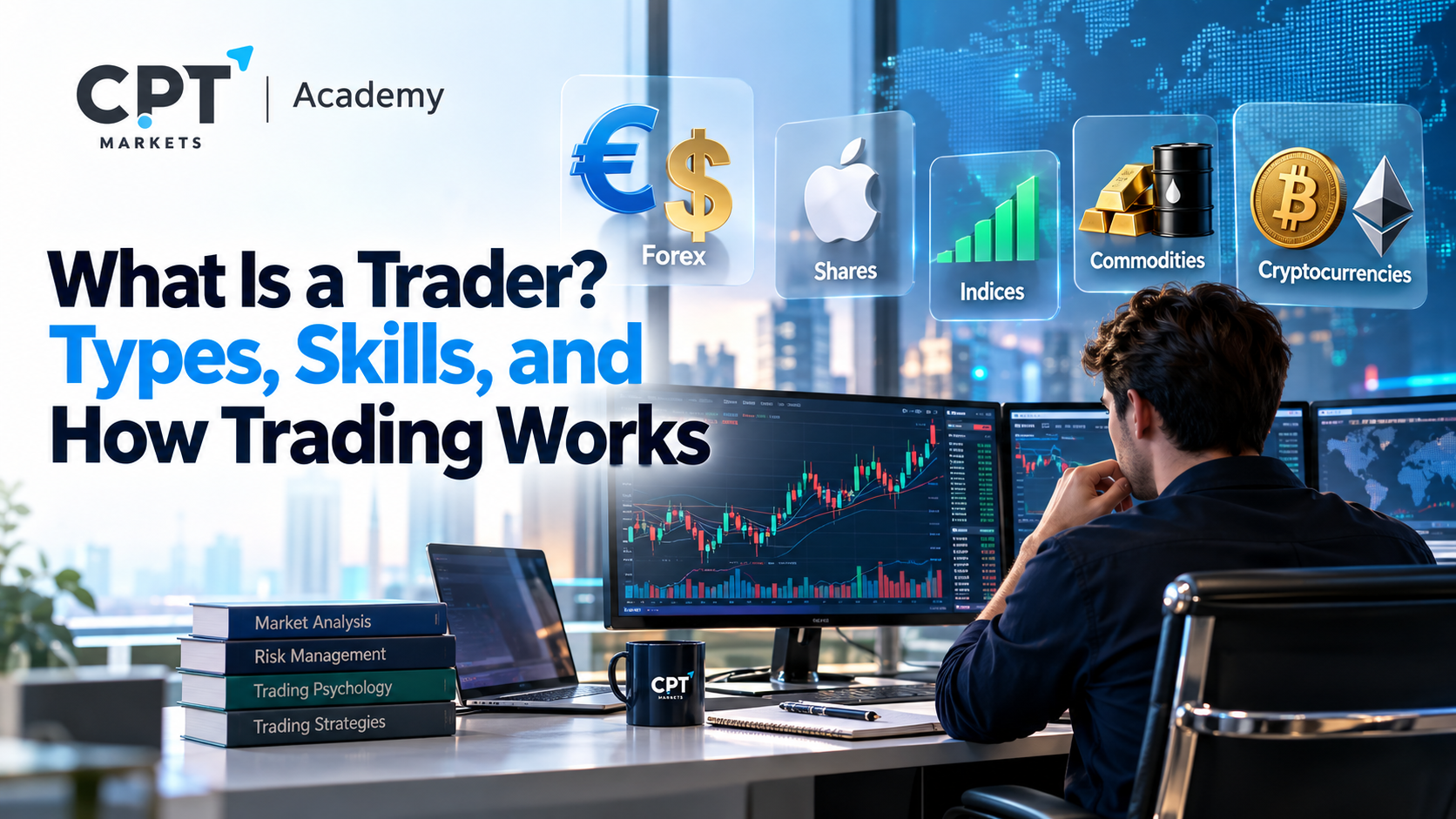
A trader is an individual who buys and sells financial instruments or takes positions in financial products to seek profits from changes in market prices. Traders operate across markets such as foreign exchange (forex), shares, indices, commodities, and cryptocurrencies. Some hold positions for seconds or minutes, while others keep them open for days, weeks, or longer. However, trading involves uncertainty, and no strategy or level of experience can guarantee a profit.
Understanding what traders do, how they make decisions, and how different trading approaches work can help beginners build a stronger foundation before entering the financial markets.
What Does a Trader Do?
A trader analyses financial markets, identifies potential trading opportunities, and decides whether to buy, sell, or remain out of the market. Depending on their approach, they may study price charts, economic data, company announcements, central bank decisions, and other information that could influence prices.
However, a trader’s role involves more than predicting whether a market will rise or fall. Traders also assess potential losses, consider transaction costs, and decide how much capital to risk on a position.
For example, a forex trader analysing EUR/USD might assess whether the euro could strengthen against the US dollar following an economic announcement. The trader could consider opening a position, but the market might move in the opposite direction or react differently from expectations.
Traders can work independently, manage their own accounts, or trade on behalf of financial institutions. Their responsibilities depend on their role, the instruments they trade, and the rules governing their activities.
How Does Trading Work?
Trading involves taking a position in a financial instrument and managing the potential outcome as market prices change. The exact process depends on the market and the product involved.
A typical trading process follows five steps:
1. Analyse the Market: Examine relevant price movements, economic information, and other factors that may influence the instrument.
2. Form a Trading Hypothesis: Identify a potential price movement and the conditions that could support or invalidate the idea.
3. Choose an Instrument and Position Size: Select the market to trade and determine the exposure involved.
4. Place and Manage the Trade: Submit an order, monitor the position, and apply the planned risk controls.
5. Review the Outcome: Evaluate the result, including costs, execution, and whether the original plan was followed.
Importantly, these steps do not eliminate risk. Prices can change unexpectedly, and orders may execute at prices different from those requested.
Buying and Selling
A trader’s position depends on the instrument and trading product used.
When buying shares outright, a trader generally acquires ownership of those shares. The trader may later sell them to realise a gain or loss.
In derivatives trading, the situation can differ. A contract for difference (CFD) allows a trader to speculate on changes in an underlying asset’s price without owning the asset itself. The trader’s profit or loss generally reflects the price difference between opening and closing the contract, subject to applicable charges. In CFD trading, a trader can generally open a long (buy) position when expecting the price to rise or a short (sell) position when expecting it to fall.
Nevertheless, predicting the direction correctly does not guarantee a profitable trade. The size and timing of the price movement, trading costs, and the terms of the product all affect the outcome.
A Hypothetical Trading Example
Suppose a trader opens a hypothetical buy position on an instrument priced at $100 and closes it at $105. If the position represents one unit and no transaction costs apply, the gross gain is $5.
If the price instead falls to $95, the gross loss is $5.
|
Item |
Hypothetical Outcome |
|
Opening Price |
$100 |
|
Closing Price After a Rise |
$105 |
|
Gross Gain per Unit |
$5 |
|
Alternative Closing Price |
$95 |
|
Gross Loss per Unit |
$5 |
This simplified example excludes spreads, commissions, financing charges, and other possible costs. Actual outcomes depend on the instrument, position size, and applicable trading conditions. Leverage magnifies exposure to price movements and can increase losses relative to the funds committed. Whether losses can exceed the initial investment depends on the product and the protections available.
What Are the Different Types of Traders?
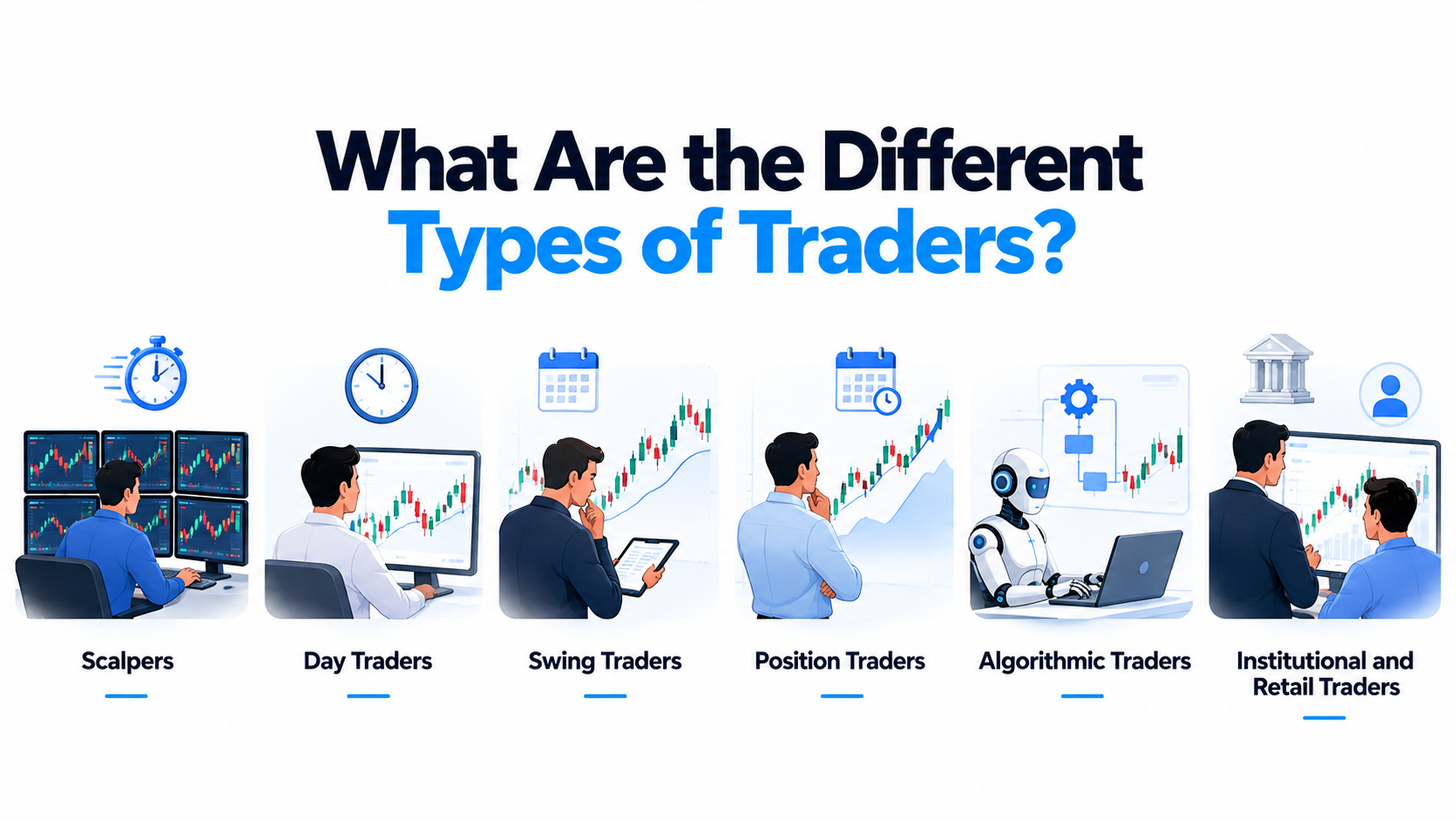
Traders can be classified by how long they hold positions, how they analyse markets, or whether they trade independently or professionally. These categories can overlap, so a trader does not necessarily belong to only one group.
1. Scalpers
Scalpers seek to benefit from small price movements over very short periods, sometimes holding positions for only seconds or minutes. They often place multiple trades during a session and pay close attention to execution speed, spreads, and transaction costs.
However, frequent trading can increase costs and expose traders to rapid price changes. Small gains on an individual trade do not guarantee positive overall results.
2. Day Traders
Day traders typically open and close positions within the same trading day rather than deliberately holding them overnight. They may use technical analysis, intraday price patterns, and scheduled economic announcements to identify potential opportunities.
Day trading requires sustained attention and disciplined decision-making. Rapid market movements, repeated transaction costs, and emotional reactions can contribute to substantial losses. It is not a reliable shortcut to making money.
3. Swing Traders
Swing traders seek to capture price movements that develop over several days or weeks. They may combine technical analysis with economic or company-related information to identify potential entry and exit points.
Because positions remain open longer, swing traders face risks from overnight price gaps, unexpected announcements, and changing market conditions. Depending on the product, holding positions overnight may also incur financing charges.
4. Position Traders
Position traders generally hold positions for weeks, months, or sometimes longer. They tend to focus on broader market trends, economic developments, and longer-term changes in the factors affecting an asset’s price.
Although their trading frequency may be lower, their positions can still experience significant losses. Longer holding periods may also increase exposure to changing fundamentals, financing costs, and other product-specific risks.
5. Algorithmic Traders
Algorithmic traders use computer programmes to identify trading signals or submit orders according to predefined rules. Some systems rely on simple conditions, while others use statistical models or complex quantitative methods.
Automation can improve consistency in executing a defined process, but it cannot remove market risk. Poor data, coding errors, unsuitable assumptions, or changing market conditions can cause a strategy to perform differently from its design.
6. Institutional Traders and Retail
Retail traders generally trade for their own accounts, while institutional traders work for organisations such as banks, asset managers, or other financial firms. Institutional roles may involve executing client orders, managing portfolios, providing liquidity, or implementing investment strategies.
The distinction concerns the trader’s role and trading context rather than how long they hold positions. Retail and institutional traders can both use short-term, medium-term, or longer-term approaches.
What Markets Can Traders Trade?
Traders can participate in different financial markets depending on their objectives, knowledge, available products, and the services offered by their provider.
· Forex: Trading currency pairs, such as EUR/USD, to speculate on changes in the exchange rate between the two currencies.
· Shares: Buying or selling company shares, or trading derivatives linked to their prices.
· Indices: Gaining exposure to the performance of a group of shares through an available investment or derivative product.
· Commodities: Trading physical commodities or financial products linked to resources such as gold, silver, and crude oil.
· Cryptocurrencies: Buying and selling digital assets or trading eligible derivatives linked to their prices.
These markets differ in trading hours, liquidity, volatility, pricing, and costs. Furthermore, direct ownership of an asset is not the same as trading a derivative that references its price.
Before trading, beginners should understand the specific instrument, how orders work, and which charges or risks apply. Product availability and regulatory requirements also vary by provider and jurisdiction.
Explore account information
Review account details, terms, and risks on the official CPT website.
What Skills Does a Trader Need?
Successful trading cannot be reduced to a fixed set of skills, and no combination guarantees positive returns. Nevertheless, several capabilities can help traders make more informed and consistent decisions.
Market Analysis
Traders need to understand the information relevant to their chosen markets. Technical analysis examines price charts, trends, and patterns, while fundamental analysis considers factors such as economic indicators, interest rates, company performance, and supply and demand.
Some traders combine both approaches. The important point is to understand the limitations of each method rather than treating any indicator or forecast as a certainty.
Risk Management
Risk management involves identifying potential losses before entering a trade and deciding how to control exposure. Traders may use position sizing, stop-loss orders, and predefined exit conditions as part of their approach.
However, these tools have limitations. A stop-loss order does not always guarantee execution at the requested price, particularly during gaps or periods of rapid market movement. Risk controls can reduce certain exposures, but they cannot eliminate trading risk.
Emotional Discipline
Fear, overconfidence, and frustration can influence trading decisions. For example, a trader who experiences a loss might increase position size in an attempt to recover it quickly, creating additional exposure.
A defined trading plan and a consistent review process can help traders recognise such behaviour. Even so, following a plan does not guarantee a profitable outcome.
Financial Knowledge and Numeracy
Traders need to understand percentages, price movements, position sizes, leverage, and transaction costs. These concepts are particularly important when comparing potential gains with potential losses.
They should also understand the difference between a gross result and a net result after applicable charges. Without that distinction, a strategy may appear more profitable than it actually is.
Research and Adaptability
Markets respond to changing economic conditions, unexpected events, and shifts in sentiment. Traders therefore need to assess new information critically and recognise when their original assumptions no longer hold.
Keeping a trading journal can help identify recurring mistakes and reveal whether decisions follow a consistent process. However, past results do not establish that a strategy will work in the future.
What Is the Difference Between a Trader and an Investor?
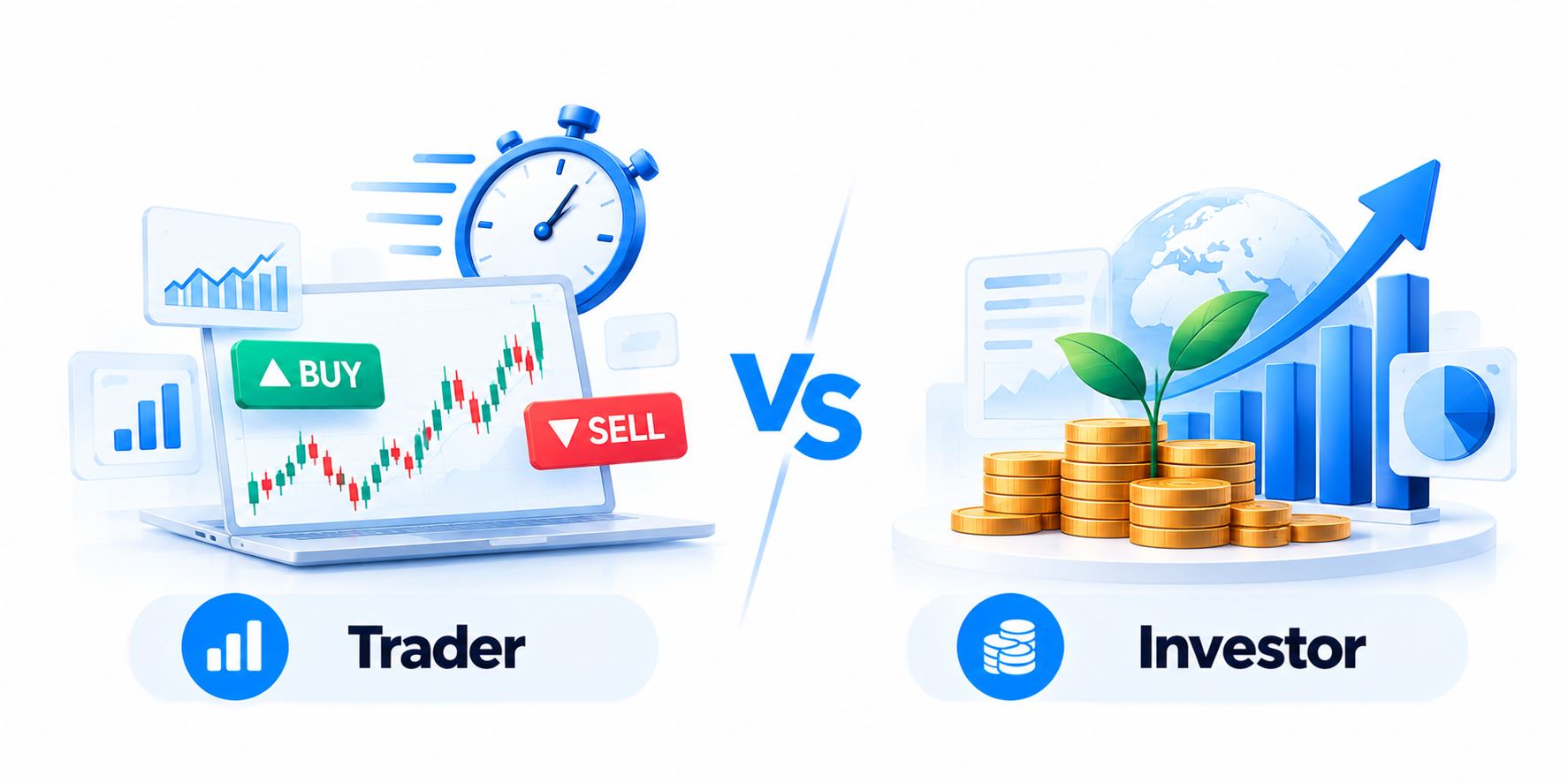
Traders and investors both participate in financial markets, but they often differ in their objectives, time horizons, and decision-making processes.
|
Factor |
Trader |
Investor |
|
Typical Focus |
Shorter-term or medium-term price movements, depending on the approach |
Longer-term growth in value or income, often through holding assets or investment products |
|
Holding Period |
Seconds to months or longer |
Often years, although this varies |
|
Common Analysis |
Price action, market conditions, and catalysts |
Business fundamentals, valuation, and long-term prospects |
|
Trading Frequency |
May be frequent or infrequent |
Often lower, depending on the strategy |
|
Main Risks |
Market movements, execution, costs, and leverage where applicable |
Market declines, business performance, and valuation risk |
These are broad distinctions rather than strict rules. Position traders may hold trades for months, while investors may sell assets quickly when circumstances change.
Neither approach is inherently superior. The suitability of a particular activity depends on the person’s objectives, experience, financial circumstances, and ability to bear losses.
What Should Beginners Know Before Becoming Traders?
Beginners should focus on understanding how markets and trading products operate before committing money. A useful starting point is to learn the terminology, practise analysing price movements, and understand how a trade can lose value.
Consider the following preparation steps:
1. Learn the Basics: Understand market orders, limit orders, spreads, margin, and leverage before using them.
2. Choose a Market to Study: Concentrate on a manageable number of instruments rather than trying to follow every market at once.
3. Practise with a Demo Account, if Available: A simulated account can help you learn platform functions and practise a trading process without risking real capital. However, demo results may differ from live trading because execution, liquidity, slippage, and the psychological impact of financial losses can vary.
4. Write Down Your Trading Rules: Define the conditions for entering and exiting positions, the risks you will accept, and the circumstances in which you will not trade.
5. Understand the Costs and Product Terms: Check spreads, commissions, overnight financing, and other applicable charges, as well as the rules governing margin and position closure.
6. Review Your Decisions: Record the reasons for each trade and assess both the result and the quality of the decision-making process.
Most importantly, never assume that a demo strategy will produce the same results in a live account. Leverage can magnify both gains and losses, and some products may expose traders to losses greater than their initial investment. Only consider trading after understanding the relevant risks, terms, and regulatory protections.
A CPT Markets Demo Account can help beginners familiarise themselves with trading platforms and practise trading in a simulated environment without risking real capital.
Understanding the Trader’s Role
Traders use different approaches depending on their objectives, preferred holding periods, and methods of analysing financial markets. Each approach has its own demands and risks.
Ultimately, understanding a trader’s approach means recognising both how trading decisions are made and the risks involved in pursuing potential returns.
Frequently Asked Questions
1. What Is a Trader in Simple Terms?
A trader is someone who buys and sells financial instruments to benefit from changes in their prices. Traders may operate in markets such as forex, shares, indices, and commodities. Some trade for their own accounts, while others work for financial institutions. Trading outcomes are uncertain, and traders can lose money when prices move against their positions.
2. How Do Traders Make Money?
Traders may make money when a position moves in the anticipated direction and the resulting gain exceeds applicable costs. Depending on the instrument, they may trade rising or falling prices. However, no trading method guarantees profits. Spreads, commissions, financing charges, execution prices, and adverse market movements can reduce gains or turn a trade into a loss.
3. What Are the Main Types of Traders?
Common categories include scalpers, day traders, swing traders, position traders, and algorithmic traders. Scalpers focus on very short-term price movements, while day traders usually close positions within the same day. Swing and position traders generally hold positions longer. Algorithmic traders use programmed rules to identify signals or execute orders. These categories can overlap.
4. Can Beginners Become Traders?
Beginners can learn trading concepts through education, market observation, and simulated practice. However, learning the mechanics of trading does not remove the risk of losing money. New traders should understand order types, market volatility, trading costs, margin, and leverage before considering live trading. They should also recognise that demo results may differ from live outcomes.
5. Is Trading the Same as Investing?
Trading often focuses on price movements over shorter or medium-term periods, while investing commonly focuses on longer-term ownership and potential value creation. Nevertheless, the two activities overlap, and their time horizons vary. Both involve risk, and neither guarantees a positive return. The main differences usually concern objectives, holding periods, and decision-making methods.
6. Is Trading Risky?
Yes. Market prices can move unexpectedly, and traders may lose some or all of their trading capital. Leveraged products increase exposure relative to the funds committed and can magnify losses. Depending on the product and applicable protections, losses may exceed the initial investment. Traders should understand the relevant terms, costs, and risks before opening a position.
Explore account information
Review account details, terms, and risks on the official CPT website.
Related articles
- Forex essentials
Base Currency vs Quote Currency: How Forex Pairs Are Read
A currency pair shows the value of one currency relative to another. The base currency is the first currency in the pair, while the quote currency is the second. The exchange rate tells you how many units of the quote currency are needed to buy one u
12 min read · estimated↗ - Digital assets
What Is Litecoin (LTC)? How It Works, Uses, and Risks
Litecoin (LTC) is a decentralised cryptocurrency designed to enable peer-to-peer transactions without requiring a central authority to process them. Launched in 2011, it uses a public blockchain and a proof-of-work consensus mechanism to record trans
12 min read · estimated↗ - Forex essentials
High-Value Currencies Compared: Exchange Rates Against the US Dollar
The highest-value currencies in the world are those that exchange for the greatest number of US dollars per unit. The Kuwaiti dinar, Bahraini dinar, and Omani rial typically lead this ranking, followed by currencies such as the Jordanian dinar and Br
14 min read · estimated↗