

Academy
Bid Price vs Ask Price: Meaning, Spread, and Examples
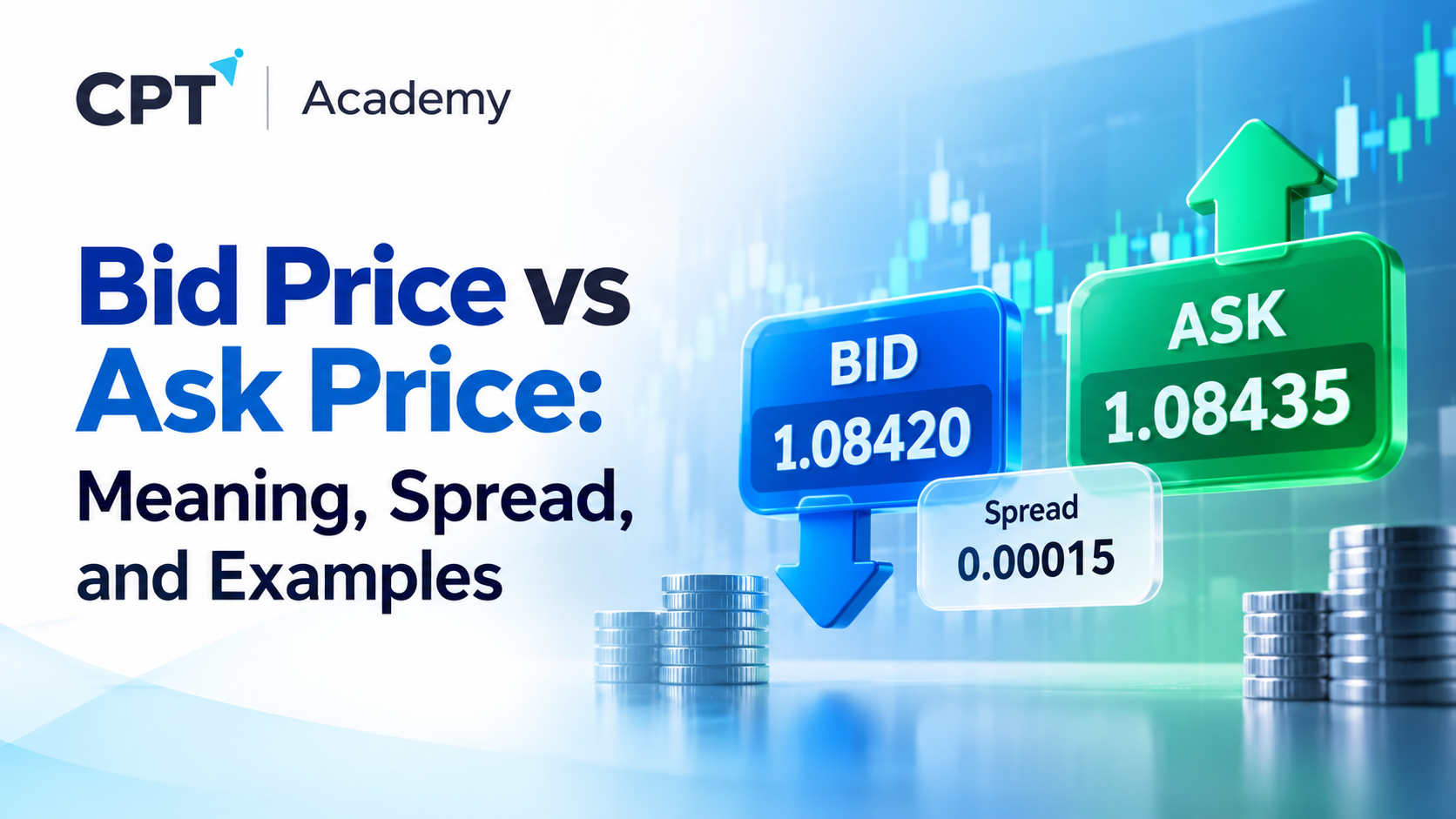
When you view a financial market quote, you will usually see two prices: the bid and the ask. The bid price is the price at which you can sell an instrument, while the ask price is the price at which you can buy it. The difference between these prices is called the spread. Understanding how bid and ask prices work helps you interpret market quotes, estimate an important component of trading costs, and understand why a position may initially show a loss after opening.
What Is the Difference Between Bid and Ask Prices?
The bid and ask represent two sides of a market quote. Although they refer to the same financial instrument, they apply to opposite trading actions.
· Bid Price: The price at which a trader can generally sell an instrument at the quoted price.
· Ask Price: The price at which a trader can generally buy an instrument at the quoted price.
In a conventional two-sided quote, the ask is equal to or higher than the bid. The difference is known as the bid-ask spread, or simply the spread.
Consider a hypothetical EUR/USD quote:
|
Quote Component |
Price |
|
Bid |
1.08420 |
|
Ask |
1.08435 |
|
Spread |
0.00015 |
If you buy EUR/USD at the quoted ask of 1.08435, you pay USD 1.08435 for each euro purchased. Conversely, if you sell at the quoted bid, the exchange rate is USD 1.08420 per euro.
The difference between the two prices is 0.00015. This may look small, but the spread becomes important when you consider the size of a position and the number of transactions.
Key Point: The bid is the selling price available to you as a trader, and the ask is the buying price available to you. Always check the quote before placing an order.
What Is the Bid-Ask Spread?
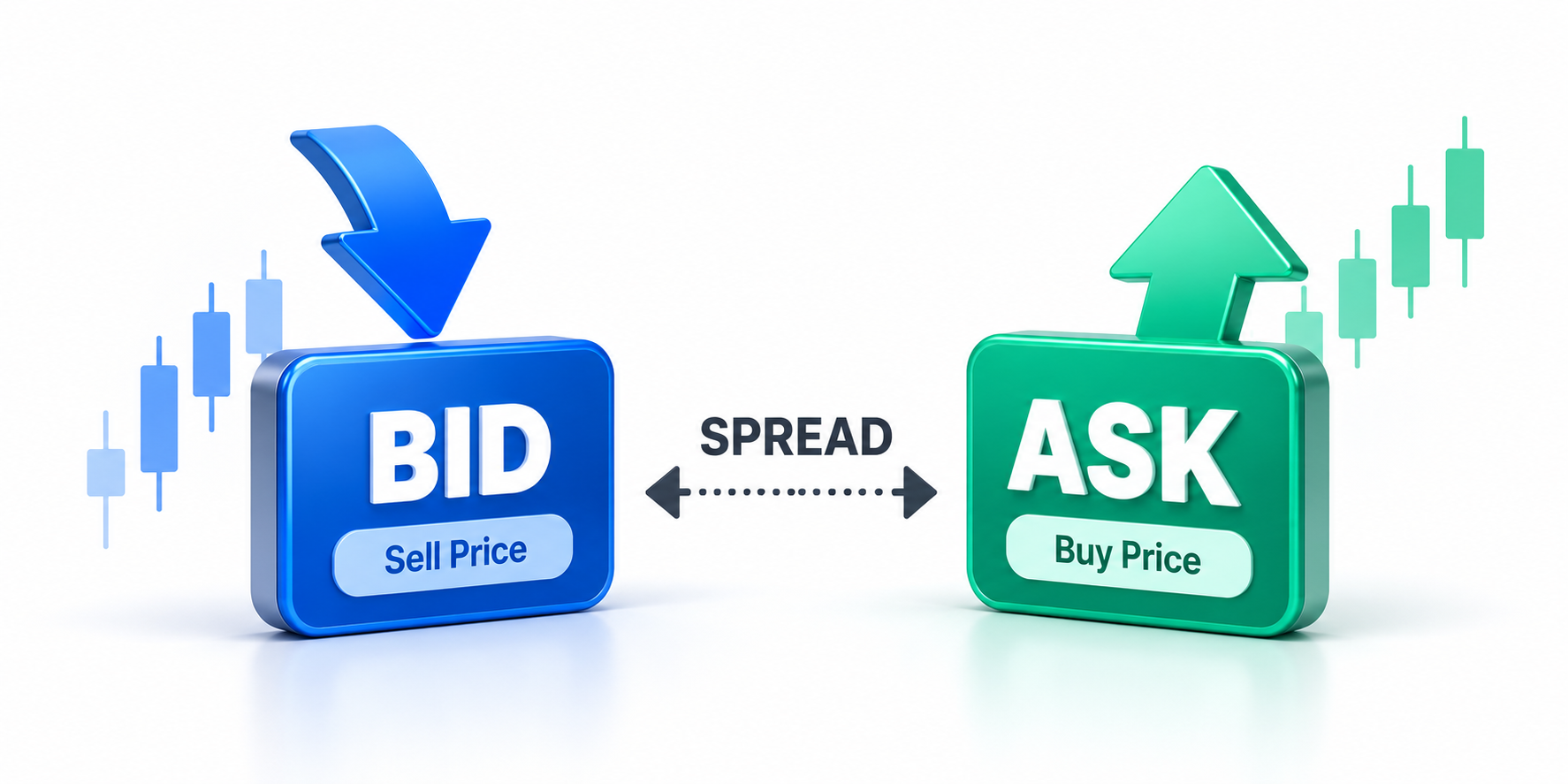
The bid-ask spread measures the gap between the buying and selling prices quoted for an instrument. It is an important part of understanding how a market is priced and how much a trader may pay to enter and exit a position.
The spread is influenced by factors such as liquidity, market conditions, and the market’s pricing structure. In order-driven markets, competing buy and sell orders help determine the best available bid and ask. In dealer-quoted markets, a dealer or provider may quote both prices based on its pricing model and prevailing market conditions.
How to Calculate the Spread
Use this formula:
Spread = Ask Price – Bid Price
For example, suppose a hypothetical quote for a financial instrument shows:
· Bid Price: 250.40
· Ask Price: 250.55
The calculation is:
250.55 − 250.40 = 0.15
The spread is 0.15 price units.
The result uses the same price units as the quoted instrument. For a currency pair, traders may express the spread in pips; for an index, it may be expressed in index points; and for a share, it may be expressed in the relevant currency per share.
However, these units are not interchangeable. The instrument’s quotation conventions determine how you interpret the numerical difference.
What Is a Pip in Forex?
A pip is a conventional unit used to measure changes in foreign exchange rates. For most currency pairs, one pip represents a movement of 0.0001, while for many yen-denominated pairs, it represents 0.01. Some trading platforms display fractional pips, commonly called pipettes, to show smaller price movements.
For example, using the hypothetical EUR/USD quote above:
Spread in Pips = (Ask Price – Bid Price) ÷ Pip Size
(1.08435 − 1.08420) ÷ 0.0001 = 1.5 pips
The spread is therefore 1.5 pips.
This calculation assumes the conventional pip size of 0.0001 for EUR/USD. Always confirm the instrument’s decimal precision and contract specifications before converting a price difference into pips.
Check out our article about pips to understand how pip values are calculated, how pips measure price movements, and how pip sizes vary across currency pairs.
Bid Price vs Ask Price in Forex Trading
In forex trading, currency pairs express the value of one currency relative to another. The first currency is the base currency, and the second is the quote currency.
For example, in EUR/USD, the euro is the base currency and the US dollar is the quote currency. A quote of 1.08420/1.08435 indicates two prices for trading the pair.
The ask is generally the relevant quoted price when opening a buy position, while the bid is generally the relevant quoted price when opening a sell position. The same distinction matters when closing an existing position.
Example: Buying EUR/USD
Suppose the quote is:
· Bid: 1.08420
· Ask: 1.08435
You expect the euro to strengthen against the US dollar and decide to buy EUR/USD.
Your hypothetical entry price is 1.08435, the ask price. If you immediately close the position at the unchanged bid of 1.08420, the difference between the entry and exit prices is 0.00015, or 1.5 pips.
This illustrates why a newly opened position may initially show a loss even when the market has not moved. The bid-ask difference already separates the quoted buying and selling prices.
For the position to become profitable, the exit price must move sufficiently in your favour to cover the spread and any other applicable trading costs, assuming those costs remain unchanged. Actual outcomes may also depend on execution prices, commissions, financing charges, and other instrument-specific terms.
Example: Selling EUR/USD
Now suppose you expect the euro to weaken against the US dollar and decide to sell EUR/USD.
Using the same quote, your hypothetical entry price is 1.08420, the bid. If you close the position immediately at the unchanged ask of 1.08435, the 1.5-pip difference works against you.
The two examples demonstrate a useful principle: buy positions generally open at the ask and close at the bid, while sell positions generally open at the bid and close at the ask.
These examples assume execution at the displayed quotes, with no market movement or additional charges. Live execution may differ.
Bid Price vs Ask Price in CFD Trading
Contracts for difference (CFDs) allow traders to speculate on price movements without owning the underlying asset. Depending on the product and its terms, CFDs may track markets such as forex, indices, commodities, shares, or cryptocurrencies.
As with other two-sided quotes, the bid and ask help determine the prices at which a trader can buy or sell a CFD. However, the exact pricing arrangements depend on the provider, instrument, and applicable contract specifications. Do not assume that every CFD has the same spread structure or cost model.
Consider a hypothetical share CFD with the following quote:
|
Component |
Price |
|
Bid |
£49.90 |
|
Ask |
£50.00 |
|
Spread |
£0.10 |
A trader opening a buy position would generally enter at £50.00. If the trader immediately closed the position at the unchanged bid of £49.90, the price difference would be £0.10 per unit.
For a hypothetical position of 100 units, the price difference would amount to £10 before commissions or any other applicable charges.
This calculation illustrates the effect of the spread, not a guaranteed loss or a complete estimate of the total cost of a CFD trade. Leverage magnifies gains and losses relative to the capital committed. Depending on the product, applicable regulations, and account protections, losses may exceed the initial investment. Traders should understand the product’s risks before trading.
Why Do Bid and Ask Prices Differ?
The bid and ask differ because buying and selling interest does not always meet at the same price. The spread also reflects the structure of the market and, where applicable, the pricing arrangements of a broker or dealer.
Several factors can influence the gap between the two prices.
Market Liquidity
Liquidity describes how readily an instrument can be bought or sold without significantly affecting its price. In markets with sufficient liquidity, deep order books, and strong competition between buyers and sellers, the best available bid and ask may sit relatively close together. However, spreads also depend on volatility, market structure, and prevailing pricing arrangements.
By contrast, an instrument with fewer available orders may have a wider spread. However, liquidity varies by instrument, venue, position size, and time, so a narrow spread at one moment does not guarantee that the same conditions will continue.
Market Volatility
Volatility measures the extent to which prices fluctuate. During major economic announcements, unexpected news, or rapid market movements, quoted prices and available liquidity can change quickly.
Consequently, the spread may widen, and the price available when an order executes may differ from the price displayed when the order was submitted. The size and likelihood of these differences depend on the instrument and execution arrangements.
Trading Session and Market Conditions
Trading activity varies throughout the day. For example, activity in a currency pair can change when the major financial centres associated with its currencies are open or closed.
However, there is no universal rule that spreads are always narrow during a particular session. The instrument, liquidity, market events, and provider’s pricing arrangements all matter.
Instrument and Pricing Arrangements
Different financial instruments have different quotation conventions, liquidity profiles, and market structures. Furthermore, providers may use different spread models and charge commissions separately or incorporate certain costs into their quotes.
Therefore, compare the applicable instrument specifications and cost disclosures rather than assuming that two similar-looking instruments have identical trading costs.
How Does the Spread Affect Trading Costs?
The spread is an important consideration because it represents the difference between the quoted buying and selling prices. A wider spread generally means a larger price difference to overcome when entering and exiting a position, assuming the other conditions remain unchanged.
To estimate the effect of the spread, you need to understand the instrument’s price units, position size, and contract specifications.
For instruments quoted directly in currency per unit, a simplified estimate of the spread’s monetary effect is:
Spread Cost = Spread × Number of Units
For contracts quoted in lots, points, ticks, or other units, use the relevant contract specifications and monetary value per unit to calculate the equivalent cost.
For example, suppose a hypothetical instrument has a spread of £0.05 per unit and a position contains 200 units.
£0.05 × 200 = £10
The resulting £10 represents the price difference for that position at the quoted prices. It is not necessarily the complete transaction cost.
Other costs may also apply, depending on the product and account. These can include commissions, overnight financing, and currency conversion charges. In addition, execution differences and market movements can affect the final result.
Before opening a position, check the provider’s current pricing information, contract specifications, and relevant fees. A smaller spread alone does not establish that a product is cheaper overall or more suitable for a particular trader.
Common Mistakes When Reading Bid and Ask Prices
Understanding the definitions is only the first step. The following mistakes can also lead to confusion when interpreting a trading platform.
· Assuming the Ask Is the Selling Price: The ask is generally the price at which you buy. The bid is generally the price at which you sell.
· Ignoring the Spread: Looking only at the last traded price or one side of a quote can obscure the difference between the buying and selling prices.
· Treating Every Spread as Fixed: Spreads may change with liquidity, volatility, and pricing arrangements. Check whether the applicable product uses a fixed or variable spread model.
· Confusing Pips with Price Units: A numerical difference must be interpreted using the instrument’s quotation convention. A difference of 0.0001 does not represent the same thing for every asset.
· Assuming the Spread Is the Only Cost: Commissions, financing, conversion charges, and other applicable costs may affect the total cost of a trade.
· Assuming a Displayed Price Guarantees Execution: Quotes can change before an order executes. Actual execution may depend on the order type, available liquidity, and provider’s execution arrangements.
By checking both sides of the quote and understanding the relevant product specifications, you can interpret market prices more accurately and assess trading costs more carefully.
How to Check Bid and Ask Prices Before Trading
Use this simple process when reviewing a quote on a trading platform.
1. Identify the Instrument: Confirm the currency pair, share, index, commodity, or other product you intend to trade.
2. Locate Both Prices: Find the bid and ask in the quote panel or order ticket. Confirm which value corresponds to each side.
3. Calculate the Spread: Subtract the bid from the ask, then express the difference in the correct units.
4. Review the Contract Specifications: Check the minimum price movement, contract size, and any other details needed to interpret the quote.
5. Check the Full Cost Structure: Review applicable commissions, financing charges, and other fees rather than relying on the spread alone.
6. Consider Execution Risk: Remember that displayed prices can change and that execution may not occur at the price you initially see.
This process can help you make sense of the numbers on screen. Nevertheless, understanding a quote does not remove the financial risks of trading, particularly when using leveraged products such as CFDs.
Bid and Ask Prices: What Traders Need to Know
Bid and ask prices are fundamental to understanding financial market quotes. The bid is generally the price at which you can sell an instrument, while the ask is generally the price at which you can buy it. Their difference, known as the spread, is an important component of trading costs.
Once you understand how to calculate the spread, interpret pips and price units, and distinguish quoted prices from actual execution prices, you can assess market quotes more confidently. However, always consider the full cost structure, changing market conditions, and the risks associated with the instrument you intend to trade.
Explore more trading concepts and practical insights in our CPT Academy to build your understanding of financial markets and trading fundamentals.
Frequently Asked Questions
1. What Is the Main Difference Between Bid and Ask Prices?
The bid price is generally the price at which you can sell an instrument, while the ask price is the price at which you can buy it. The ask is usually higher than the bid, and the difference between them is called the spread. Both prices matter when opening or closing a trading position.
2. Is the Bid Price Higher Than the Ask Price?
No. In a conventional two-sided market quote, the bid is normally lower than the ask. In a conventional order-driven market, the bid represents the highest price a buyer is currently willing to pay, while the ask represents the lowest price a seller is currently willing to accept. The difference between these prices is the spread. In unusual market conditions, a quote may behave differently, so traders should verify the displayed prices and their applicable quotation conventions.
3. How Do You Calculate the Bid-Ask Spread?
Subtract the bid price from the ask price. For example, if the bid is 1.1000 and the ask is 1.1003 for EUR/USD, the spread is 0.0003, equivalent to three pips under the conventional EUR/USD pip definition of 0.0001. For other instruments, use the appropriate price units and contract specifications.
4. Why Can a Trade Start with a Loss?
A trade may initially show a loss because the buying and selling prices differ. A buy position generally opens at the ask and closes at the bid, while a sell position generally opens at the bid and closes at the ask. If the market remains unchanged, the difference between the entry and immediate exit prices generally results in an initial unrealised loss reflecting the spread, before any additional charges.
5. Does a Lower Spread Always Mean Lower Trading Costs?
Not necessarily. A lower spread reduces one component of trading costs, all else being equal. However, commissions, overnight financing, currency conversion charges, and execution differences may also affect the total. Traders should compare the full pricing structure for the relevant instrument and account instead of using the spread as the sole measure of cost.
6. Do Bid and Ask Prices Change During the Trading Day?
Yes. Bid and ask prices can change as market prices, liquidity, trading activity, and available orders change. Spreads may also widen during volatile conditions or periods of reduced liquidity. The extent of these changes depends on the instrument and its pricing arrangements. Consequently, a displayed quote should not be treated as a guarantee of the eventual execution price.
Explore account information
Review account details, terms, and risks on the official CPT website.
Related articles
- Forex essentials
Base Currency vs Quote Currency: How Forex Pairs Are Read
A currency pair shows the value of one currency relative to another. The base currency is the first currency in the pair, while the quote currency is the second. The exchange rate tells you how many units of the quote currency are needed to buy one u
12 min read · estimated↗ - Trading essentials
What Is a Trader? Types, Skills, and How Trading Works
A trader is an individual who buys and sells financial instruments or takes positions in financial products to seek profits from changes in market prices. Traders operate across markets such as foreign exchange (forex), shares, indices, commodities,
13 min read · estimated↗ - Digital assets
What Is Litecoin (LTC)? How It Works, Uses, and Risks
Litecoin (LTC) is a decentralised cryptocurrency designed to enable peer-to-peer transactions without requiring a central authority to process them. Launched in 2011, it uses a public blockchain and a proof-of-work consensus mechanism to record trans
12 min read · estimated↗