
Forex essentials
Major, Minor, and Exotic Currency Pairs Explained
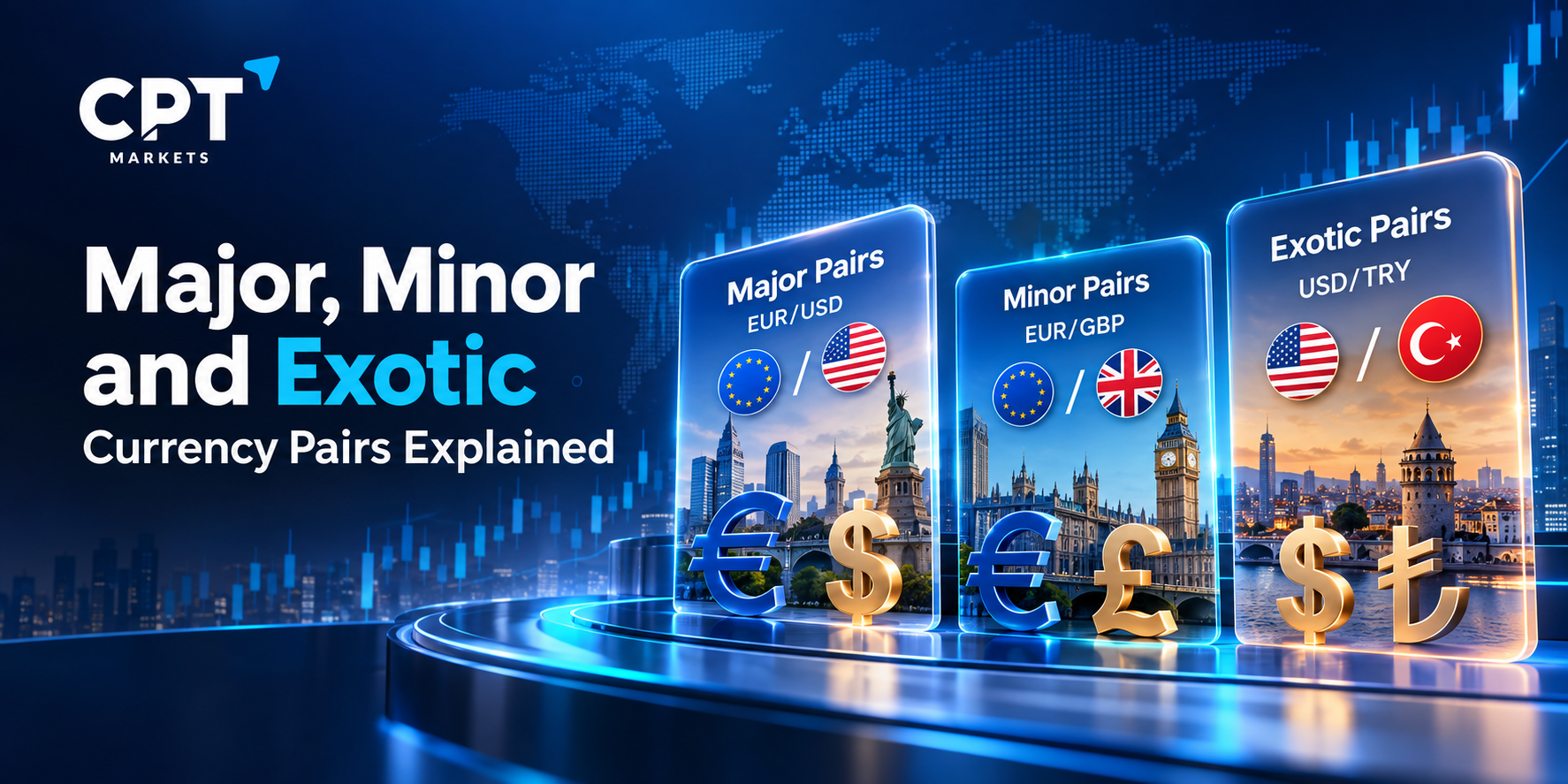
Learn how major, minor, and exotic currency pairs differ, including liquidity, volatility, spreads, risks, and key trading considerations.
What Are Major, Minor, and Exotic Currency Pairs?
Forex currency pairs are commonly divided into three main groups: major, minor, and exotic pairs. This classification helps traders distinguish between different types of currency pairs and compare characteristics such as trading activity, liquidity, spreads, and volatility.
Among these groups, major currency pairs generally account for the highest levels of trading activity, while minor and exotic pairs can offer different market characteristics and trading conditions. Each group includes a range of currency pairs that may suit different trading approaches, depending on factors such as market liquidity, volatility, and the currencies involved.
Understanding these categories can help traders build a clearer view of the Forex market and identify the characteristics that distinguish one group from another. Let’s explore major, minor, and exotic currency pairs in more detail, starting with the most widely traded group.
Major Currency Pairs
Major currency pairs generally refer to the most actively traded Forex pairs involving the US dollar and another major global currency.
The commonly recognised major currencies include the euro (EUR), Japanese yen (JPY), British pound (GBP), Swiss franc (CHF), Australian dollar (AUD), Canadian dollar (CAD), and New Zealand dollar (NZD).
The US dollar remains dominant in global FX trading. According to the Bank for International Settlements’ 2025 Triennial Survey, it was on one side of 89.2% of all FX trades in April 2025, while the 10 most-traded currency pairs all involved the US dollar.
Common examples of major currency pairs include:
|
Major Pair |
Currencies |
|
EUR/USD |
Euro / US dollar |
|
USD/JPY |
US dollar / Japanese yen |
|
GBP/USD |
British pound / US dollar |
|
USD/CHF |
US dollar / Swiss franc |
|
AUD/USD |
Australian dollar / US dollar |
|
USD/CAD |
US dollar / Canadian dollar |
|
NZD/USD |
New Zealand dollar / US dollar |
The exact list can vary slightly between market participants, particularly when discussing which pairs qualify as the “major” pairs. However, these seven are among the most widely recognised examples.
Why Are Major Pairs Popular?
Major pairs generally benefit from substantial trading activity. Greater market participation can contribute to deeper liquidity and, under normal market conditions, can make these pairs easier to trade than less actively traded currencies.
They can also attract significant attention because their exchange rates respond to major economic and monetary developments. For example, EUR/USD can react to changes in expectations for European Central Bank or Federal Reserve policy, while USD/JPY can be sensitive to developments involving the Federal Reserve and Bank of Japan.
However, high liquidity does not mean a pair is risk-free. Major currency pairs can still experience sharp movements around interest-rate decisions, inflation data, employment reports, geopolitical events, and unexpected changes in market expectations.
Minor Currency Pairs
Minor currency pairs, often called cross currency pairs or simply crosses, generally combine two major currencies without the US dollar.
Examples include:
– EUR/GBP
– EUR/JPY
– GBP/JPY
– AUD/JPY
– EUR/CHF
– GBP/CHF
– AUD/NZD
For example, EUR/GBP expresses the value of the euro relative to the British pound. Unlike EUR/USD, the US dollar is not part of the quoted pair.
How Are Minor Pairs Different From Major Pairs?
The key distinction is the absence of USD rather than an assumption that every minor pair is necessarily illiquid.
Some crosses can have substantial trading activity. For example, EUR/JPY and GBP/JPY are widely followed by Forex traders. Nevertheless, trading characteristics can differ from those of the most actively traded USD pairs.
Liquidity may vary according to the currency pair, trading session, and prevailing market conditions. As a result, spreads and price movements can also differ.
Minor pairs can be useful when a trader wants exposure to the relative performance of two non-USD currencies. For instance, a trader analysing European and UK monetary policy may pay particular attention to EUR/GBP rather than expressing the view through a USD pair.
Exotic Currency Pairs
Exotic currency pairs generally combine a major currency with the currency of an emerging or smaller economy.
Examples may include:
– USD/TRY
– USD/ZAR
– USD/MXN
– USD/THB
– EUR/TRY
The precise classification can vary between brokers and market participants. Therefore, a pair described as “exotic” in one context may not always be classified identically elsewhere.
Why Can Exotic Pairs Behave Differently?
Exotic currencies can be affected by domestic economic conditions, monetary policy, political developments, capital flows, and external factors such as commodity prices.
Trading activity can also be lower than in the most heavily traded major pairs. Consequently, traders may encounter wider spreads or greater price fluctuations, particularly during periods of market stress or reduced liquidity.
This does not mean that every exotic pair is constantly more volatile or expensive to trade. Instead, traders should check the current trading conditions for the specific pair rather than relying solely on its category.
Major vs Minor vs Exotic Currency Pairs
The main differences can be summarised as follows:
|
Feature |
Major Pairs |
Minor Pairs |
Exotic Pairs |
|
Typical Structure |
USD + major currency |
Two major currencies excluding USD |
Major currency + emerging/smaller-market currency |
|
Examples |
EUR/USD, USD/JPY |
EUR/GBP, GBP/JPY |
USD/TRY, USD/ZAR |
|
Typical Liquidity |
High |
Varies, often substantial |
Generally lower |
|
Typical Spread Environment |
Often tighter under normal conditions |
Can vary by pair |
Often wider |
|
Potential Volatility |
Can be significant |
Can be significant |
Can be higher or more uneven |
|
Main Considerations |
Major macroeconomic events |
Relative performance of two non-USD economies |
Domestic and external economic risks |
These are broad market characteristics rather than guarantees. Actual liquidity, spreads, and volatility depend on the individual instrument and prevailing market conditions.
Explore account information
Review account details, terms, and risks on the official CPT website.
Liquidity, Spreads, and Volatility
Understanding the classification of a currency pair is useful, but traders should not stop there. Three related concepts deserve particular attention: liquidity, spreads, and volatility.
Liquidity
Liquidity describes how readily an instrument can be bought or sold without causing a substantial change in its price.
Highly traded currency pairs generally have a larger pool of market participants. However, liquidity can change throughout the trading day and during major economic events.
Spreads
The spread is the difference between the bid and ask price and can affect the trading cost of a Forex position. This article explains how spreads work and the factors that can influence them.
A pair with lower liquidity may have a wider spread than a highly traded pair, although actual spreads depend on market conditions and the trading environment.
Traders should therefore examine the current spread of the specific instrument rather than assuming that every major pair will always have a lower trading cost than every minor or exotic pair.
Volatility
Volatility refers to the degree and speed of price movement.
An exotic pair can experience significant volatility when political, economic, or monetary conditions change rapidly. Nevertheless, major and minor pairs can also move sharply, particularly around central-bank decisions and high-impact economic releases.
Greater volatility can result in larger price movements, but it also increases the potential for losses. Traders should consider position size, risk limits, and market conditions before entering a leveraged Forex or CFD position.
How to Choose Between Major, Minor, and Exotic Pairs
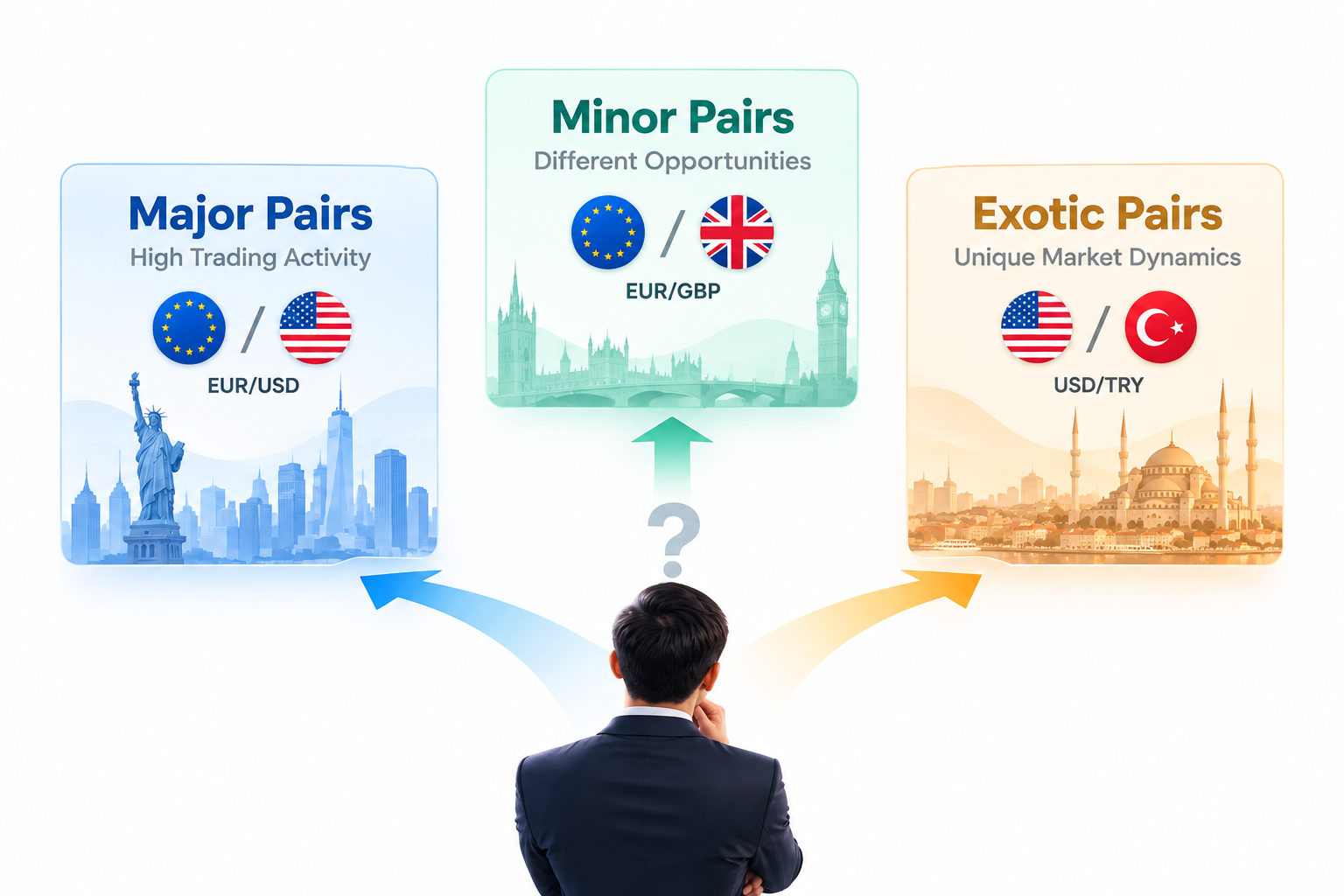
There is no single currency-pair category that is automatically suitable for every trader.
Instead, consider the following factors.
1. Understand the Currencies Involved
Start with the economic relationship behind the pair. Consider which countries or regions the currencies represent and what factors could influence their exchange rates.
2. Check Current Trading Conditions
Review the available spread, trading hours, contract specifications, and other applicable costs for the exact instrument.
Do not assume that a category alone determines the cost of trading.
3. Consider Liquidity
Liquidity can affect the ease and cost of entering or exiting a position. It can also change during different market sessions or around major events.
4. Assess Volatility
A currency pair that moves quickly can create larger gains or losses over a short period. Therefore, volatility should be considered alongside position size and risk management.
5. Understand Leverage
Forex and CFD trading may involve leverage, which can magnify both gains and losses. A relatively small price movement can therefore have a much larger effect on account equity than the underlying percentage movement might suggest.
Before trading, make sure you understand the applicable margin and leverage conditions and the possibility of losing capital.
A demo environment can also help traders compare how major, minor, and exotic pairs behave under different market conditions. With a CPT Markets Demo Account, traders can use virtual funds and live market data to observe differences in pricing, spreads, and price movement before considering live trading. Features and availability may vary by entity and jurisdiction.
A Simple Example: Comparing Three Pair Types
Consider three hypothetical scenarios:
– EUR/USD: A trader expects the euro to strengthen against the US dollar after analysing monetary-policy expectations.
– EUR/GBP: A trader expects the euro to outperform the British pound and chooses a cross that excludes USD.
– USD/TRY: A trader analysing the US dollar against the Turkish lira chooses USD/TRY while recognising that the pair may have different liquidity, spread, and volatility characteristics from major pairs.
These examples are educational only and do not represent trading recommendations or forecasts.
The important point is that the trader’s market view determines the currency relationship they are analysing. The pair’s classification then provides additional context about potential liquidity, volatility, and trading-cost characteristics.
Understanding Pips, Lot Size, and Risk
Currency-pair classification is only one part of learning Forex. Traders should also understand how price movements translate into potential gains and losses.
A pip is a standard unit used to describe changes in many Forex exchange rates. For most major currency pairs, one pip is typically the fourth decimal place, while JPY pairs commonly use the second decimal place. The exact convention can depend on the currency pair and quote format.
Position size also matters because a larger position means that the same price movement can produce a larger monetary gain or loss. Understanding lot size in Forex can help traders see how position size relates to pip value and potential trading outcomes.
Leverage adds another layer of risk because it allows traders to control a larger position relative to the capital required as margin. As a result, both gains and losses can be amplified.
These concepts should be considered together rather than in isolation. Understanding whether a pair is major, minor, or exotic does not by itself determine whether a trade is appropriate or how much risk a trader should take.
Key Takeaways
– Major currency pairs generally combine the US dollar with another major global currency and are among the most actively traded Forex pairs.
– Minor currency pairs, or crosses, combine major currencies without the US dollar.
– Exotic currency pairs generally combine a major currency with an emerging or less-traded currency.
– The classifications are market conventions, so definitions can vary between market participants.
– Liquidity, spreads, and volatility differ by instrument and market conditions. Category alone does not determine trading costs or risk.
– Forex and CFD trading can involve leverage, which can magnify both profits and losses.
– Understanding pips, lot size, margin, and leverage is also important when assessing Forex trading risk.
Understanding the differences between major, minor, and exotic currency pairs provides a foundation for navigating the Forex market. From here, traders can build on that knowledge by learning how spreads, pips, lot size, margin, and leverage affect the cost and risk of a Forex position.
Frequently Asked Questions
1. What Are Major Currency Pairs?
Major currency pairs are commonly understood as the most actively traded Forex pairs involving the US dollar and another major currency, such as the euro, Japanese yen, British pound, Swiss franc, Australian dollar, Canadian dollar, or New Zealand dollar. Examples include EUR/USD, USD/JPY, and GBP/USD. The exact classification can vary because these categories are market conventions rather than universal regulatory definitions.
2. What Are Minor Currency Pairs?
Minor currency pairs, also known as crosses, generally contain two major currencies but do not include the US dollar. Examples include EUR/GBP, EUR/JPY, and GBP/JPY. Their liquidity and trading costs can vary significantly between pairs and market conditions. Therefore, traders should examine the specific instrument rather than assuming every minor pair has the same characteristics.
3. What Are Exotic Currency Pairs?
Exotic currency pairs generally combine a major currency with the currency of an emerging or smaller economy. Examples can include USD/TRY and USD/ZAR. These pairs can have different liquidity, spread, and volatility characteristics from major pairs. Because classifications vary between market participants, traders should check the specific instrument’s current trading conditions before trading.
4. Are Major Currency Pairs Less Risky Than Exotic Pairs?
Not necessarily. Major pairs generally have high trading activity, but they can still experience substantial price movements during economic releases, central-bank decisions, or geopolitical events. Exotic pairs may have additional liquidity and volatility considerations, but risk depends on the specific instrument, position size, leverage, and market conditions. A pair’s classification should therefore not be treated as a measure of overall investment risk.
5. Which Currency Pair Is Best for Beginners?
There is no universally best currency pair for every beginner. New traders should first understand how currency quotes, spreads, pips, position size, margin, and leverage work. Highly traded major pairs are often easier to study because they receive extensive market attention, but beginners should still assess the risks and current trading conditions before using real capital.
Explore account information
Review account details, terms, and risks on the official CPT website.
Related articles
- Forex essentials
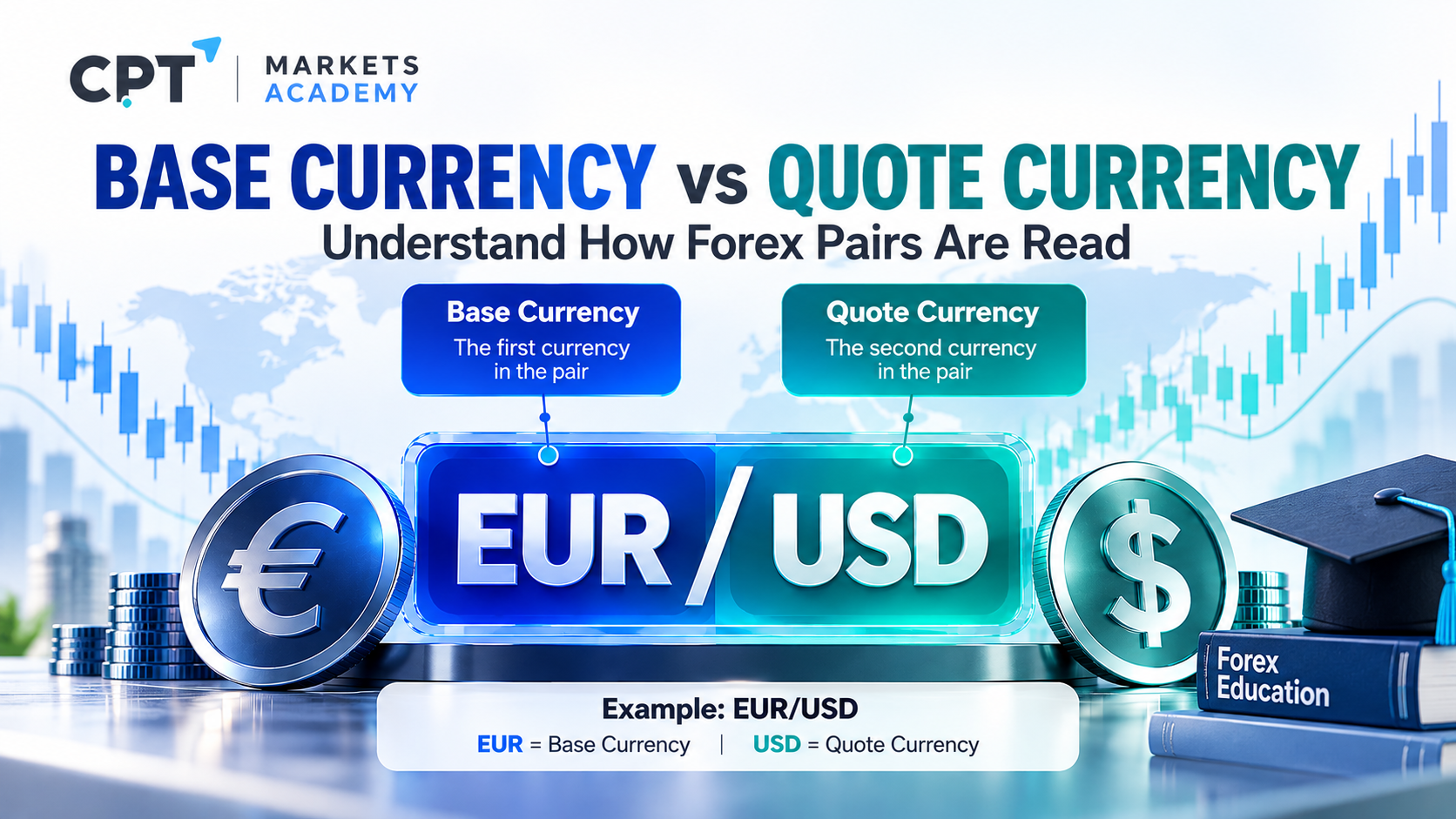
Base Currency vs Quote Currency: How Forex Pairs Are Read
A currency pair shows the value of one currency relative to another. The base currency is the first currency in the pair, while the quote currency is the second. The exchange rate tells you how many units of the quote currency are needed to buy one u
12 min read · estimated↗ - Trading essentials
What Is a Trader? Types, Skills, and How Trading Works
A trader is an individual who buys and sells financial instruments or takes positions in financial products to seek profits from changes in market prices. Traders operate across markets such as foreign exchange (forex), shares, indices, commodities,
13 min read · estimated↗ - Digital assets
What Is Litecoin (LTC)? How It Works, Uses, and Risks
Litecoin (LTC) is a decentralised cryptocurrency designed to enable peer-to-peer transactions without requiring a central authority to process them. Launched in 2011, it uses a public blockchain and a proof-of-work consensus mechanism to record trans
12 min read · estimated↗