

Risk management
Forex Risk Management: Tools, Rules and Worked Examples
Forex risk management is the process of identifying, measuring, and controlling the potential losses associated with currency trading. It includes calculating position sizes, setting stop-loss levels, limiting exposure across open trades, and monitoring account drawdown. Although these techniques can help traders define their risk before entering a position, they cannot eliminate losses or guarantee an execution price. Effective risk management starts with understanding how much a trade could lose, not how much it might earn.
What Is Forex Risk Management?
Forex risk management involves setting rules for how much capital a trade can expose to loss and how to respond when market conditions change. Rather than relying on a forecast being correct, a trader establishes limits before entering a position and checks whether the potential loss fits within those limits.
These decisions matter because currency prices can move quickly in response to economic data, central bank announcements, geopolitical developments, and changes in market liquidity. Furthermore, leverage allows traders to control a larger position relative to their account equity, which can amplify losses as well as gains.
Risk management does not make an unsuccessful trade profitable. Instead, it provides a framework for measuring exposure, limiting planned losses, and evaluating decisions consistently over time.
Calculate Risk per Trade
Risk per trade is the amount of money a trader is prepared to lose if a position reaches its planned exit level. Traders often express this amount as a percentage of account equity or as a fixed monetary figure.
For illustration, consider an account with equity of $5,000. A hypothetical risk limit of 1% would equal $50.
Formula:
Risk Amount = Account Equity × Risk Percentage
In this example:
$5,000 × 1% = $50
The $50 represents the planned risk for the individual trade, not a guaranteed maximum loss. Execution differences, slippage, transaction costs, and gaps in market prices can cause the realised loss to exceed the amount calculated in advance.
There is no universally suitable risk percentage for every trader. A percentage that appears small may still represent an unacceptable loss, depending on an individual’s financial circumstances and tolerance for risk. Therefore, the percentage used in an educational example should not be interpreted as a recommendation.
Choose a Position Size That Matches the Risk
Position sizing determines how much currency exposure a trade carries. It connects the distance between an entry price and a stop-loss level with the monetary amount at risk.
A wider stop generally requires a smaller position to maintain the same planned monetary risk. Conversely, a narrower stop may allow a larger position under the same calculation, although the stop must still reflect the trade’s underlying logic rather than being selected solely to increase position size.
Basic Position-Sizing Formula:
Position Size (Lots) = Risk Amount ÷ (Stop-Loss Distance in Pips × Pip Value per Standard Lot)
The formula requires the planned risk amount, the stop-loss distance, and the pip value of one standard lot for the relevant currency pair and account currency. The resulting position size is expressed in standard lots.
Worked Example: Calculating Position Size
Assume the following hypothetical trade:
|
Input |
Example |
|
Account Equity |
$5,000 |
|
Planned Risk Percentage |
1% |
|
Planned Monetary Risk |
$50 |
|
Stop-Loss Distance |
25 Pips |
|
Pip Value per Standard Lot |
$10 |
|
Calculated Position Size |
0.20 Standard Lots |
The planned risk is $50, while each standard lot would lose approximately $250 if the market moved 25 pips against the position, assuming the stated pip value remains applicable and excluding costs.
The calculation is:
Position Size = $50 ÷ (25 × $10) = 0.20 Standard Lots
At 0.20 standard lots, the assumed pip value is $2. The planned loss at the stop-loss level is therefore 25 × $2 = $50, before transaction costs and any execution difference.
This is a simplified hypothetical example. Actual pip values vary by instrument and account currency. Traders should verify contract specifications and use the correct pip-value calculation for their particular trade.
Understand Stop-Loss Orders and Their Limitations
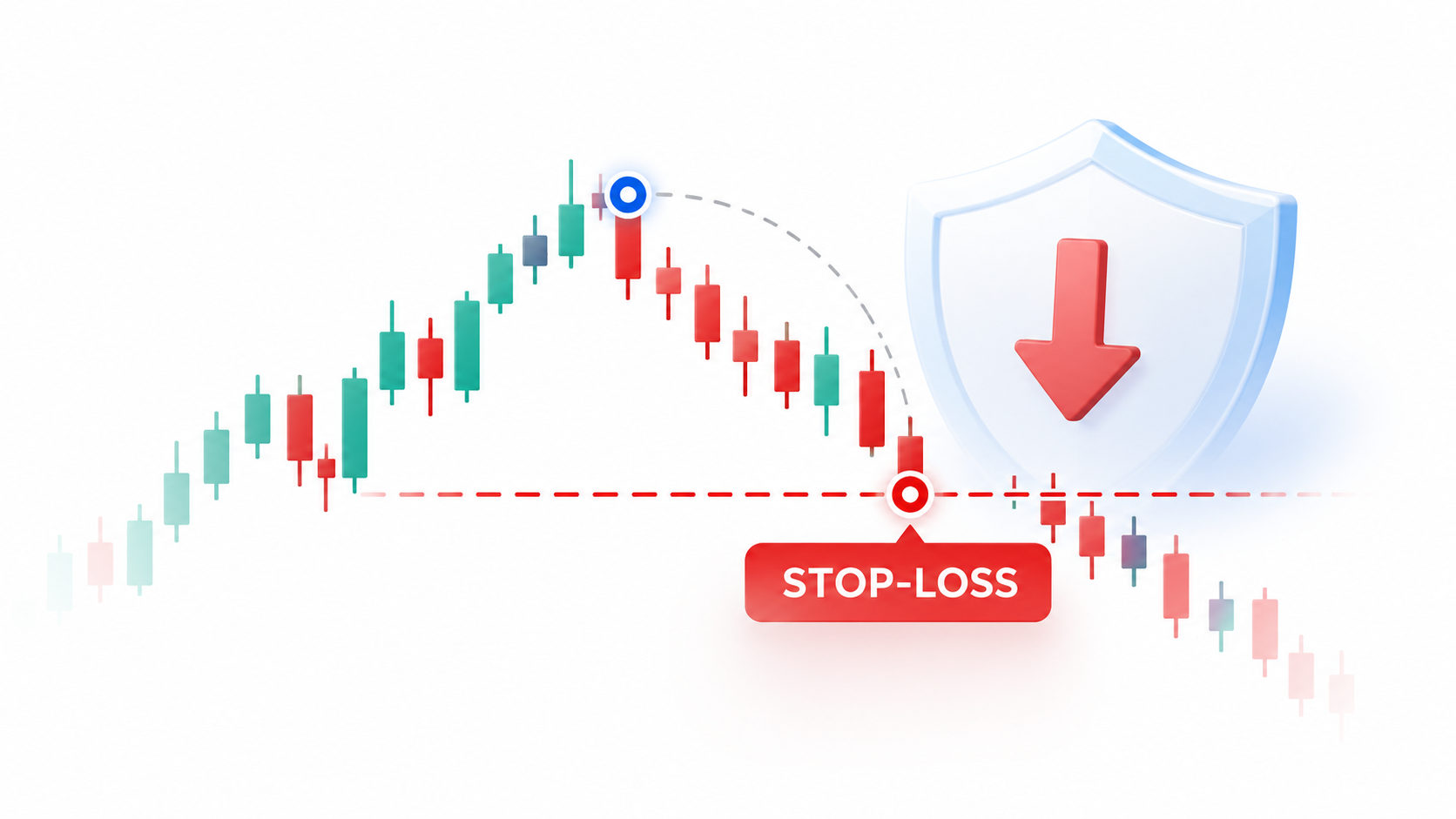
A stop-loss order is an instruction designed to close a position when the applicable market price reaches a specified trigger level, subject to the provider’s order execution rules. Traders commonly use stop-loss orders to define an exit point before entering a trade.
For example, a hypothetical EUR/USD position might have an entry price of 1.1000 and a stop-loss level of 1.0975. For a long position, the stop sits 25 pips below the entry, providing a reference point for calculating planned risk.
However, the stop price is not necessarily the final execution price. A stop order may become a market order once triggered, and the actual fill can differ from the specified level. Fast markets, price gaps, and limited liquidity can contribute to this difference.
A stop-limit order introduces a limit on the acceptable execution price, but it may not execute at all if the market moves beyond that limit. Consequently, neither order type removes every execution risk.
Before placing a trade, consider:
– Whether the stop level reflects a clear reason to exit the trade.
– Whether the resulting position size fits the planned risk amount.
– Whether relevant market events could increase volatility.
– Whether spreads, commissions, and other applicable charges affect the total risk calculation.
The availability and precise behaviour of particular order types depend on the instrument and provider.
Use a Risk-to-Reward Ratio to Evaluate Trade Scenarios
The risk-to-reward ratio compares the potential loss on a trade with its potential profit if the planned target is reached. It helps describe a trade’s payoff structure, but it does not indicate how likely either outcome is.
Formula:
Risk-to-Reward Ratio = Potential Loss : Potential Profit
For example, if a trade has a planned loss of $50 and a potential profit of $100, the risk-to-reward ratio is 1:2.
This means the potential profit is twice the planned loss. However, the ratio does not indicate the probability of success or guarantee that the profit target will be reached.
Worked Example: Comparing Two Setups
|
Hypothetical Setup |
Planned Risk |
Potential Profit |
Risk-to-Reward Ratio |
|
Setup A |
$50 |
$50 |
1:1 |
|
Setup B |
$50 |
$100 |
1:2 |
Setup B offers a larger potential profit relative to the planned loss. However, the ratio alone cannot establish whether Setup B is more likely to succeed. The outcome also depends on market behaviour, the quality of the entry and exit assumptions, and trading costs.
Furthermore, a strategy with a higher potential reward per trade can still lose money if its successful trades occur too infrequently or its actual losses exceed its planned risk. Risk-to-reward analysis is therefore one input into a broader assessment, rather than a standalone measure of trading quality.
Explore account information
Review account details, terms, and risks on the official CPT website.
Set Rules for Maximum Exposure
Risk per trade measures the planned exposure of one position. Total exposure considers the combined risk across several open positions.
This distinction matters when multiple trades share a common driver. For example, a long EUR/USD position and a short USD/CHF position may both be sensitive to movements in the US dollar. Although the positions involve different currency pairs, their risks may overlap.
A trader who calculates each trade independently could therefore underestimate the combined exposure of the account.
A written risk-management plan can define:
– A maximum planned risk for each trade.
– A limit on the combined planned risk of open positions.
– Conditions for avoiding additional exposure when existing trades are already at risk.
– Rules for reassessing positions before major economic announcements.
– A process for recording the reasons behind each trade and its eventual outcome.
These are examples of rules a trading plan might contain, not universal thresholds. The appropriate limits depend on the strategy, instruments, account size, and individual circumstances.
Importantly, adding a new position should not automatically be treated as diversification. Several positions can react similarly to the same market event, even when they involve different currency pairs.
Monitor Drawdown and Protect Trading Capital
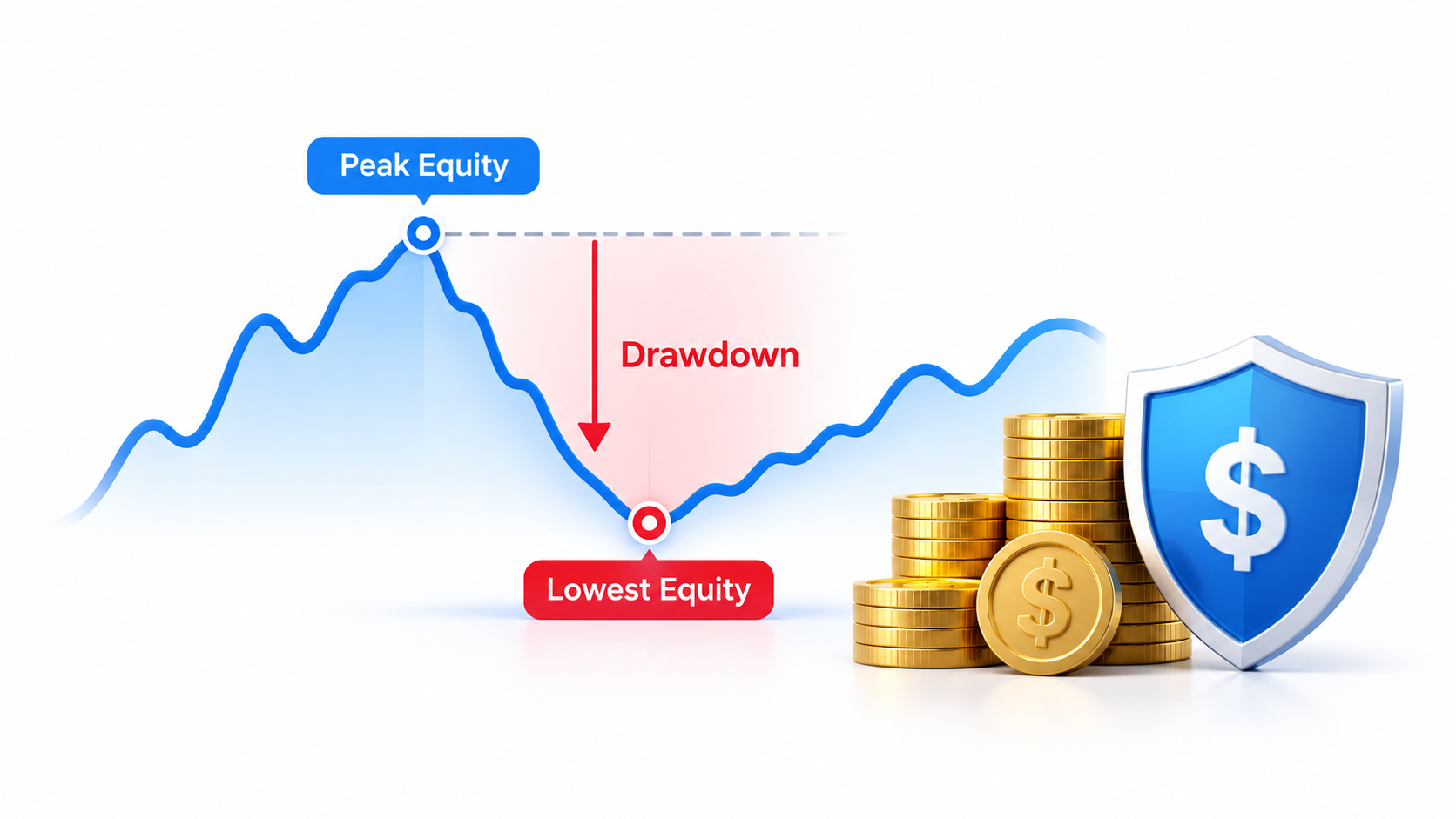
Drawdown measures the decline in account equity from a previous peak. It provides a way to assess how much an account has fallen from its earlier value.
Formula:
Drawdown (%) = (Previous Peak Equity − Current Equity) ÷ Previous Peak Equity × 100
For example, if account equity falls from $5,000 to $4,500, the drawdown is:
($5,000 − $4,500) ÷ $5,000 × 100 = 10%
The account has declined by 10% from its previous peak.
Recovering from a loss requires a larger percentage gain than the percentage originally lost. After a 10% decline, an account worth $4,500 must gain $500, or approximately 11.11% of its current equity, to return to $5,000, assuming no deposits, withdrawals, or other adjustments.
This asymmetry becomes more pronounced as drawdown increases. A 20% decline requires a 25% gain on the remaining capital to recover to the original level.
|
Drawdown |
Equity Remaining from $5,000 |
Gain Needed to Return to $5,000 |
|
10% |
$4,500 |
11.11% |
|
20% |
$4,000 |
25% |
|
30% |
$3,500 |
42.86% |
These figures are mathematical illustrations, not forecasts. They show why monitoring account equity and controlling exposure can matter even when individual planned losses appear modest.
A drawdown rule can also define when to pause and review a trading process. For example, a trader might review whether position sizes, market conditions, or adherence to the trading plan have changed after a predefined decline. Such a review does not guarantee recovery, but it can help identify whether the original assumptions remain valid.
Understand Leverage, Margin, and Total Trading Costs
Leverage allows a trader to gain exposure to a position that is larger than the capital committed as margin. This can make relatively small market movements have a significant effect on account equity.
Margin, however, is not a limit on the amount a position can lose. A position may lose more than the margin initially required to open it, depending on the product, market movement, and applicable account protections.
For example, a hypothetical position worth $20,000 that moves 1% against the trader produces a $200 loss before costs, assuming a linear relationship between the price movement and the position’s value. If the position required $1,000 in initial margin, the $200 loss would represent 20% of that margin, not 1%.
Trading costs also affect results. Depending on the product and account terms, these may include spreads, commissions, and overnight financing charges. In addition, slippage can cause an executed trade to differ from the price assumed in a calculation.
For this reason, risk calculations should distinguish between the planned price-based loss and the total realised result. Before trading, review the applicable product specifications, margin rules, charges, and execution terms.
Read What Is Forex Trading? for an introduction to the market, and What Is a Lot Size in Forex? for more detail on position size.
Build a Repeatable Risk-Management Checklist
Risk management becomes more useful when it forms part of a consistent process rather than a decision made after a position starts losing money.
Before entering a hypothetical trade, work through the following checklist:
1. Define the Trade Scenario: Identify the entry, the reason for entering, and the conditions that would invalidate the idea.
2. Set the Exit Level: Choose a stop-loss level based on the trade’s logic, not solely on the amount of money you want to risk.
3. Calculate the Risk Amount: Determine the monetary amount represented by the stop distance and the proposed position size.
4. Check the Position Size: Confirm that the planned loss fits within the risk limit specified in the trading plan.
5. Assess Combined Exposure: Review existing positions and consider whether they share exposure to the same currency or economic event.
6. Account for Costs and Execution Uncertainty: Include applicable charges and recognise that the actual exit price may differ from the stop price.
7. Record the Outcome: Log the trade, the original assumptions, the realised result, and whether the rules were followed.
After closing a trade, review the process separately from the outcome. A profitable trade does not necessarily demonstrate sound risk management, just as a losing trade does not automatically mean the decision was poorly structured. The quality of the decision depends on the information available at the time and whether the trader followed a coherent, documented process.
Conclusion
Forex risk management combines position sizing, stop-loss planning, risk-to-reward analysis, exposure limits, and drawdown monitoring. Together, these tools help traders measure potential losses and apply consistent rules, although none can eliminate market risk or guarantee an outcome.
The calculations are most useful when traders understand their assumptions, account for costs and execution differences, and distinguish planned risk from the loss that may actually occur. A disciplined process cannot guarantee profitable trading, but it can make the risks of each decision clearer before capital is exposed.
To put these concepts into practice, traders can start with a CPT Markets Demo Account to explore the trading platform and practise applying risk-management techniques in a simulated environment without committing real money.
This provides an opportunity to test position-sizing calculations, set stop-loss levels, and monitor hypothetical drawdowns before considering live trading. Demo trading does not eliminate the risks of live markets, where execution conditions and trading psychology may differ.
Frequently Asked Questions
1. What Is the 1% Rule in Forex Trading?
The 1% rule is a risk-management guideline in which a trader sets a planned loss limit equal to 1% of account equity for an individual trade. For example, 1% of $5,000 is $50. This is an illustrative convention, not a universally suitable risk level, and the actual loss may exceed the planned amount because of execution differences and trading costs.
2. How Do You Calculate Risk er Trade in Forex?
Multiply account equity by the chosen risk percentage to calculate the planned monetary risk. For example, an account with $5,000 in equity and a hypothetical 1% risk limit produces a planned risk amount of $50. Next, calculate a position size that corresponds to that amount and the distance between the entry and stop-loss levels, accounting for pip value and applicable costs.
3. Does a Stop-Loss Order Guarantee That You Will Not Lose More Than Planned?
No. A stop-loss order is designed to trigger an exit at a specified price, but it may execute at a different price when markets move quickly or gaps occur. Costs can also increase the realised loss. The degree of execution uncertainty depends on market conditions, the order type, and the provider’s terms.
4. What Is a Good Risk-to-Reward Ratio in Forex?
There is no single risk-to-reward ratio that is suitable for every trading strategy. A ratio of 1:2, for example, compares a planned loss of $50 with a potential profit of $100. However, it does not establish the probability of reaching either outcome. A meaningful assessment also considers the strategy’s results, trading costs, and the reliability of its assumptions.
5. What Is Drawdown in Forex Trading?
Drawdown is the percentage decline in account equity from a previous peak. If equity falls from $5,000 to $4,500, the drawdown is 10%. Drawdown helps describe the extent of a decline and the gain required to recover. It does not predict future performance, and a larger drawdown generally requires a larger percentage gain on the remaining equity to return to the previous peak.
6. Can Risk Management Eliminate Forex Trading Losses?
No. Risk-management tools help traders define and monitor exposure, but they cannot remove market risk, guarantee a stop-loss execution price, or ensure that a trade will be profitable. Leverage, price gaps, slippage, and transaction costs can affect the final result. Forex trading can result in substantial losses, so calculations and trading rules should never be treated as guarantees.
Explore account information
Review account details, terms, and risks on the official CPT website.
Related articles
- Forex essentials
Base Currency vs Quote Currency: How Forex Pairs Are Read
A currency pair shows the value of one currency relative to another. The base currency is the first currency in the pair, while the quote currency is the second. The exchange rate tells you how many units of the quote currency are needed to buy one u
12 min read · estimated↗ - Trading essentials
What Is a Trader? Types, Skills, and How Trading Works
A trader is an individual who buys and sells financial instruments or takes positions in financial products to seek profits from changes in market prices. Traders operate across markets such as foreign exchange (forex), shares, indices, commodities,
13 min read · estimated↗ - Digital assets
What Is Litecoin (LTC)? How It Works, Uses, and Risks
Litecoin (LTC) is a decentralised cryptocurrency designed to enable peer-to-peer transactions without requiring a central authority to process them. Launched in 2011, it uses a public blockchain and a proof-of-work consensus mechanism to record trans
12 min read · estimated↗