
Forex essentials
What Is a Lot Size in Forex? - CPT Markets
In forex trading, everything you risk, earn, or lose on a trade is controlled by one number sitting quietly on your order ticket: the lot size. A lot size defines exactly how much currency you’re buying or selling in a single trade and understanding it is the difference between trading with a plan and gambling with your account balance.
What Is a Lot Size in Forex?
In forex, you don’t trade “a little EUR/USD” or “some dollars.” Trades are executed in standardised blocks of currency called lots. A lot size is simply the measurement that tells you and your broker exactly how many units of the base currency are in your trade.
Think of it like buying eggs, you don’t ask the store for “some eggs”; you ask for a carton, and everyone knows a carton holds a fixed number.

Forex works the same way, instead of negotiating an odd number of units every time you trade, the market agreed on standard sizes, so a “1.0 lot” means the exact same thing whether you’re trading in Dubai, London or New York.
It is a volume measurement and volume is what turns a tiny pip movement into real money, for better or worse.
The Four Lot Sizes Every Trader Should Know
If you only take one number away from this article, make it this: 1 lot size in forex equals 100,000 units of the base currency. That is the forex standard lot size, and the exact benchmark every smaller size is measured against.
Forex brokers, including the MT4, MT5 and cTrader platforms most traders use today, offer four standard lot sizes. Here is a quick reference table, followed by what each one means in practice:
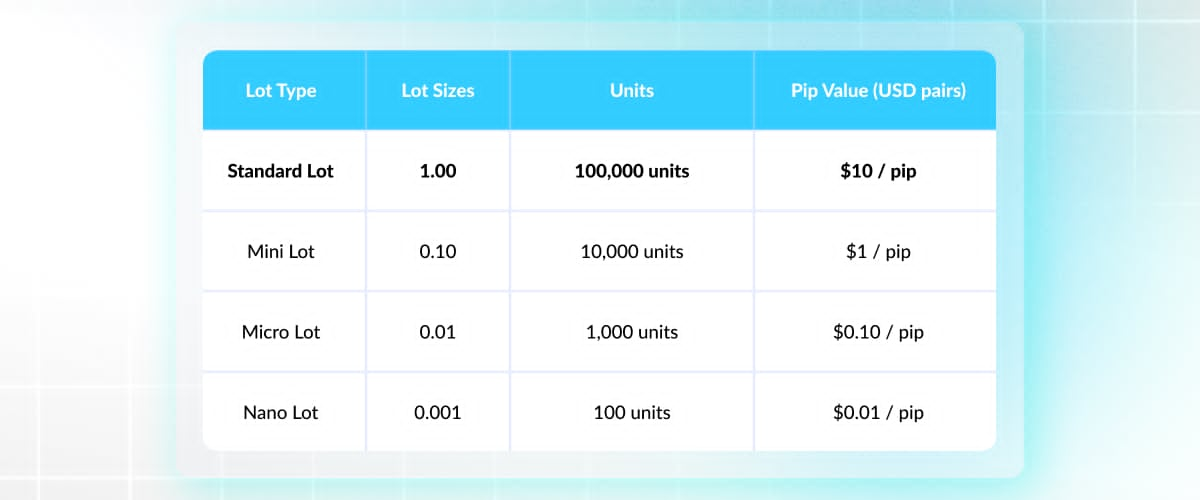
• Standard Lot (100,000 units): This is the forex standard lot size, the original, full size benchmark that every other lot is measured against. One standard lot of EUR/USD means you’re controlling €100,000, used mostly by experienced traders and institutional players.
• Mini Lot (10,000 units): A good middle ground for traders who want meaningful exposure without the volatility of full-size positions.
• Micro Lot (1,000 units): This is where most retail traders, especially beginners, should start. Small swings, manageable losses, and room to learn without heavy consequences.
• Nano Lot (100 units): The smallest size available, and not every broker offers it. Primarily useful for testing strategies in live market conditions with almost no financial risk.
Lot Size and Pip Value: The Link You Can’t Skip
To understand why lot size matters so much, you need one more concept: the pip. A pip is the smallest standard price movement in a currency pair, typically the fourth decimal place (0.0001) for most pairs or the second decimal (0.01) for JPY pairs.
Every pip of movement is worth a different dollar amount depending on how large your position is. That amount is called the pip value, and it scales directly with your lot size:
• Standard lot (100,000 units): ≈ $10 per pip on most USD quoted pairs
• Mini lot (10,000 units): ≈ $1 per pip
• Micro lot (1,000 units): ≈ $0.10 per pip
• Nano lot (100 units): ≈ $0.01 per pip
This is the bridge between “the market moved” and “my account balance changed.” A 50 pip move means something completely different to a trader holding 0.01 lots than to one holding 5.00 lots, even though the market itself doesn’t know or care who’s watching.
How Does Lot Size Affect Forex Profit?
This is where everything clicks; your profit or loss on any trade comes down to one relationship:
Profit / Loss = Pip Value × Pips Moved × Number of Lots
Let’s make it concrete. Say EUR/USD moves 50 pips in your favour, a perfectly routine move that can happen in a few hours. Here is what that same 50 pip move means at different lot sizes:
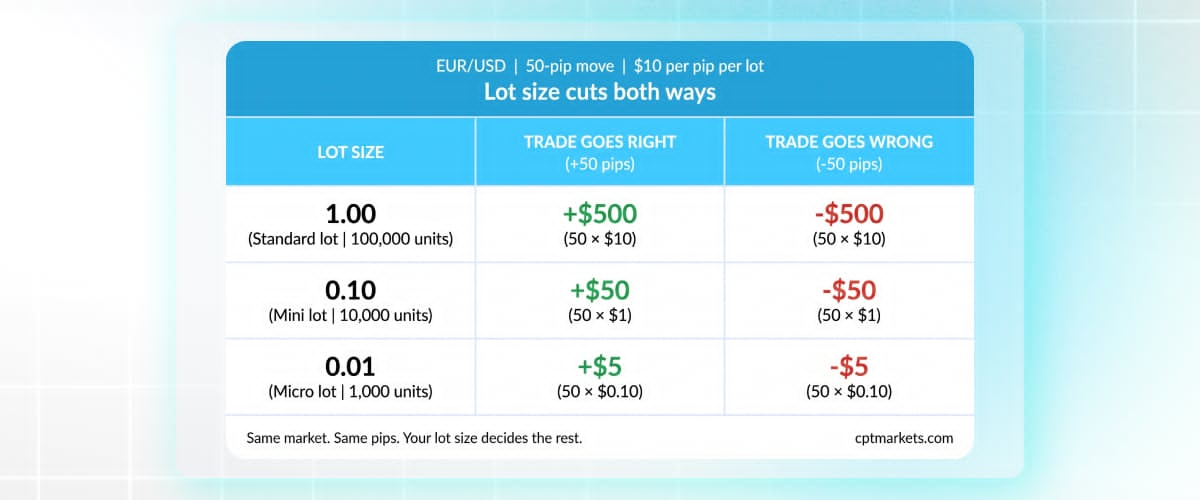
Same market, same direction, same 50 pips. Three completely different financial outcomes, separated only by the size of the position. And that cuts both ways, if the market had moved 50 pips against you, those exact same numbers become losses.
This is precisely why lot size is usually the real reason new traders blow up accounts. They get the direction right more often than they think; they just size positions as if they’re already certain, instead of sizing for the very real chance they’re wrong.
Explore account information
Review account details, terms, and risks on the official CPT website.
How to Calculate the Right Lot Size: A Step-by-Step Guide
Most experienced traders anchor their lot size to a simple rule: never risk more than 1-2% of the account on a single trade. From there, the calculation is straightforward:
Lot Size = (Account Balance × Risk %) ÷ (Stop Loss in Pips × Pip Value)
Here is how that looks in practice, step by step:
1. Define your account risk: You have a $2,000 account and are comfortable risking 1% per trade = $20 maximum risk.
2. Set your stop loss distance: Your stop loss sits 40 pips from your entry.
3. Calculate risk per pip: $20 ÷ 40 pips = $0.50 risk per pip.
4. Convert to lot size: Since a micro lot ($0.10/pip) gives $0.50/pip at 0.05 lots, your correct lot size is 0.05 lots.
This is where micro lots earn their keep; being able to trade in 0.01 lot increments means you can fine tune your position size to match your exact risk tolerance instead of being forced into an all or nothing standard 1 lot decision.
The Mistakes Worth Avoiding
A few patterns show up again and again with traders who learn lot size the hard way:
· Sizing for excitement, not for the account: Choosing a lot size because it “feels like enough action” rather than calculating what the account can actually absorb.
· Forgetting to resize when the stop-loss changes: A wider stop with the same lot size means more dollars at risk, even though nothing else about the trade changed.
· Confusing available margin with safe position size: Just because the platform allows you to open five standard lots doesn’t mean your account can survive the swings that come with them.
· Upsizing too fast: Moving from micro to standard lots before a strategy has proven itself over enough trades is one of the most common ways profitable strategies turn into losing ones.
The Takeaway
A lot size isn’t just a technical setting buried in your order ticket, it’s the steering wheel of your entire trading strategy. Your analysis decides if you’re right, your lot size decides how much that’s worth, in either direction.
The traders who last in this market aren’t necessarily the ones with the sharpest charts; they’re the ones who treat position sizing with the same seriousness as their entries.
Start small, calculate deliberately, and let your lot size grow only as your account, your experience, and your risk management grow with it. That’s not a limitation; it’s the foundation everything else gets built on.
This is exactly why we built CPT Markets the way we did. With micro lot trading from as few as 0.01 lots across MT4 and MT5, you’re never forced into a position bigger than your plan calls for. Every trade can be sized to fit your account, not the other way around.
If you’re still getting comfortable with position sizing, open a free CPT Markets demo account and practice risk-free until the math becomes second nature.
When you’re ready to go live, our platforms and team are there to support every trade you make. Master your lot size, and you’ve already mastered the hardest part of trading.
⚠️ Risk Warning: Forex trading with leverage carries a high level of risk and may not be suitable for all investors. Please ensure you fully understand the risks involved before trading.
FAQs
What is a lot size in forex?
A lot size in forex is a standardised unit that defines the volume of a trade, in other words, how many units of the base currency you are buying or selling.
How much is 1 lot size in forex?
1 lot in forex equals 100,000 units of the base currency. On most USD quoted pairs like EUR/USD, one standard lot means each pip movement is worth approximately $10.
What does 0.1 lot size mean?
0.1lot (mini lot) equals 10,000 units of the base currency. It is the smallest lot size available at most brokers, where each pip movement is worth approximately $1.
How many lots can I trade with $100?
With $100, trade 0.01 lots (micro lot). Each pip is worth just $0.10, and at 1% risk per trade your maximum risk is $1, which equals one micro lot with a 10 pip stop-loss.
How much is 1 pip in 0.01 lot size?
1 pip = $0.10 at 0.01 lots (micro lot) on most USD quoted pairs.
Explore account information
Review account details, terms, and risks on the official CPT website.
Related articles
- Forex essentials
Base Currency vs Quote Currency: How Forex Pairs Are Read
A currency pair shows the value of one currency relative to another. The base currency is the first currency in the pair, while the quote currency is the second. The exchange rate tells you how many units of the quote currency are needed to buy one u
12 min read · estimated↗ - Trading essentials
What Is a Trader? Types, Skills, and How Trading Works
A trader is an individual who buys and sells financial instruments or takes positions in financial products to seek profits from changes in market prices. Traders operate across markets such as foreign exchange (forex), shares, indices, commodities,
13 min read · estimated↗ - Digital assets
What Is Litecoin (LTC)? How It Works, Uses, and Risks
Litecoin (LTC) is a decentralised cryptocurrency designed to enable peer-to-peer transactions without requiring a central authority to process them. Launched in 2011, it uses a public blockchain and a proof-of-work consensus mechanism to record trans
12 min read · estimated↗