
Trading essentials
What is a Trader? Key Traits of a Professional Trader
What exactly is a trader, and what do they do in the financial markets? In this article, CPT will walk you through the role of a trader, the essential skills they need, and the key factors that contribute to their success.
From understanding market trends to managing emotions and risk, let’s explore the core foundations you need to build a strong and effective trading career of your own.

What is a Trader?
A trader is someone who buys and sells financial assets in the market, intending to profit from price movements. Traders typically operate in markets such as stocks, forex, and cryptocurrencies.
A trader can be an individual or someone representing an institution or investment fund to execute trades. They play a vital role in financial markets because of their frequent buying and selling activity.
Traders help create liquidity, making it easier for others to enter and exit positions.
To become a professional trader, you need a solid understanding of economics and finance, the ability to use technical analysis effectively, and strong skills in capital and risk management. In addition, maintaining emotional control and trading discipline is essential for long-term success.
Common Types of Traders
1. Day Trader
A day trader is someone who uses short-term trading strategies to profit from price movements within the same day, without holding any positions overnight. This approach is known as day trading, and it is commonly used in markets such as forex, indices, and cryptocurrencies.
Day traders typically operate at a high trading frequency, focusing on capturing small price movements throughout the day. They often use leverage consistently to maximize returns, with a common target of around 5% profit while keeping risk controlled at roughly 2% per trade.
A key characteristic of day trading is that all positions are closed before the end of the trading day. This helps avoid risks from overnight market movements. Day traders usually work on short timeframes, such as minutes or hours, and rely heavily on technical analysis to make entry and trade-management decisions.
Advantages
- Reduces the risk of unexpected and hard-to-predict overnight news or market moves.
- No overnight fees.
- If executed well, returns can grow quickly over time.
Disadvantages
- High trading frequency means transaction costs can add up significantly.
- More exposed to intraday market manipulation and false signals.
- May miss larger market moves or long-term trends.
- Requires constant monitoring during trading sessions to make timely decisions.
- Demands a relatively high level of skill and experience, so not all traders can perform consistently.
- Can be mentally stressful due to the fast-paced nature of trading.
2. Swing Trader
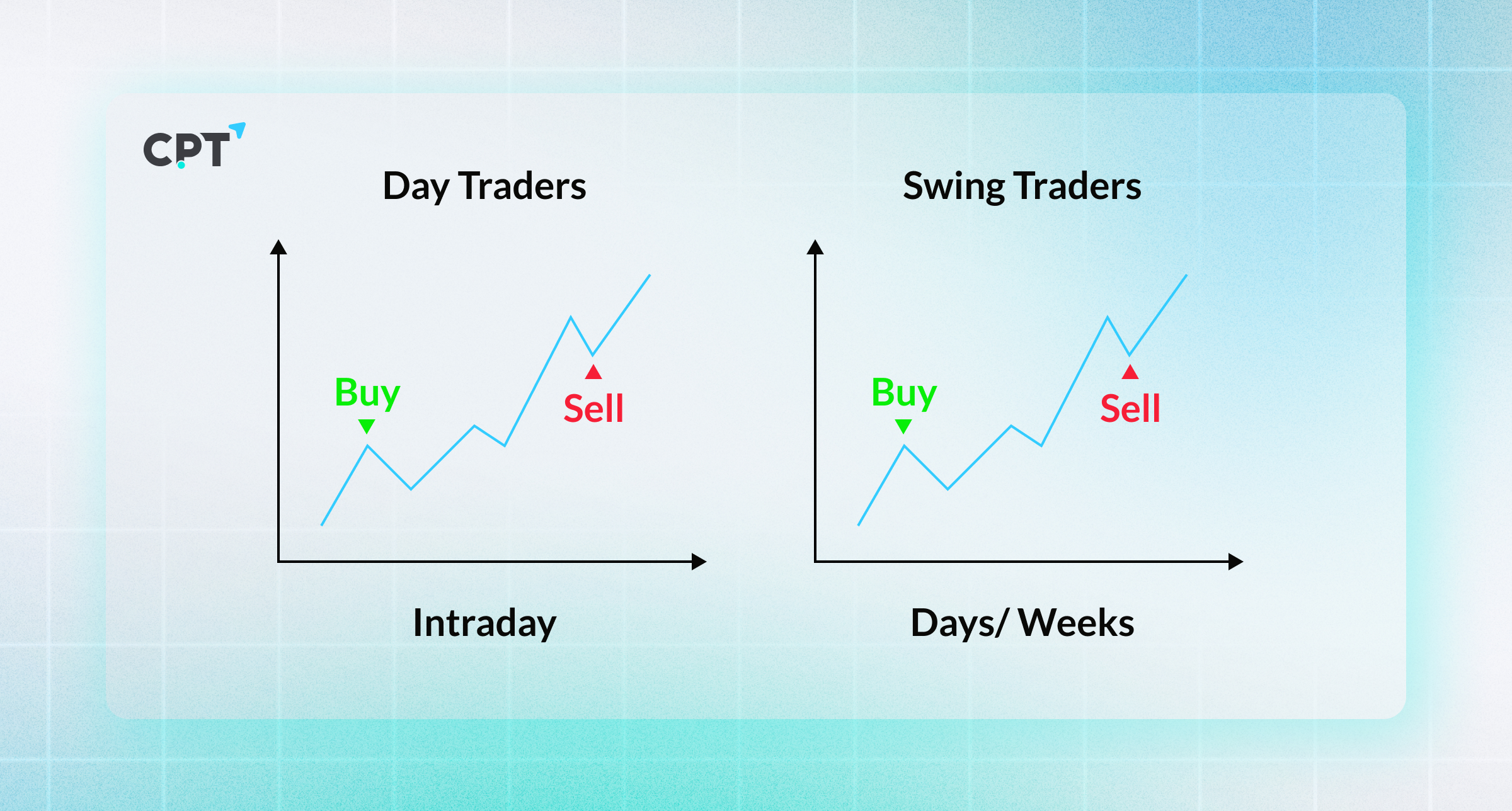
A swing trader is also focused on short-term trading, aiming to profit from price movements over a relatively short period. This is one of the most common types of traders across financial markets.
Unlike day traders, swing traders operate on a medium-term horizon with lower trading frequency. They typically hold positions for several days to a few weeks, taking advantage of short-term market swings.
Most swing traders rely heavily on technical analysis to guide their decisions, using timeframes such as H1, H4, or D1 to identify trends and entry points. Instead of targeting small intraday fluctuations, they focus on capturing larger price moves to maximize profit potential.
Swing traders generally aim for higher returns per trade, around 12%, while maintaining a controlled risk of approximately 5% per position.
Advantages
- Can help reduce exposure to short-term market noise and sudden intraday volatility.
- If executed well, returns can still grow significantly over time.
- Accessible for newer traders compared to more intensive strategies.
- Less psychological pressure than day trading.
- Holding periods are not too short, so they don’t require constant market monitoring.
Disadvantages
- Still exposed to overnight news and unexpected events.
- Requires solid skills, experience, and strong trading psychology.
- Trading frequency is still relatively high so that transaction costs can be noticeable.
3. Position Trader
A position trader is someone who holds trades over a longer period, ranging from several months to even years. Instead of focusing on short-term price fluctuations, they aim to capture major market trends.
Position traders are less common in the market due to their long holding periods and the patience required for this approach.
To become a position trader, you need strong fundamental analysis skills to evaluate macroeconomic factors and market cycles. In addition, combining this with technical analysis on higher timeframes such as weekly (W1) or monthly (MN) can help optimize entry points and overall trade management.
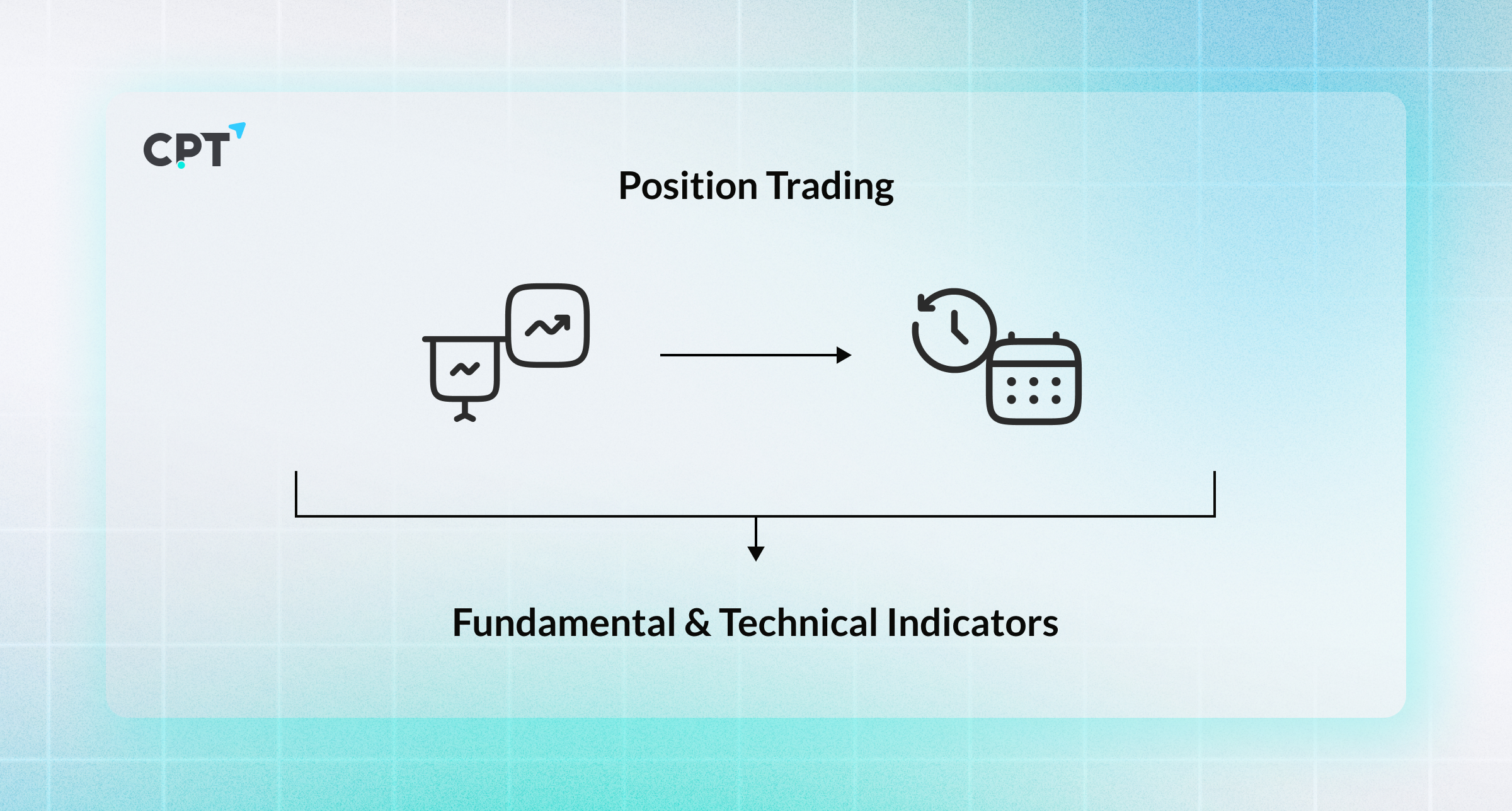
Position traders are more commonly found in the stock market than in forex or crypto, as long-term trends tend to be clearer and more stable.
One key advantage of this approach is that it doesn’t require constant market monitoring. However, each position usually comes with higher profit expectations, which also means accepting greater risk during the holding period.
Advantages
- Very low trading frequency, so transaction costs are minimal.
- Does not require constant market monitoring.
- Less psychological pressure compared to shorter-term trading styles.
- Helps avoid emotional traps and short-term market noise.
Disadvantages
- Slower decision making, which may lead to delayed reactions to unexpected risks.
- Requires strong knowledge of fundamental and financial analysis, along with regular updates on macroeconomic conditions.
- Profit tends to be more stable but generally lower compared to shorter-term strategies.
- Overnight holding costs or interest (when using leverage) can be significant, so careful risk and cost management is essential to avoid account erosion.
Pros and Cons of Being a Trader
Trading can offer attractive income opportunities, but it also comes with significant risks. One of the biggest advantages is the potential for unlimited income; traders can generate substantial profits in a relatively short time if they have an effective trading strategy.
Another major benefit is flexibility. Traders can work from anywhere, at any time, as long as they have a device and an internet connection. This level of independence makes trading appealing to many people.
Throughout their journey, traders also develop valuable skills such as market analysis, capital management, and risk control. These are transferable skills that can be useful in many areas of finance and investing.
However, these benefits come with notable downsides. Financial markets are highly volatile, which means the risk of losses is always present, especially for those who lack experience.
In addition, psychological pressure is a major challenge. Constantly monitoring price movements and dealing with losses can lead to stress and emotional fatigue.
Ultimately, achieving long-term success as a trader requires a solid knowledge base, strong analytical skills, and a clear, disciplined trading plan.
Explore account information
Review account details, terms, and risks on the official CPT website.
What Are the Key Factors of a Successful Trader?
To become a successful trader, the first and most important step is to choose a trading style that fits your personality and preferences.
This helps minimize emotional pressure and allows you to make better decisions under market conditions.
Once you’ve identified your approach, the next step is to build strong foundational knowledge in finance. This includes both fundamental analysis and technical analysis. Equally important are capital management and risk management; these are what protect your account over the long run.
Successful traders also take time to review and analyze their trading history. By tracking past trades, they can identify mistakes, learn from them, and continuously improve their performance.
Ultimately, the goal is to develop a trading strategy that works consistently. Once you have a proven strategy, discipline becomes critical. Sticking to your plan without letting emotions interfere is what separates consistent traders from the rest.

6 Steps from CPT to Help You Become a Professional Trader
- Learn the basics of the market: Start by building a solid understanding of financial markets, different asset classes, and how trading works.
- Study technical and fundamental analysis: Traders need to know how to read price charts and use indicators like MA, RSI, and MACD. At the same time, it’s important to follow economic and political news to understand how they impact the markets.
- Build your trading strategy: Identify a trading style that fits your personality and develop a clear, rule-based strategy.
- Practice on a demo account: Before trading with real money, use a demo account to gain experience and understand how the market behaves without risking your capital.
- Manage capital and psychology: Strong money management and emotional control are essential to avoid blowing your account and to stay consistent.
- Keep learning and improving: Markets are constantly evolving, so traders must continuously update their knowledge and refine their skills over time.
Opportunities & Challenges for Traders Today
Financial markets are continuously expanding and evolving, with a growing number of participants and the introduction of new financial instruments. This creates significant opportunities for traders who can identify trends and take advantage of market movements.
However, markets are constantly changing across different phases, and competition is becoming increasingly intense. This means traders must continuously update their knowledge, refine their skills, and adapt to shifting market conditions.
Through this article, we hope you now have a clearer understanding of what a trader is, the common trading styles, and the opportunities and challenges in this field. To succeed, traders need not only knowledge but also discipline and a long-term mindset throughout their journey.
Start your journey to becoming a professional trader with CPT Markets today:
👉 Try a Demo Account – Access real-time market data, practice, and test any trading strategy without risking real capital.
Explore account information
Review account details, terms, and risks on the official CPT website.
Related articles
- Forex essentials
Base Currency vs Quote Currency: How Forex Pairs Are Read
A currency pair shows the value of one currency relative to another. The base currency is the first currency in the pair, while the quote currency is the second. The exchange rate tells you how many units of the quote currency are needed to buy one u
12 min read · estimated↗ - Trading essentials
What Is a Trader? Types, Skills, and How Trading Works
A trader is an individual who buys and sells financial instruments or takes positions in financial products to seek profits from changes in market prices. Traders operate across markets such as foreign exchange (forex), shares, indices, commodities,
13 min read · estimated↗ - Digital assets
What Is Litecoin (LTC)? How It Works, Uses, and Risks
Litecoin (LTC) is a decentralised cryptocurrency designed to enable peer-to-peer transactions without requiring a central authority to process them. Launched in 2011, it uses a public blockchain and a proof-of-work consensus mechanism to record trans
12 min read · estimated↗