

Academy
What Is a Take-Profit Order? How It Works and Its Limits
A take-profit order is a trading instruction that initiates the process of closing an open position when the relevant market price reaches a specified level. The final execution price may differ from the target, depending on the instrument, execution method, and market conditions. Traders use it to define an exit target in advance, helping them manage trades without constantly monitoring the market. However, reaching a target does not always guarantee execution at the exact price, and a take-profit order cannot eliminate the risk of loss.
How Does a Take-Profit Order Work?
A take-profit order sets a price at which a trading platform or broker is instructed to close an open position. For a buy position, traders generally set the target above the entry price; for a sell position, they generally set it below the entry price. When the relevant market price reaches the trigger level, the system initiates the closing process according to its execution rules.
This approach helps traders define an exit before emotions influence their decisions. Nevertheless, a take-profit order does not guarantee that a trade will make money after trading costs, nor does it guarantee execution at the specified price under every market condition.
What Is a Take-Profit Order in Trading?
A take-profit order, commonly abbreviated to TP, is an instruction associated with an open trading position. It identifies the price level at which a trader wants to exit a trade that has moved in a favourable direction.
For example, imagine a trader buys the euro (EUR) against the US dollar (USD), quoted as EUR/USD, at 1.1000 and sets a take-profit level at 1.1050. If the relevant price reaches the target and the closing instruction executes, the trader exits the position. The difference between the entry and exit prices determines the gross trading result before applicable costs.
Conversely, a trader who sells EUR/USD at 1.1000 might set a take-profit level at 1.0950. In this case, the target sits below the entry price because the trader expects to benefit from a decline.
Take-profit instructions are commonly associated with foreign exchange (forex), contracts for difference (CFDs), and other trading products. However, their exact mechanics depend on the instrument, trading platform, broker, and applicable market rules. Traders should check the relevant product documentation rather than assume that every platform handles take-profit instructions identically.
How Does a Take-Profit Order Work Step by Step?
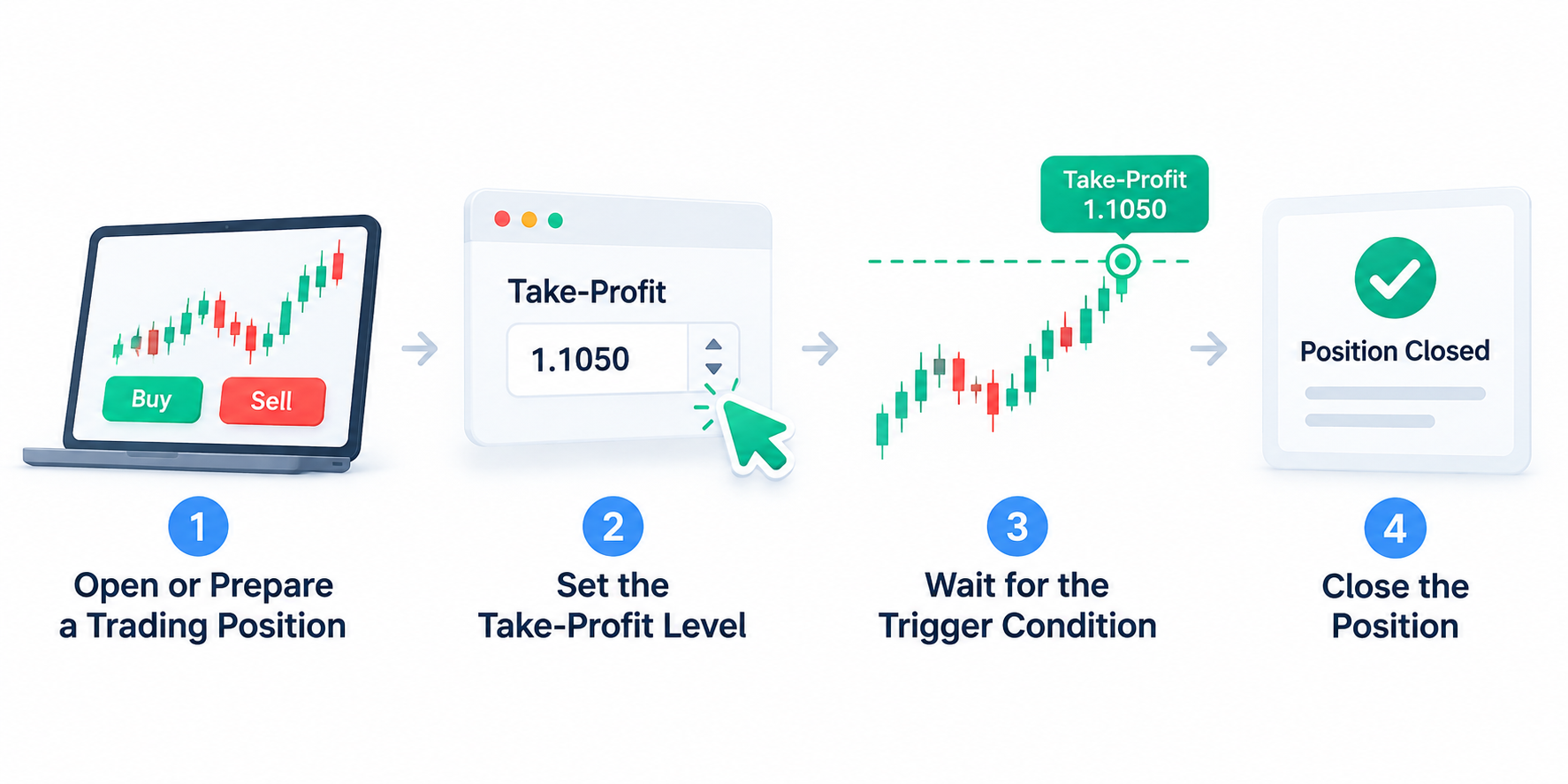
The process generally involves selecting an instrument, opening a position, and specifying a target price. The platform then associates that level with the relevant position or order, subject to its supported functionality and execution rules.
Step 1: Open or Prepare a Trading Position
First, a trader identifies an instrument and decides whether to buy or sell. Depending on the platform, a take-profit level can be attached when opening a position or added to an existing position.
Step 2: Set the Take-Profit Level
Next, the trader enters a target price consistent with the intended direction of the trade.
· Buy Position: The take-profit level is generally above the entry price.
· Sell Position: The take-profit level is generally below the entry price.
The exact price reference used to trigger the instruction can vary by instrument and platform.
Step 3: Wait for the Trigger Condition
Once the instruction is active, the market must reach the applicable trigger level. If the price never reaches that level, the take-profit instruction may remain pending without being triggered, and the position may stay open unless another event closes or modifies it.
Importantly, a price displayed on a chart may not be the same as the price used to trigger the instruction. For conventional OTC forex quotes on MetaTrader 5, a buy position’s take-profit level is generally triggered by the Bid price, while a sell position’s level is generally triggered by the Ask price. Trigger-price conventions may differ for other instrument types and execution configurations, so traders should check their platform’s specifications.
Step 4: Close the Position
When the trigger condition is met, the platform or broker initiates the closing process. The final result depends on the applicable execution model and market conditions.
Therefore, traders should distinguish between the take-profit trigger price and the actual closing price. They are not necessarily identical.
Hypothetical Example: Setting a Take-Profit Level
Consider a hypothetical EUR/USD trade with the following parameters.
|
Parameter |
Example |
|
Position |
Buy EUR/USD |
|
Entry Price |
1.1000 |
|
Take-Profit Level |
1.1050 |
|
Price Difference |
50 pips |
|
Position Size (Base Currency) |
EUR 10,000 |
|
Illustrative Gross Profit if Closed at the Target |
USD 50 |
Assume the trader buys EUR 10,000 against the US dollar at 1.1000 and closes the position at the take-profit level of 1.1050. The price increases by 0.0050 USD per EUR, equivalent to 50 pips, using the conventional pip size of 0.0001 for EUR/USD.
The hypothetical gross profit is calculated as follows:
Gross Profit = Position Size × (Exit Price − Entry Price)
Gross Profit = EUR 10,000 × 0.0050 USD per EUR = USD 50
This calculation excludes spreads, commissions, overnight financing, slippage, and any other applicable trading costs. It also assumes that the position closes at the specified take-profit price.
If the actual closing price differs from 1.1050, the gross result will change accordingly. Furthermore, if the market never reaches the take-profit trigger level, the position may remain open, and the anticipated gain will not be realised.
This example is hypothetical and illustrates how to calculate gross trading profit. It is not a forecast, a recommendation to trade EUR/USD, or a guarantee of any particular outcome.
Why Do Traders Use Take-Profit Orders?
Take-profit orders can support a structured trading process. However, their usefulness depends on the strategy, market conditions, and the trader’s broader risk management.
1. Define an Exit in Advance
A predetermined target gives a trade a clear exit condition. As a result, traders can plan the potential reward before entering a position rather than making every decision in response to short-term price movements.
2. Reduce the Need for Constant Monitoring
An active take-profit instruction can initiate a position closure without requiring the trader to click a manual close button at the target. This can be useful when prices move while the trader is away from the screen.
However, this benefit depends on the platform’s order-handling arrangements, connectivity requirements, and whether the instruction remains active.
3. Support Trading Discipline
A predefined target can help traders follow a documented plan instead of repeatedly moving their exit level because they hope for a larger gain. Nevertheless, the target itself must make sense within the strategy; an arbitrary price does not become a sound trading decision simply because it is automated.
4. Make Potential Reward Easier to Assess
A take-profit level helps traders calculate the potential price movement between entry and exit. When combined with a stop-loss level, it can also help them compare hypothetical reward with potential loss.
Still, a planned reward-to-risk ratio is not a prediction of the trade’s probability of success. Actual outcomes depend on market movements, execution, and trading costs.
What Are the Limitations of a Take-Profit Order?
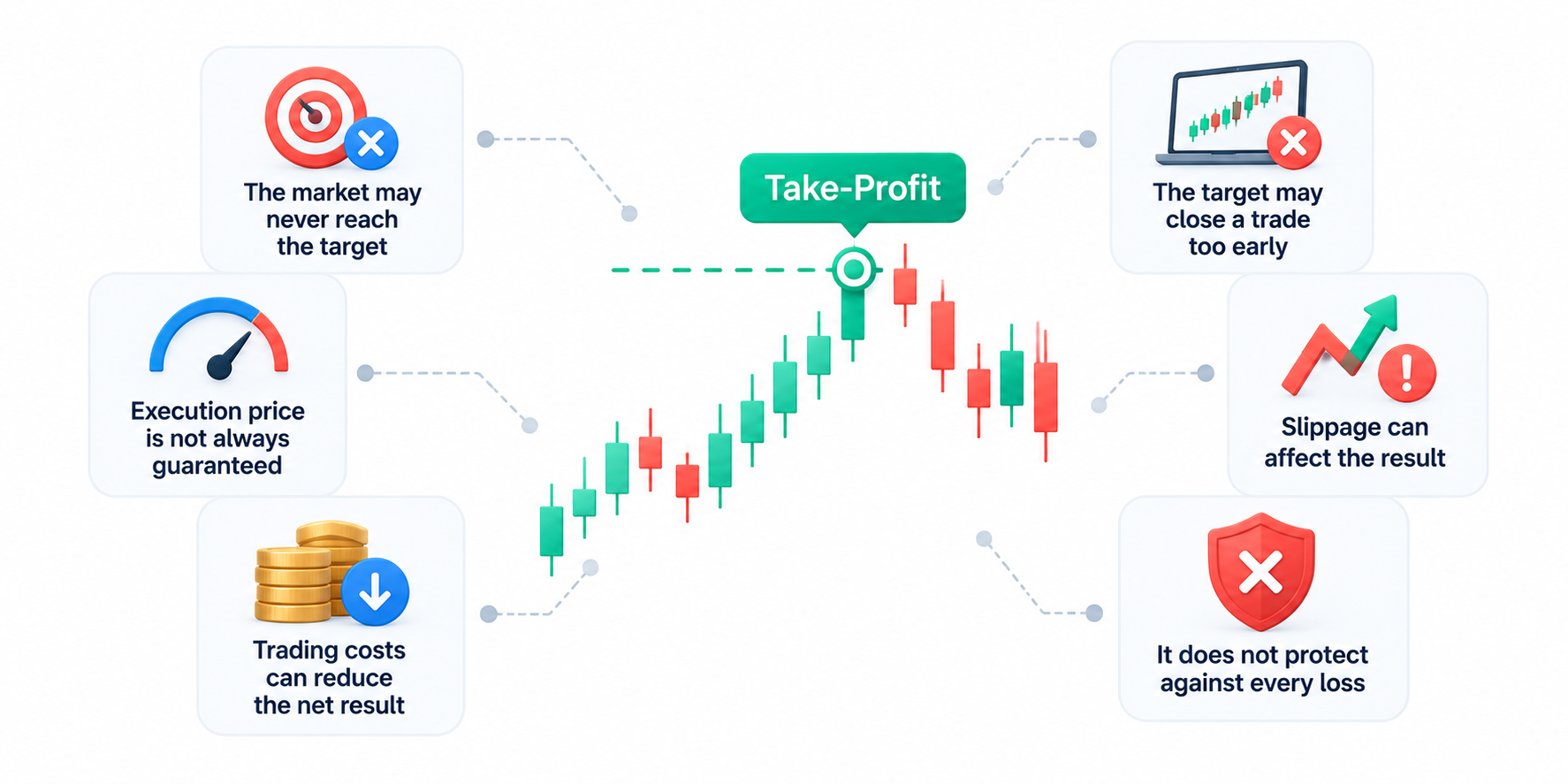
A take-profit order can help define an exit, but it cannot remove market risk. Understanding its limitations is essential before using it.
Execution Price Is Not Always Guaranteed
A take-profit instruction identifies a trigger condition, but the execution method determines how the position closes. Rapid price movements, changes in available liquidity, and broker-specific execution rules can affect the final result.
Consequently, traders should not automatically assume that the position will close at precisely the price shown on the chart. The relevant platform and product documentation should explain how the trigger and execution processes work.
Slippage Can Affect the Result
Slippage is the difference between an expected execution price and the actual execution price. It can occur when prices change between order triggering and execution.
For instance, a hypothetical position with a target at 1.1050 might close at a different price if the market moves quickly and the applicable execution method permits that outcome. Whether positive or negative slippage can occur, and how it is handled, depends on the broker’s terms and execution arrangements.
The Market May Never Reach the Target
Markets do not have to move towards a trader’s chosen exit level. If the target is never reached, the take-profit instruction may not activate, and the position may remain exposed to adverse price movements.
A take-profit order is therefore not a substitute for assessing the downside of a trade or deciding how to manage a position if the market moves in the opposite direction.
The Target May Close a Trade Too Early
A target that is too close to the entry price may close a position before a larger favourable move develops. Conversely, a distant target may remain untriggered for an extended period.
Neither outcome is automatically wrong. The appropriate level depends on the trading method, market conditions, and the trader’s predefined objectives. However, traders should avoid treating the highest possible gain as the only measure of a target’s quality.
Trading Costs Can Reduce the Net Result
A favourable price movement does not necessarily translate into the same amount of net profit. Spreads, commissions, financing charges, and other applicable costs may reduce the final result.
This distinction is particularly important for leveraged products such as CFDs, where the financial result depends on the contract specifications, position size, price movement, and applicable charges.
A Take-Profit Order Does Not Protect Against Every Loss
A take-profit order addresses a favourable exit condition. It does not automatically close a position when the market moves against the trader.
For this reason, traders should understand the difference between a take-profit order and a stop-loss order, and consider how each fits into their risk management plan. Neither instruction guarantees that a trade will be profitable.
Take-Profit vs Stop-Loss Orders
Both instructions can automate aspects of position management, but they serve different purposes.
|
Feature |
Take-Profit Order |
Stop-Loss Order |
|
Primary Purpose |
Close a position at a predefined favourable target |
Trigger a position closure when the relevant market price reaches the specified stop-loss level |
|
Typical Buy-Position Level |
Above the entry price |
Below the entry price |
|
Typical Sell-Position Level |
Below the entry price |
Above the entry price |
|
Main Limitation |
The target may never be reached, and execution at the target is not universally guaranteed |
The trigger may not guarantee the execution price, and losses can exceed the planned amount in some circumstances |
|
Is the Execution Price Guaranteed? |
Not in all circumstances; depends on the execution method and market conditions. |
Not in all circumstances; the actual closing price may differ from the stop-loss level. |
The key distinction is that a take-profit order defines a potential exit on a favourable move, whereas a stop-loss order defines a potential exit on an adverse move. Traders may use both instructions on the same position when supported by their platform.
Traders should check the relevant product specifications and execution rules, particularly when trading leveraged CFDs.
To learn more about how stop-loss orders work, how traders use them to manage risk, and their limitations, read our guide to understanding stop-loss orders.
How to Choose a Take-Profit Level
There is no universally correct take-profit level. Instead, traders can assess several factors before deciding where to place it.
1. Trading Strategy: Consider whether the target aligns with the strategy’s entry and exit rules rather than selecting a price arbitrarily.
2. Market Structure: Review relevant price levels and the conditions that could support or obstruct further movement.
3. Potential Reward and Loss: Compare the planned gain with the potential loss associated with the stop-loss level, where applicable.
4. Trading Costs: Account for spreads, commissions, financing charges, and other costs that may affect the net result.
5. Volatility and Execution: Consider how quickly prices can move and how the broker handles triggered instructions.
6. Review and Consistency: Record the rationale for the target and evaluate the method across a suitable set of observations rather than judging it from a single trade.
For example, a trader might choose a target based on a predefined strategy and then calculate the price distance from entry. Another trader might use a fixed reward-to-risk ratio. Neither approach guarantees success, and a target should not be treated as reliable simply because it follows a formula.
Before using any order type, traders should understand its mechanics, costs, and limitations. They should also avoid changing a plan impulsively in response to short-term market movements.
Using Take-Profit Orders in CFD Trading
A CFD allows a trader to speculate on price movements without owning the underlying asset. A take-profit instruction on a CFD is generally intended to close the relevant position when its specified trigger condition is met, subject to the platform and broker’s terms.
Because CFDs are leveraged products, even small price movements can result in gains or losses that are large relative to the initial margin. Leverage can magnify both gains and losses. In addition, financing charges and other costs may affect the final outcome when a position remains open.
Therefore, a take-profit order should form part of a broader trading plan rather than serve as a standalone risk control. Traders should understand the specific CFD contract, the platform’s trigger-price rules, the execution policy, and the charges applicable to the product.
Key Takeaways
· A take-profit order instructs a platform or broker to initiate the closure of a position when a specified favourable price condition is met.
· Traders can use predefined targets to structure exits and reduce the need for manual monitoring.
· The trigger price and final execution price may differ, depending on the instrument, execution method, and market conditions.
· A take-profit order does not guarantee a profit, prevent losses, or ensure that the market reaches the target.
· Traders should consider execution risks, trading costs, and stop-loss arrangements as part of a broader risk management plan.
Frequently Asked Questions
1. What Is a Take-Profit Order in Forex?
A take-profit order in forex trading is an instruction to close a currency position when the relevant market price reaches a predefined target. For a buy position, the target is generally above the entry price; for a sell position, it is generally below it. However, execution depends on the platform’s trigger rules and the applicable market conditions.
2. Does a Take-Profit Order Guarantee Profit?
No. A take-profit order does not guarantee a profit because the market may never reach the target. Even when the trigger condition is met, the final closing price may differ from the specified level. Furthermore, spreads, commissions, financing charges, and other applicable costs can reduce or eliminate a potential gain.
3. What Is the Difference Between Take-Profit and Stop-Loss Orders?
A take-profit order aims to close a position when the market moves towards a favourable target. A stop-loss order aims to trigger a closure when the market moves in an unfavourable direction. Traders may use both to define exit conditions, but neither guarantees the execution price or eliminates trading risk.
4. Can I Change a Take-Profit Level After Opening a Trade?
In many trading platforms, traders can modify or remove an active take-profit level associated with an open position. The available options depend on the platform, instrument, and broker’s rules. MetaTrader 5, for example, provides functionality for modifying position levels, subject to the relevant trading conditions.
5. Is a Take-Profit Order Suitable for Beginners?
A take-profit order can help beginners understand predefined exit planning and reduce the need to monitor every price movement manually. However, beginners should first learn how trigger prices, execution, trading costs, and stop-loss orders work. They should also recognise that an automated exit instruction cannot guarantee a positive outcome or replace an understanding of market risk.
Explore account information
Review account details, terms, and risks on the official CPT website.
Related articles
- Forex essentials
Base Currency vs Quote Currency: How Forex Pairs Are Read
A currency pair shows the value of one currency relative to another. The base currency is the first currency in the pair, while the quote currency is the second. The exchange rate tells you how many units of the quote currency are needed to buy one u
12 min read · estimated↗ - Trading essentials
What Is a Trader? Types, Skills, and How Trading Works
A trader is an individual who buys and sells financial instruments or takes positions in financial products to seek profits from changes in market prices. Traders operate across markets such as foreign exchange (forex), shares, indices, commodities,
13 min read · estimated↗ - Digital assets
What Is Litecoin (LTC)? How It Works, Uses, and Risks
Litecoin (LTC) is a decentralised cryptocurrency designed to enable peer-to-peer transactions without requiring a central authority to process them. Launched in 2011, it uses a public blockchain and a proof-of-work consensus mechanism to record trans
12 min read · estimated↗