

Forex essentials
What Is a Lot Size in Forex? Types, Pip Value, and Examples
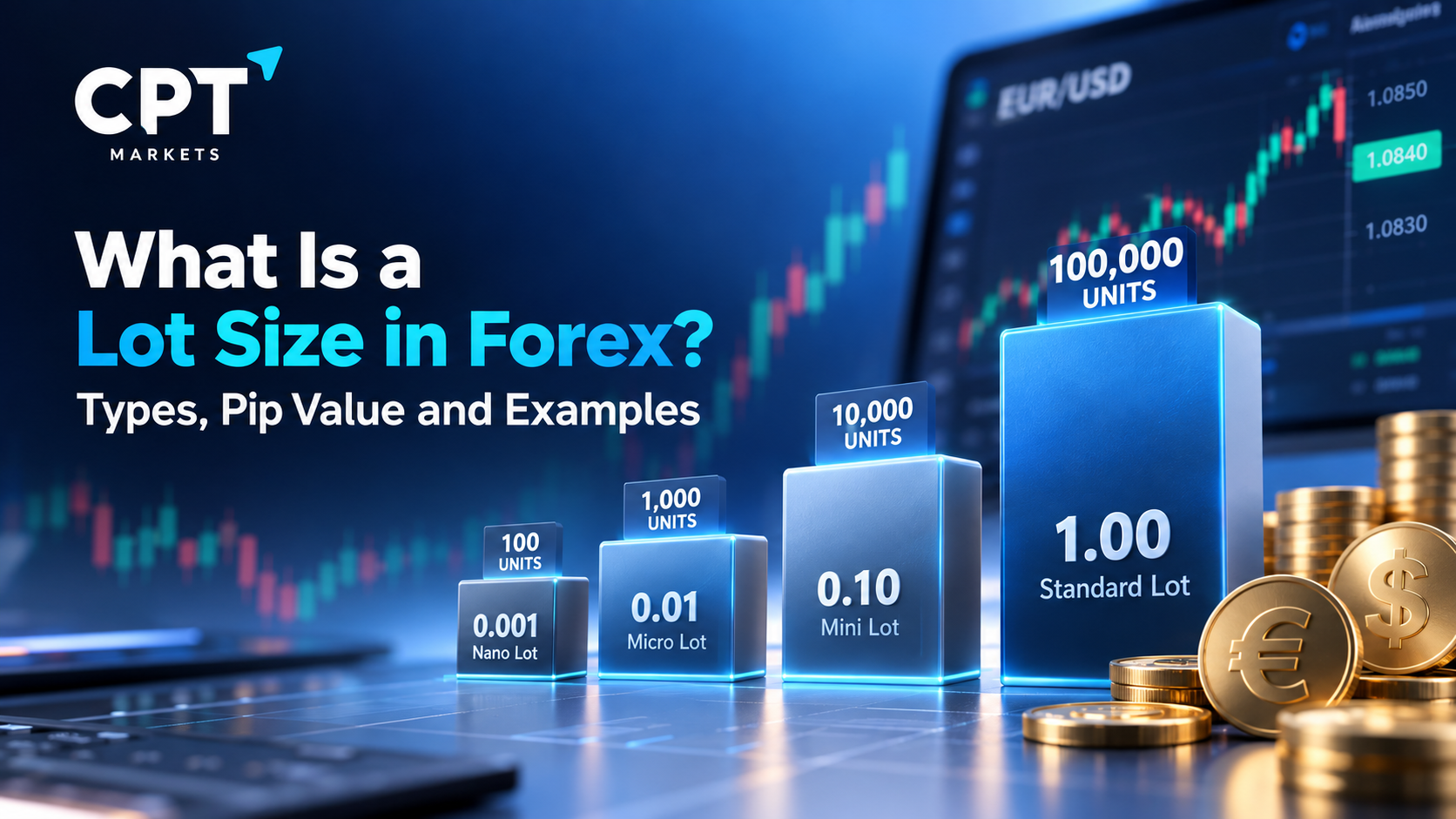
A lot size in forex measures the volume of a currency trade. It tells you how many units of the base currency are included in a position. The most common conventions are 1.00 standard lot = 100,000 units, 0.10 lot = 10,000 units, and 0.01 lot = 1,000 units. Because pip value changes with position size, choosing a lot size directly affects the potential profit or loss from each price movement.
What Is a Lot Size in Forex?
In forex trading, a lot is a standard way of expressing trade volume. Rather than describing a position only by its currency units, trading platforms commonly display volume in lots.
For example, a 1.00-lot EUR/USD position represents 100,000 euros of the base currency. A 0.10-lot position represents 10,000 euros, while a 0.01-lot position represents 1,000 euros.
The important point is that lot size measures position volume, not the amount of money you deposit into a trading account. A trader may use margin to open a position, but the economic exposure of the position is determined by its contract or trade size.
As a general convention, one standard forex lot represents 100,000 units of the base currency, with mini and micro lots representing progressively smaller trade volumes.
For more background on currency pairs and how forex trading works, see the CPT Markets Forex Trading Guide.
Forex Lot Size Types Explained
Several lot-size labels are commonly used in retail forex trading. The exact volume available on a trading platform can vary by broker, account, and instrument, so these categories should be treated as standard conventions rather than a guarantee of product availability.
|
Lot type |
Typical units |
Platform volume |
Approx. pip value on EUR/USD* |
|
Standard lot |
100,000 |
1.00 |
$10 |
|
Mini lot |
10,000 |
0.10 |
$1 |
|
Micro lot |
1,000 |
0.01 |
$0.10 |
|
Nano lot |
100 |
0.001 |
$0.01 |
*Illustrative values for EUR/USD when the account currency is USD. Actual pip value can differ depending on the currency pair, exchange rate, and account currency.
Standard Lot
A standard lot represents 100,000 units of the base currency. Therefore, buying 1.00 lot of EUR/USD represents a position size of 100,000 euros.
For EUR/USD, where the quote currency is USD, one pip is 0.0001. Consequently, a 1.00-lot position has an illustrative pip value of approximately $10.
Standard lots create relatively large exposure. Therefore, even a modest price movement can produce a comparatively large change in the position’s profit or loss.
Mini Lot
A mini lot represents 10,000 units, or 0.10 standard lots.
On EUR/USD, the illustrative pip value is approximately $1 per pip. As a result, a 30-pip move would correspond to approximately $30 before other trading costs, assuming the currency pair and account currency match the example.
Micro Lot
A micro lot represents 1,000 units, or 0.01 standard lots.
For EUR/USD, one micro lot has an illustrative pip value of approximately $0.10. This smaller position size can make it easier to model how different trade volumes affect P/L without assuming that every position must be a full standard lot.
Nano Lot
Some forex education sources also use the term ‘nano lot’ for 100 units, or 0.001 standard lots. However, this convention is not universally supported, so traders should check the minimum trade volume and contract specifications available through their broker and platform.
How Does Lot Size Affect Pip Value?
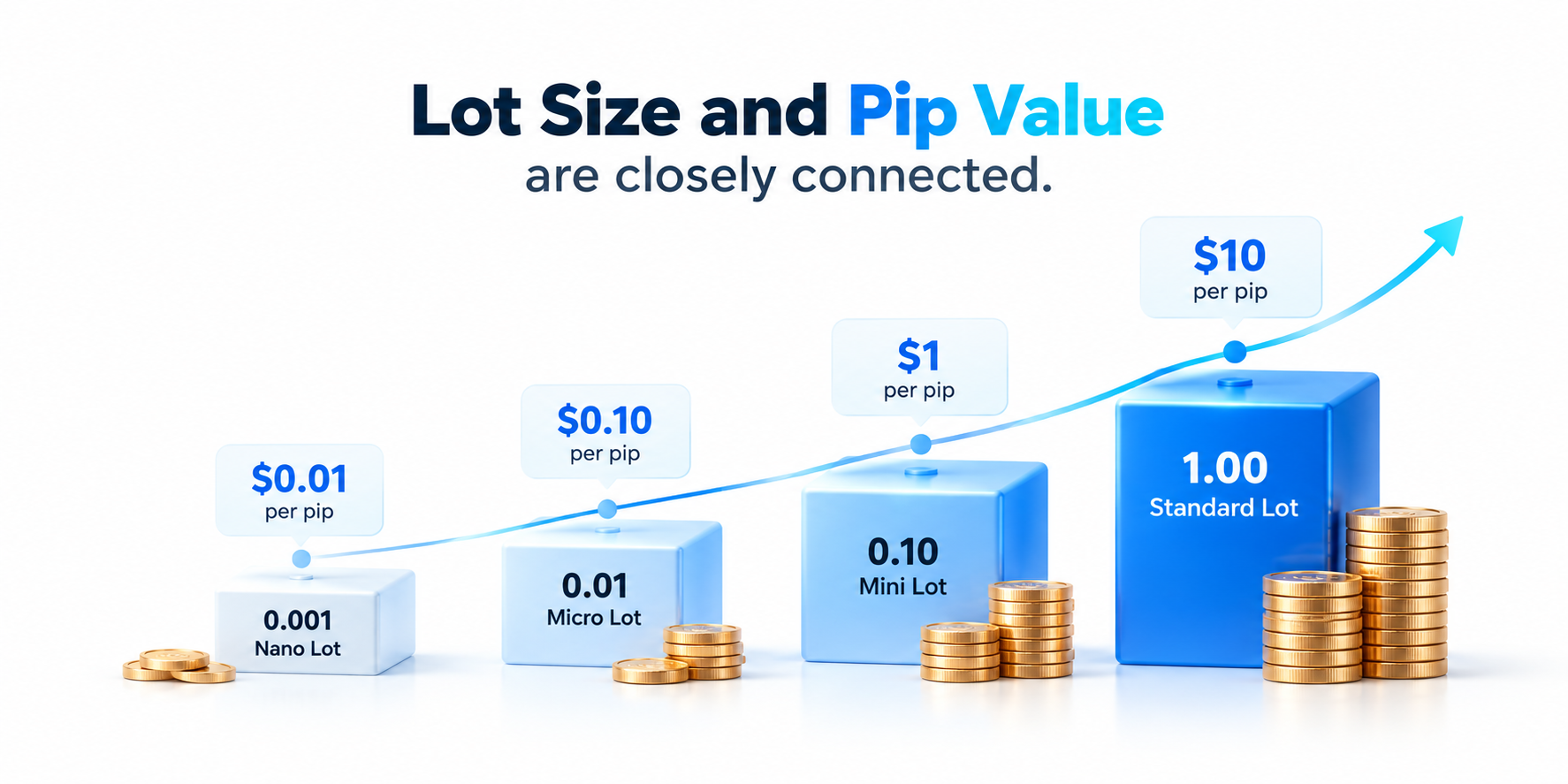
Lot size and pip value are closely connected. A pip is a standard unit used to measure movement in a currency pair. For many major currency pairs, one pip corresponds to 0.0001. For JPY pairs, one pip is commonly 0.01.
For a USD-quoted pair such as EUR/USD, the basic relationship can be illustrated as:
Pip Value = Position Size × Pip Size
For EUR/USD:
- 100,000 units × 0.0001 = $10 per pip
- 10,000 units × 0.0001 = $1 per pip
- 1,000 units × 0.0001 = $0.10 per pip
- 100 units × 0.0001 = $0.01 per pip
This relationship explains why the same market movement can have very different financial effects at different lot sizes.
However, the simple calculation does not apply unchanged to every currency pair or account currency. For pairs where the quote currency differs from the account currency, the resulting pip value may need to be converted using the relevant exchange rate.
For more on how pip values change across different position sizes, see our guide to pips in forex: https://www.cptmarkets.com/en/learn/academy/What-Is-a-Pip-in-Forex-Meaning-Value-and-Calculation-Examples
Forex Lot Size Examples
The easiest way to understand lot size is to keep the market movement constant while changing only the position size.
Example 1: Comparing Different Lot Sizes
Assume EUR/USD moves 50 pips in your favour. The following is a hypothetical calculation using the illustrative pip values above:
|
Lot size |
Units |
Approx. pip value |
50-pip movement |
|
1.00 lot |
100,000 |
$10 |
$500 |
|
0.10 lot |
10,000 |
$1 |
$50 |
|
0.01 lot |
1,000 |
$0.10 |
$5 |
|
0.001 lot |
100 |
$0.01 |
$0.50 |
These figures are hypothetical calculations, not forecasts or expected trading results.
Importantly, the same calculation works in the opposite direction. If EUR/USD moves 50 pips against the position, the corresponding figures represent losses rather than gains, before applicable costs.
That is why lot size should be considered alongside the distance to a stop-loss, the account’s available funds, and the trader’s risk parameters.
Example 2: Calculating Profit or Loss from Pips
Suppose a hypothetical trader buys 0.10 lot of EUR/USD.
The illustrative pip value is approximately $1 per pip. If EUR/USD then moves 35 pips in the trader’s favour:
35 pips × $1 = $35
The hypothetical result is therefore a $35 profit before costs.
If the pair instead moves 35 pips against the position:
35 pips × $1 = -$35
The calculation demonstrates an important principle: lot size affects the financial value of the price movement, but it does not determine the direction of that movement.
How to Calculate Forex Lot Size
There is no single lot size that is appropriate for every trader or every trade. Instead, position size can be calculated by working backwards from the amount a trader has decided to risk and the distance to the stop-loss.
A simplified educational formula is:
Position Size (in Lots) = Maximum Monetary Risk ÷ (Stop-Loss Distance in Pips × Pip Value per Standard Lot)
Consider this hypothetical example:
- Maximum planned loss: $20
- Stop-loss distance: 40 pips
- Pip value of 1.00 EUR/USD lot: $10
First calculate the monetary risk per pip:
$20 ÷ 40 = $0.50 per pip
A standard lot produces approximately $10 per pip in this example. Therefore:
$0.50 ÷ $10 = 0.05 lots
The resulting hypothetical position size is 0.05 lots.
This example is for educational purposes only. It does not constitute a recommended risk level or position size. Actual calculations can also be affected by account currency, currency pair, contract specifications, execution prices, and trading costs. A stop-loss level does not guarantee execution at a specific price, and actual losses may differ in fast-moving or gapping markets.
Explore account information
Review account details, terms, and risks on the official CPT website.
Lot Size vs Margin: What Is the Difference?
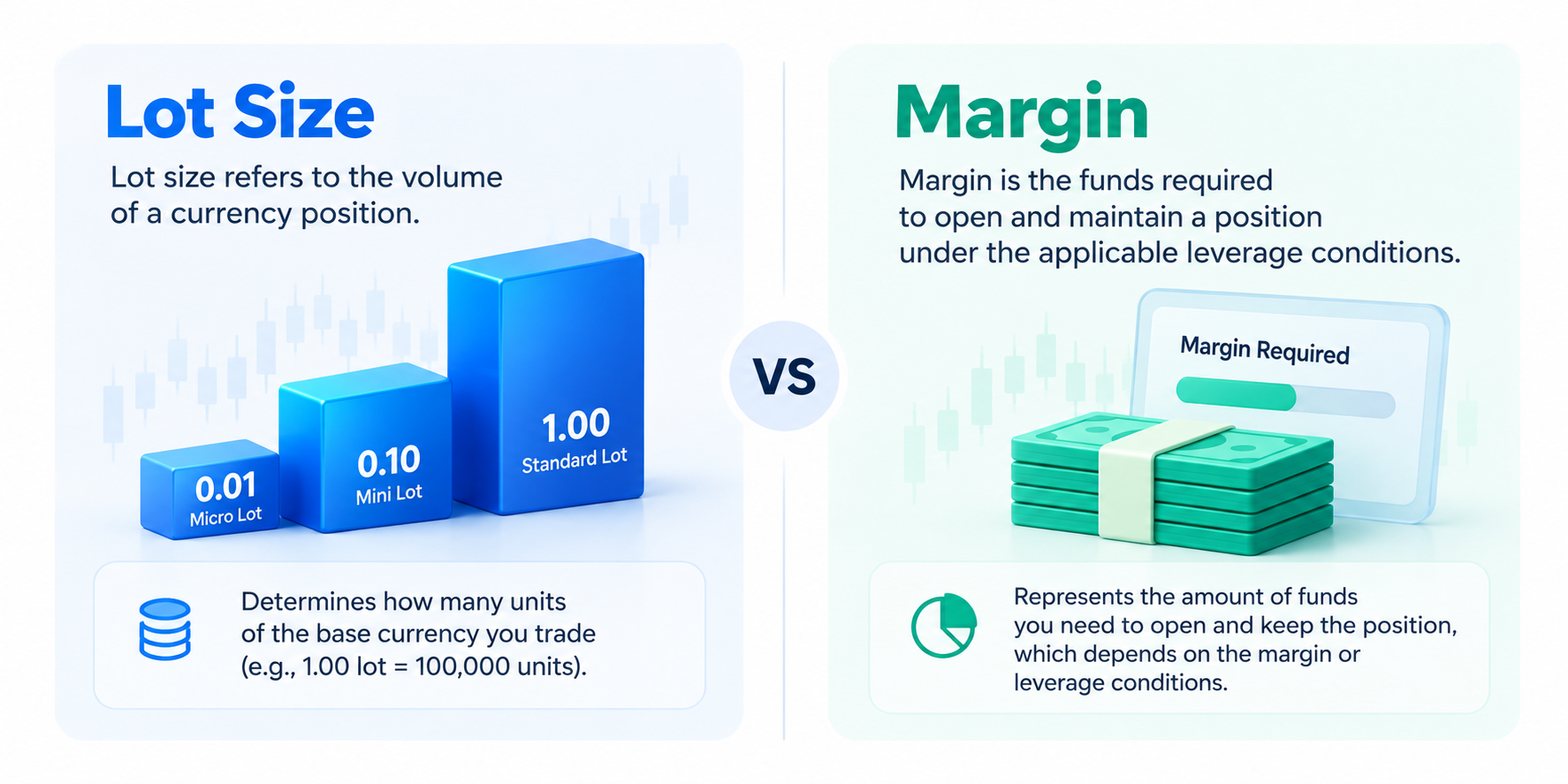
Lot size and margin are related, but they are not the same thing. Lot size describes the volume of the position. Margin refers to the funds required to open and maintain a leveraged position under the applicable trading conditions.
For example, a 1.00-lot position can represent 100,000 units of the base currency, while the amount of margin required to open that position depends on the applicable margin or leverage conditions.
Therefore, a platform showing that an account has enough available margin to open a position does not automatically mean that the position size is appropriate for the trader’s risk parameters.
Traders should also distinguish position size from account balance. A larger balance does not automatically make every large position appropriate, just as a smaller balance does not make every small position safe.
Common Lot-Size Mistakes to Avoid
Confusing Lot Size with Risk
A 0.10-lot position is not automatically low risk. Risk depends on several factors, including the instrument, stop-loss distance, pip value, and market movement.
Assuming Every Currency Pair Has the Same Pip Value
The familiar $10-per-pip figure applies to a standard lot of EUR/USD under the stated assumptions. Pip values can change when the quote currency or account currency changes.
Treating Available Margin as a Risk Limit
A platform may allow a trader to open a position that is much larger than their intended risk parameters. Margin availability and sensible position sizing are separate considerations.
Ignoring the Stop-Loss Distance
Changing the stop-loss distance changes the potential monetary loss for a given position size. A wider stop with the same lot size generally exposes the position to a larger potential loss before the stop is reached.
Assuming a Lot Size Guarantees a Particular Outcome
Lot size determines the scale of the position, not whether the trade will be profitable. Market prices can move in either direction, and leveraged forex/CFD trading can result in substantial losses.
How to Practise Lot-Size Calculations

For beginners, it can be useful to practise the relationship between lot size, pips, and P/L before considering live trading.
CPT Markets offers a Demo Trading Account with virtual funds, allowing users to practise lot-size calculations, explore trading strategies, and become familiar with the trading platform before using real capital.
When practising, focus on the mechanics:
1. Select a hypothetical currency pair.
2. Choose a hypothetical lot size.
3. Identify the pip value.
4. Set a hypothetical entry and stop-loss.
5. Calculate the monetary effect of a specified number of pips.
6. Repeat the exercise using different lot sizes.
This process can help demonstrate why changing from 0.01 to 0.10 or 1.00 lot materially changes the financial impact of the same market movement.
Key Takeaway
A lot size tells you how large your forex position is. Standard, mini, and micro lots represent progressively smaller volumes, while nano lots are another smaller convention whose availability varies.
Because pip value changes with position size, lot size directly affects the monetary impact of each pip. Therefore, understanding lot size is an important part of interpreting potential profit and loss and planning position size.
The calculation is straightforward, but the assumptions matter. Always check the relevant contract specifications, account currency, and trading conditions before relying on a pip-value calculation.
For educational information about forex trading with CPT Markets, see the relevant product and risk disclosures for your jurisdiction before trading.
FAQs
What Is a Lot Size in Forex?
A lot size in forex describes the volume of a currency position. The common convention is that 1.00 standard lot represents 100,000 units of the base currency. Smaller conventions include 0.10 lot, or 10,000 units, and 0.01 lot, or 1,000 units. The exact trade volume available can depend on the broker, platform, and instrument.
How Much Is 1 Lot in Forex?
One standard forex lot is conventionally 100,000 units of the base currency. For EUR/USD, a 1.00-lot position has an illustrative pip value of approximately $10 when the account currency is USD. The actual monetary value of a pip can vary for other currency pairs or account currencies.
What Does 0.01 Lot Mean in Forex?
A 0.01-lot position is commonly called a micro lot and represents 1,000 units of the base currency. For EUR/USD with a USD account, one pip is approximately $0.10 under the standard calculation. This is an illustrative relationship, not a guarantee of the amount gained or lost on a trade.
How Much Is 0.10 Lot in Forex?
A 0.10-lot position is commonly called a mini lot and represents 10,000 units of the base currency. On EUR/USD, the illustrative pip value is approximately $1 when the account currency is USD. A 20-pip movement would therefore correspond to approximately $20 before costs, whether the movement produces a gain or loss.
Does a Bigger Lot Size Mean Higher Profit?
A bigger lot size increases the monetary effect of each pip, so it can increase both potential gains and potential losses from the same market movement. It does not increase the probability that a trade will be profitable. Because forex and CFDs can involve leverage, traders should consider position size, stop-loss distance, and overall risk together.
What Is the Difference Between Lot Size and Pip Value?
Lot size measures the volume of the position, while pip value measures how much one pip of price movement is worth in monetary terms for that position. Generally, increasing the lot size increases pip value. However, the exact pip value also depends on the currency pair and the currency in which the trading account is denominated.
Explore account information
Review account details, terms, and risks on the official CPT website.
Related articles
- Forex essentials
Base Currency vs Quote Currency: How Forex Pairs Are Read
A currency pair shows the value of one currency relative to another. The base currency is the first currency in the pair, while the quote currency is the second. The exchange rate tells you how many units of the quote currency are needed to buy one u
12 min read · estimated↗ - Trading essentials
What Is a Trader? Types, Skills, and How Trading Works
A trader is an individual who buys and sells financial instruments or takes positions in financial products to seek profits from changes in market prices. Traders operate across markets such as foreign exchange (forex), shares, indices, commodities,
13 min read · estimated↗ - Digital assets
What Is Litecoin (LTC)? How It Works, Uses, and Risks
Litecoin (LTC) is a decentralised cryptocurrency designed to enable peer-to-peer transactions without requiring a central authority to process them. Launched in 2011, it uses a public blockchain and a proof-of-work consensus mechanism to record trans
12 min read · estimated↗