

Academy
How to Calculate Position Size in Foreign Exchange: Formula and Examples

Position sizing is an essential part of foreign exchange (forex) risk management because it determines how much currency a trader buys or sells and how much they could lose if the market moves against them. Rather than choosing a lot size at random, traders can calculate it using their account balance, planned risk amount, stop-loss distance, and pip value.
This guide explains the forex position sizing formula, how to convert the result into lots, and how to work through practical examples. It also covers common calculation mistakes and explains why a correctly sized position cannot eliminate trading risk.
What Is Position Size in Forex?
Position size refers to the amount of currency a trader buys or sells in a forex trade. Traders typically express it in units of the base currency or in lots.
For example, in the euro/US dollar (EUR/USD) currency pair, the euro is the base currency and the US dollar (USD) is the quote currency. A position of 10,000 units therefore represents EUR 10,000 of the base currency, with its equivalent value in US dollars determined by the prevailing EUR/USD exchange rate.
Forex brokers commonly use the following standard lot conventions:
|
Lot Type |
Units of Base Currency |
|
Standard Lot |
100,000 |
|
Mini Lot |
10,000 |
|
Micro Lot |
1,000 |
|
Nano Lot |
100 |
These are common industry conventions, not a guarantee that every trading account supports every lot size. Always check the contract specifications for the instrument and account you intend to use.
Position size matters because it affects the financial impact of each pip movement. For the same currency pair and stop-loss distance, a larger position generally produces a larger potential loss if the stop-loss level is reached. Conversely, a smaller position reduces that exposure, although it does not make an otherwise unsuitable trade safe.
How to Calculate Position Size in Forex
The forex position sizing formula uses three main inputs: the amount you are prepared to risk, the stop-loss distance in pips, and the monetary value of each pip for the chosen position size.
Position Size in Standard Lots = Amount at Risk in Account Currency ÷ (Stop-Loss Distance in Pips × Pip Value per Standard Lot in Account Currency)
The pip value in the position sizing formula must be expressed in your account currency and must correspond to one standard lot. If you use pip value per currency unit instead, the formula returns the position size in currency units rather than lots.
Before applying the formula, calculate the amount at risk:
Amount at Risk = Account Balance × Risk Percentage
Express the risk percentage as a decimal. For example, 1% is 0.01, while 0.5% is 0.005.
Step 1: Calculate the Amount at Risk
First, determine the monetary amount used in the calculation. This represents the estimated price-movement loss if the stop-loss executes at the specified price, excluding additional trading costs and any difference between the expected and actual execution price.
For example, suppose an account has a balance of USD 5,000 and the calculation uses a hypothetical risk allowance of 1%.
Amount at Risk = USD 5,000 × 0.01 = USD 50.
The USD 50 represents the planned price-movement risk in this example, not a recommended risk amount. An appropriate risk allowance depends on individual circumstances, and the actual loss may exceed the calculated amount.
Step 2: Determine the Stop-Loss Distance
A stop-loss order is intended to close a position when the market reaches a specified price. The distance between the planned entry price and the stop-loss price determines how many pips the market can move against the position before reaching that level.
For example, suppose a hypothetical EUR/USD trade has an entry price of 1.0850 and a stop-loss price of 1.0825. The difference is 0.0025, equivalent to 25 pips under the standard convention for this pair.
For most currency pairs, one pip is 0.0001. For many Japanese yen (JPY)-quoted pairs, one pip is 0.01. Some trading platforms also display fractional pips, often called pipettes, so check the instrument’s price format before calculating the distance.
The stop-loss should reflect the trade’s defined exit conditions rather than being moved arbitrarily to produce a preferred position size.
Step 3: Find the Pip Value
Pip value is the monetary amount gained or lost when a currency pair moves by one pip for a given position size.
For many standard-lot EUR/USD contracts, one pip is worth approximately USD 10 when the account currency is USD. However, pip value varies with position size, the exchange rate, and the account currency.
When the quote currency differs from the account currency, you may need to convert the pip value using the relevant exchange rate. For USD/JPY, the pip value is initially calculated in JPY. For a USD-denominated account, this amount must be converted into USD using the applicable exchange rate, so the resulting pip value changes as the exchange rate moves.
Use your trading platform’s instrument specifications or a reliable pip-value calculator to verify the applicable value before placing a trade.
Step 4: Calculate the Position Size
Once you know the amount at risk, stop-loss distance, and pip value per standard lot, divide the amount at risk by the product of the other two inputs.
The result gives the theoretical position size in standard lots. Convert it into currency units if needed, then check the platform’s minimum trade volume and permitted volume increments. Where a smaller permitted position is available, round down to the nearest permitted increment and recalculate the potential loss. If the minimum permitted volume exceeds the calculated size, the trade cannot be placed at the intended risk allowance under those conditions. This helps confirm that the estimated price-movement risk remains within the intended allowance before transaction costs and execution differences.
Forex Position Size Calculation Examples
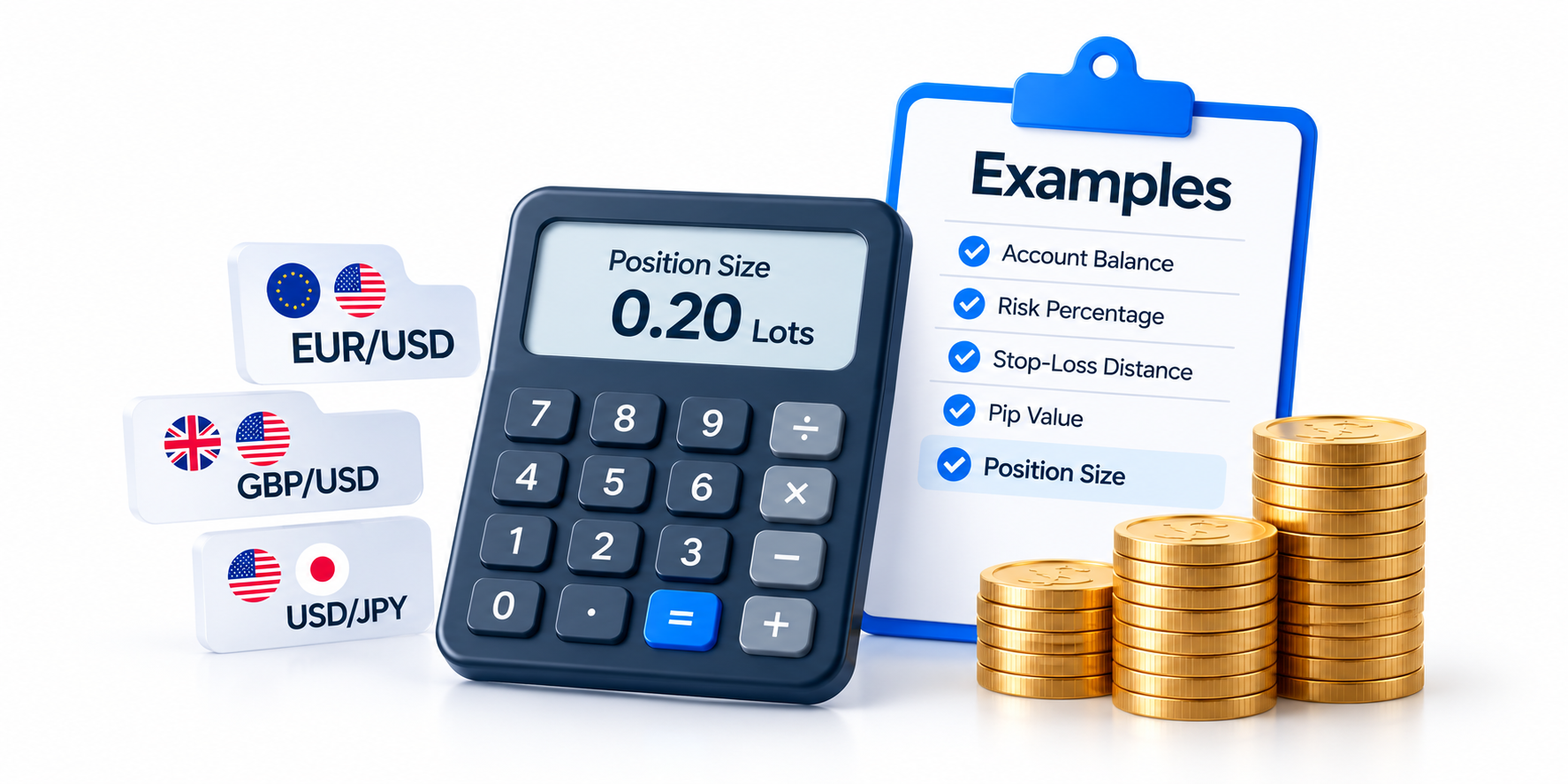
The following examples are hypothetical and illustrate the arithmetic only. They do not represent trading recommendations or forecasts.
Example 1: Calculating Position Size for EUR/USD
Suppose a trader uses these inputs:
|
Input |
Hypothetical Value |
|
Account Balance |
USD 5,000 |
|
Risk Percentage |
1% |
|
Amount at Risk |
USD 50 |
|
Stop-Loss Distance |
25 pips |
|
Pip Value per Standard Lot |
USD 10 |
Apply the formula:
Position Size = USD 50 ÷ (25 × USD 10)
Position Size = USD 50 ÷ USD 250 = 0.20 standard lots.
A standard lot represents 100,000 units of the base currency under the convention used here. Therefore, 0.20 standard lots represents 20,000 units of EUR.
To check the calculation, multiply the stop-loss distance by the pip value for the calculated position:
25 pips × USD 2 per pip = USD 50.
The result matches the planned price-movement risk allowance before transaction costs and any difference between the expected and actual exit price.
Example 2: How Stop-Loss Distance Changes Position Size
Consider the same USD 5,000 account and 1% hypothetical risk allowance, but increase the stop-loss distance from 25 pips to 50 pips. Assume the same USD 10 pip value per standard lot.
Position Size = USD 50 ÷ (50 × USD 10)
Position Size = 0.10 standard lots.
The position is now half the size of the previous example. This illustrates an important principle: when the risk allowance and pip value remain constant, a wider stop-loss distance generally requires a smaller position.
A wider stop does not automatically make a trade safer, just as a narrower stop does not automatically make it better. The calculation determines the position size for a given stop distance; it does not establish whether the trade’s entry or exit levels are appropriate.
Example 3: Calculating Position Size for a Different Account Balance
Suppose a hypothetical trader has a USD 10,000 account, uses a 0.5% risk allowance, and plans a 30-pip stop-loss on EUR/USD. Assume a pip value of USD 10 per standard lot.
Amount at Risk = USD 10,000 × 0.005 = USD 50.
Position Size = USD 50 ÷ (30 × USD 10)
Position Size = 0.1667 standard lots, approximately.
If the platform permits volume increments of 0.01 lots, rounding down would produce a position of 0.16 lots. At 0.16 standard lots, the assumed pip value is USD 1.60. Therefore, a 30-pip movement against the position would result in an estimated price-movement loss of USD 48 (30 × USD 1.60), before trading costs and execution differences.
However, the available volume increments must be verified for the specific instrument and account. Do not assume that every platform accepts the same order size.
How to Convert Position Size Into Lots and Units
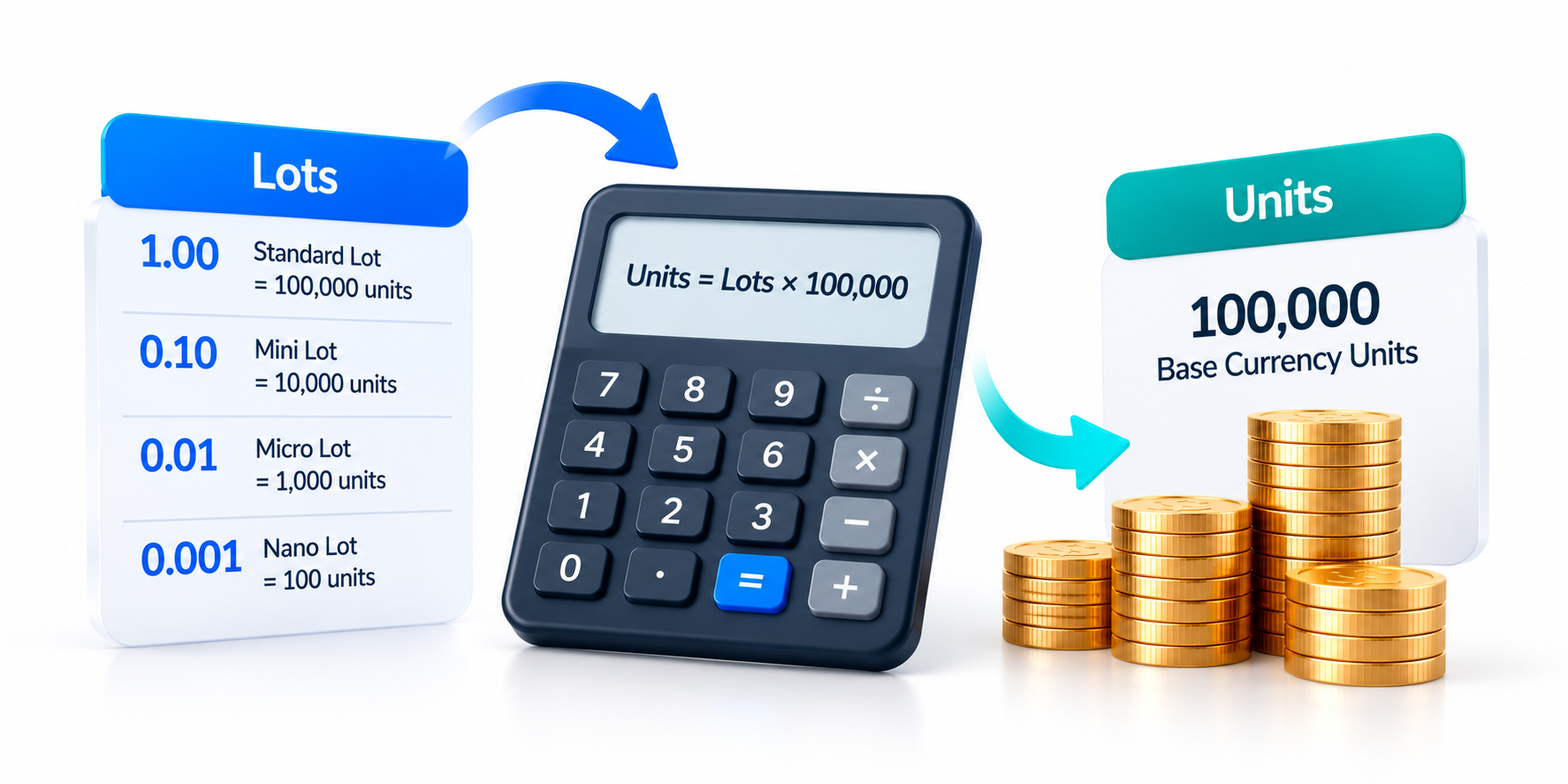
After calculating the position size, convert the result into the format required by your trading platform.
Position Size in Units = Position Size in Standard Lots × 100,000
For example, 0.20 standard lots equals 20,000 units of the base currency. Similarly, 0.05 standard lots equals 5,000 units.
If your formula returns units instead of lots, divide the unit amount by 100,000 to obtain standard lots under the same convention.
Before submitting an order, verify the minimum trade volume, volume step, contract size, and margin requirement shown in the platform. A mathematically correct result may not match the platform’s permitted order sizes.
Position Size vs Lot Size vs Leverage
These terms are related, but they describe different aspects of a trade.
|
Term |
Meaning |
|
Position Size |
The total amount of currency exposure in a trade |
|
Lot Size |
A standardised way of expressing the amount traded |
|
Leverage |
The relationship between a position’s notional value and the margin required to open it |
|
Margin |
Funds required to open and maintain a leveraged position, subject to the applicable terms |
For example, a trader may calculate a position of 0.20 standard lots and then need to meet the applicable margin requirement to open it. The margin requirement determines the funds needed to open and maintain a leveraged position, but it does not establish whether the potential loss is acceptable. Position size should be assessed against the planned risk allowance, stop-loss distance, and pip value.
Leverage can magnify gains and losses relative to the margin committed. Therefore, having enough margin to open a position does not mean that its potential loss is affordable.
Common Position Sizing Mistakes to Avoid
Even a straightforward formula can produce misleading results if its inputs are incorrect. Check these points before relying on a calculation.
· Using the Wrong Pip Value: Pip values differ across currency pairs, exchange rates, position sizes, and account currencies. Verify the value for the actual instrument.
· Confusing Pips with Fractional Pips: Some platforms display an additional decimal place. Make sure the stop-loss distance uses the correct pip convention.
· Ignoring Transaction Costs: A position size calculation based only on the stop-loss distance and pip value estimates price-movement risk, not the full cost of a trade. Spreads, commissions, applicable financing charges, slippage, and execution differences may increase the actual loss.
· Rounding the Position Size Up: A platform’s minimum volume or volume increment may prevent the exact theoretical size. Where appropriate, rounding down can help keep the planned price-movement loss within the intended allowance.
· Treating the Stop-Loss Price as a Guaranteed Exit Price: In fast-moving or gapping markets, the execution price may differ from the requested stop level. The actual loss can therefore exceed the calculation.
· Confusing Margin with Risk: A small margin requirement does not necessarily mean that a position carries little risk. Evaluate potential loss as well as the funds required to open the trade.
· Ignoring Correlated Positions: Several open trades may respond to the same economic event or currency movement. Assess combined exposure rather than considering every position in isolation.
How Position Sizing Fits Into Forex Risk Management
Position sizing is one part of a broader risk management process. It translates a planned stop-loss distance into a position size based on the selected risk allowance and pip value. Traders should also assess total exposure, applicable costs, margin requirements, and the possibility of adverse execution.
Before entering a trade, identify the entry conditions, determine the stop-loss level, calculate the monetary risk, and check the position size. Then account for applicable trading costs, margin requirements, and the possibility that execution may differ from the expected price.
It is also useful to review total exposure across open positions. For example, multiple positions involving the USD may respond to the same economic announcement, potentially increasing the combined impact of an adverse move.
Finally, remember that repeated losses can reduce account equity and make subsequent losses more significant relative to the remaining balance. A position sizing formula supports consistency, but it does not replace an understanding of market risk, a suitable trading plan, or independent financial guidance where appropriate.
Calculating Position Size with Confidence
Reliable position sizing depends on accurate pip values, the correct account-currency conversion, and realistic assumptions about execution. Before placing a trade, check the permitted volume, account exposure, and applicable costs. Position sizing supports risk management, but it cannot eliminate the risks of leveraged forex trading.
Frequently Asked Questions
1. What Is the Formula for Calculating Position Size in Forex?
Position size in standard lots equals the amount at risk divided by the product of the stop-loss distance in pips and the pip value per standard lot. First, calculate the amount at risk by multiplying your account balance by the selected risk percentage. Then verify the pip value in your account currency before applying the formula.
2. How Do I Calculate Forex Lot Size for a USD 1,000 Account?
Start by multiplying the USD 1,000 balance by the hypothetical risk percentage. At 1%, the amount at risk would be USD 10. If the stop-loss distance were 20 pips and the pip value were USD 10 per standard lot, the theoretical position size would be 0.05 standard lots. This excludes trading costs and execution differences and is not a recommended trade.
3. Does a Wider Stop-Loss Mean I Should Use a Smaller Position?
Generally, yes, if the account balance, planned risk amount, and pip value remain unchanged. A wider stop-loss allows more adverse price movement before reaching the stop level, so the position size must decrease to maintain the same calculated risk. However, stop placement should reflect the trading plan rather than being adjusted solely to obtain a preferred position size.
4. What Is the Difference Between Position Size and Leverage?
Position size measures how much currency exposure a trade represents, while leverage describes the relationship between that exposure and the margin required. A larger leveraged position can amplify gains and losses relative to the margin committed. Therefore, meeting a platform’s margin requirement does not establish that the position’s potential loss is acceptable.
5. Can a Position Sizing Calculator Prevent Trading Losses?
No. A position sizing calculator estimates exposure using the inputs provided, but it cannot predict market movements or guarantee the execution price of a stop-loss order. Spreads, commissions, currency conversions, slippage, and gaps may affect the final result. Position sizing is a risk management tool, not a guarantee against losses.
6. Should I Include Spreads and Commissions When Calculating Position Size?
Yes. The basic formula estimates the loss associated with a specified price movement, but trading costs can increase the total loss. Consider the applicable spread, commissions, and financing charges when relevant. Also account for the possibility that a stop-loss order may execute at a different price from the requested level.
Explore account information
Review account details, terms, and risks on the official CPT website.
Related articles
- Forex essentials
Base Currency vs Quote Currency: How Forex Pairs Are Read
A currency pair shows the value of one currency relative to another. The base currency is the first currency in the pair, while the quote currency is the second. The exchange rate tells you how many units of the quote currency are needed to buy one u
12 min read · estimated↗ - Trading essentials
What Is a Trader? Types, Skills, and How Trading Works
A trader is an individual who buys and sells financial instruments or takes positions in financial products to seek profits from changes in market prices. Traders operate across markets such as foreign exchange (forex), shares, indices, commodities,
13 min read · estimated↗ - Digital assets
What Is Litecoin (LTC)? How It Works, Uses, and Risks
Litecoin (LTC) is a decentralised cryptocurrency designed to enable peer-to-peer transactions without requiring a central authority to process them. Launched in 2011, it uses a public blockchain and a proof-of-work consensus mechanism to record trans
12 min read · estimated↗