

Academy
How to Create a Trading Plan: Template and Beginner Checklist
A trading plan is a written set of rules that defines what you trade, when you enter and exit positions, how much risk you accept, and how you evaluate your decisions. To create one, set clear objectives, choose a trading approach, establish entry and exit criteria, define risk limits, and record your results. A structured plan cannot eliminate losses, but it can help you make decisions consistently and review them objectively.
What Is a Trading Plan?
A trading plan is a personal framework for making and reviewing trading decisions. It translates your objectives into specific rules, so you know which conditions must be met before opening a position and what actions to take if the market moves against you.
A trading plan typically covers:
· Trading Objectives: What you want to learn or achieve, and the timeframe you have set.
· Markets and Instruments: The assets or financial products you intend to trade.
· Trading Strategy: The conditions that must occur before you consider entering a trade.
· Risk Management: How you determine position size, set stop-loss levels, and limit potential losses.
· Trading Routine: When you analyse markets, execute trades, and review performance.
· Performance Evaluation: How you record results and identify areas for improvement.
A trading plan differs from a trading strategy. A strategy describes the rules used to identify trading opportunities, whereas a plan also covers risk controls, trading routines, and performance reviews.
For beginners, this distinction matters because identifying a potential opportunity is only one part of the process. You also need rules for managing the position and deciding when not to trade.
Why Do Beginners Need a Trading Plan?
Financial markets can move quickly, and prices do not always behave as expected. Without predefined rules, traders may react emotionally to short-term price movements, increase their exposure after a loss, or enter positions without understanding the potential downside.
A written plan provides a reference point for decisions. It also creates a record that you can use to assess whether your results reflect your strategy, your execution, or changing market conditions.
A trading plan can help you:
· Set Boundaries: Define acceptable risk before entering a position.
· Improve Consistency: Apply the same decision-making criteria across comparable market situations.
· Recognise Mistakes: Identify repeated behaviours, such as entering trades too early or ignoring exit rules.
· Evaluate a Strategy: Compare actual results with your original expectations.
· Manage Uncertainty: Prepare for scenarios in which prices move against your position.
However, a plan does not guarantee profitable trades or prevent any loss. Market volatility, execution conditions, transaction costs, and unexpected events can all affect outcomes. A plan provides structure, but it cannot remove the uncertainty inherent in trading.
How to Create a Trading Plan Step by Step
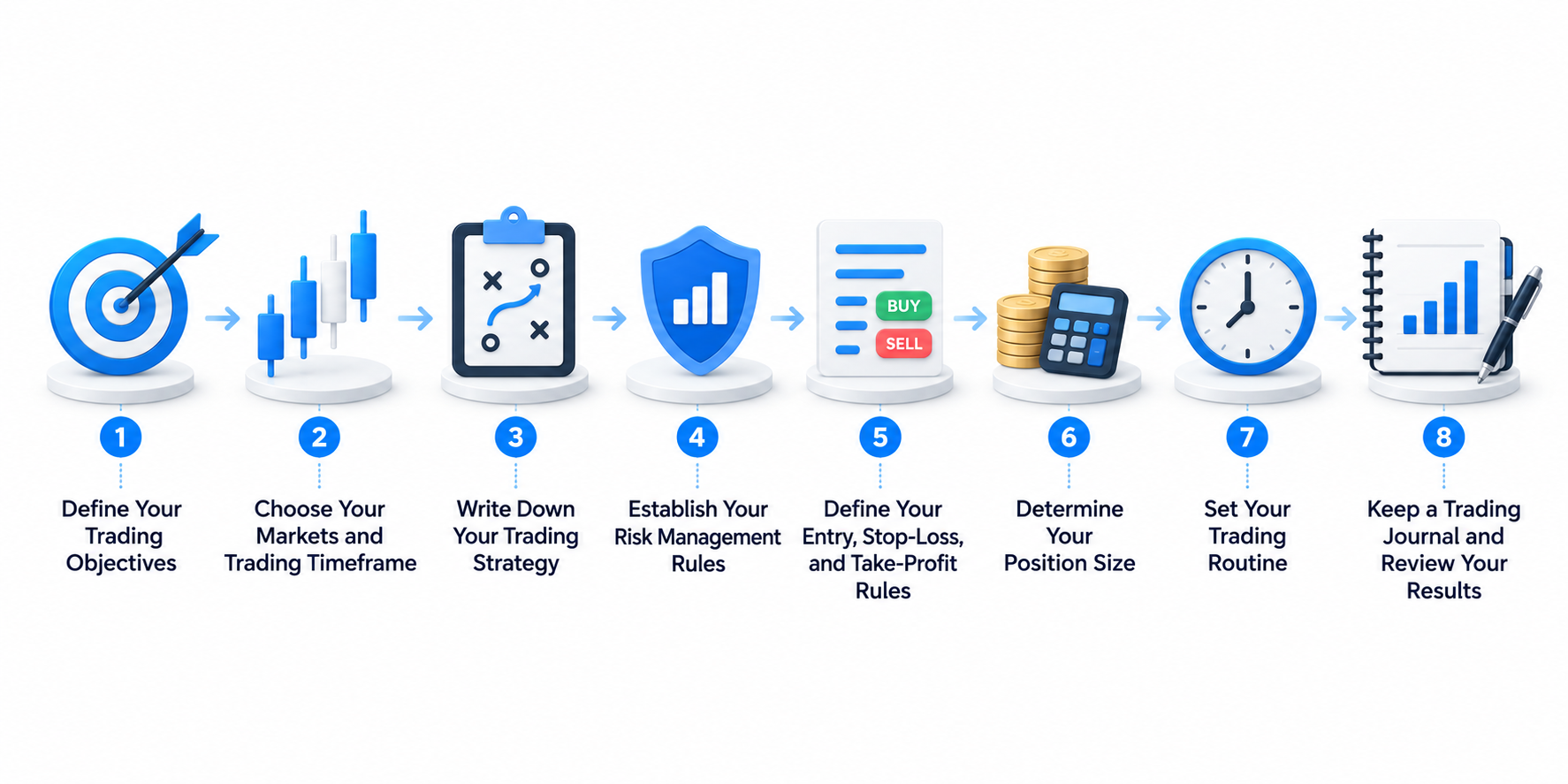
1. Define Your Trading Objectives
Start by identifying why you want to trade and what you want to achieve through the process. Beginners may focus on learning how markets work, testing a strategy, or developing a consistent routine before setting performance targets.
Make your objectives specific and measurable. For example, you could aim to document every trade for a defined period and review whether you followed your entry and exit rules.
Your objectives should also reflect your experience, available time, financial circumstances, and willingness to accept losses. Avoid setting profit targets that pressure you to take trades simply to meet a deadline.
2. Choose Your Markets and Trading Timeframe
Next, decide which markets you will study and which instruments you will consider trading. Depending on the product and provider, these may include foreign exchange (forex), indices, commodities, stocks, or cryptocurrencies.
For beginners, concentrating on a limited number of instruments can make it easier to understand price behaviour, relevant economic events, and the factors that influence market movements.
You should also select a trading timeframe. For example, a day trader may analyse intraday price movements, while a swing trader may hold positions for several days or longer.
Your timeframe influences how often you need to monitor the market, which charts you use, and how you manage overnight exposure and prepare for upcoming economic announcements.
3. Write Down Your Trading Strategy
Your strategy should explain the conditions under which you will consider opening a position. Avoid vague instructions such as “buy when the market looks strong”. Instead, define observable criteria that you can apply and review.
A basic strategy specification should include:
|
Element |
Question to Answer |
|
Market Conditions |
What market environment does the strategy target? |
|
Entry Signal |
What specific conditions must occur before entry? |
|
Confirmation |
What evidence supports the trading decision? |
|
Invalidation |
What would show that the original trade idea is no longer valid? |
|
Exit Conditions |
When will you close the position? |
|
No-Trade Conditions |
What circumstances make the setup unsuitable? |
For example, a hypothetical trend-following strategy might require the price to move above a defined resistance level, followed by a retest that meets predetermined confirmation criteria.
This is an illustration, not a recommendation or evidence of a profitable strategy. Test your rules using historical data and, where appropriate, a demo environment before risking real money. Remember that historical results do not guarantee future performance.
4. Establish Your Risk Management Rules
Risk management should form part of your plan before you enter your first trade. Decide how much you are prepared to lose on an individual position and how you will limit your overall exposure.
Your rules may cover:
· Maximum Planned Risk Per Trade.
· Maximum Combined Planned Risk Across Open Positions.
· A Daily or Weekly Loss Limit That Triggers a Pause and Review.
· Conditions for Reducing Position Size.
· Rules Against Increasing Exposure Solely to Recover Previous Losses.
Some traders express planned trade risk as a percentage of account equity. However, no single percentage suits every trader, and a chosen limit does not guarantee that the realised loss will remain within it.
Understand the Difference Between Planned Risk and Actual Loss. A stop-loss order can help define an exit level, but it may not execute at that exact price during volatile or gapping markets. Transaction costs and other execution factors can also affect the result.
5. Define Your Entry, Stop-Loss, and Take-Profit Rules
Before opening a position, identify the entry conditions, the level at which the trade idea is invalidated, and the exit criteria.
A stop-loss order is intended to close a position when its specified trigger condition is met, although the execution price may differ from the trigger price. A take-profit order is designed to close a position when a specified profit-related level is reached, subject to the order type and execution conditions.
Neither order guarantees a particular outcome. For example, a stop order may execute at a different price from its trigger during a fast-moving market. Likewise, a take-profit level does not guarantee that the market will reach that price.
Your plan should explain why you selected each level, whether the potential reward justifies the planned risk, and what you will do if market conditions change.
6. Determine Your Position Size
Position sizing determines how large a trade will be relative to your account and planned risk. It connects your risk limit to the distance between your entry and stop-loss levels.
A simplified formula is:
Position Size = Planned Monetary Risk ÷ Assumed Loss Per Unit Between the Entry and Stop-Loss Levels
The denominator must be expressed in the same account currency as the planned risk. For leveraged products and contracts with different tick values, contract specifications and currency conversions may also be necessary.
Hypothetical Example: Calculating Position Size
Suppose a trader has account equity of USD 2,000 and sets a planned risk limit of 0.5% of equity for one trade.
· Account Equity: USD 2,000.
· Planned Risk Percentage: 0.5%.
· Planned Monetary Risk: USD 2,000 × 0.005 = USD 10.
· Assumed Loss Per Unit Between Entry and Stop-Loss: USD 2.
The simplified calculation is:
Position Size = USD 10 ÷ USD 2 = 5 units
This example assumes a linear payoff and excludes transaction costs, slippage, currency conversion, and other contract-specific factors. The five-unit result is illustrative only. The correct position size for a real trade depends on the instrument’s specifications and the actual exposure involved.
7. Set Your Trading Routine
A trading routine defines how you prepare for and manage your trading activity. It can help you avoid making decisions simply because prices are moving or because you feel pressure to participate.
Your routine might include:
· Before Trading: Review relevant economic events, assess market conditions, and identify potential setups.
· Before Entry: Check the strategy criteria, calculate position size, and confirm the exit plan.
· During a Trade: Monitor the position according to predefined rules rather than reacting to every price fluctuation.
· After Trading: Record the result, note any deviations from the plan, and identify lessons for future decisions.
Also specify when you will not trade. Examples may include periods when you cannot monitor positions as required, when market conditions fall outside your strategy, or when your loss limit has been reached.
8. Keep a Trading Journal and Review Your Results
A trading journal records the details of each trade and whether you followed your rules. Over time, it can help you distinguish between a strategy’s performance and the quality of your decision-making.
Record the instrument, date, entry and exit prices, position size, planned risk, actual result, transaction costs, and reason for entering and closing the position. You can also note relevant market conditions and your adherence to the plan.
Review the journal at regular intervals. Look for recurring errors, changes in trading costs, and patterns in the situations where your approach performs poorly.
Avoid changing your strategy after every losing trade. Instead, review a meaningful sample of trades and test proposed changes before relying on them. Equally, do not assume that a profitable short-term run proves the strategy will continue to work.
Trading Plan Template for Beginners
Use the following template to document your initial rules. Complete each section before trading and revise it when your review provides a clear reason to do so.
|
Planning Area |
Your Trading Plan |
|
Trading Objectives |
What am I trying to learn or achieve? |
|
Markets and Instruments |
Which instruments will I focus on? |
|
Trading Timeframe |
How long do I expect to hold positions? |
|
Strategy |
What conditions qualify as a setup? |
|
Entry Criteria |
What must happen before I enter? |
|
Stop-Loss Criteria |
Where is the trade idea invalidated? |
|
Exit Criteria |
What conditions trigger an exit? |
|
Risk Per Trade |
What is my maximum planned monetary risk? |
|
Exposure Limit |
How will I control combined open-position risk? |
|
Daily or Weekly Limit |
When will I stop and review? |
|
Trading Routine |
When will I prepare, monitor, and review? |
|
Journal and Review |
What will I record, and how often will I evaluate results? |
Keep the completed plan accessible while trading. The goal is to make your rules practical enough to follow, not to create a document that is too complicated to use.
Beginner Trading Plan Checklist
Before placing a trade, work through this checklist.
· I have defined my trading objectives and the time I can commit.
· I understand the instrument and its main risks.
· The setup meets my written strategy criteria.
· I have identified my entry and exit conditions.
· I have calculated position size using the relevant contract specifications.
· The planned risk fits within my individual and overall exposure limits.
· I understand the relevant transaction costs and execution risks.
· I am not trading to recover a previous loss or acting on impulse.
· I have recorded the rationale and can review the trade afterwards.
If you cannot explain a trade in terms of your written rules, pause and reassess rather than forcing an entry. Completing every item does not remove market risk, but it helps you check whether you have followed your own process.
Common Trading Plan Mistakes to Avoid
Even a well-written plan can lose its value if you do not apply it consistently. Watch out for these common mistakes:
· Setting Unrealistic Profit Targets: Ambitious targets can encourage excessive risk-taking or unnecessary trading.
· Ignoring Costs: Spreads, commissions, financing charges, and other applicable costs can affect net results. Check the relevant product and account terms rather than assuming every instrument has the same costs.
· Changing Rules Impulsively: Repeatedly changing entry criteria after individual wins or losses makes performance difficult to evaluate.
· Overlooking Correlated Exposure: Positions in different instruments can still respond to similar market drivers, so counting trades alone may understate combined risk.
· Treating Stop-Loss Orders as Guarantees: Trigger prices do not necessarily equal execution prices in all conditions.
· Not Reviewing Mistakes: Recording a trade without examining the decisions behind it limits what you can learn.
A trading plan should evolve when evidence supports a change. However, any revision should be deliberate, documented, and tested where possible.
Can You Use a Trading Plan with Contracts for Difference?
Yes. The same planning principles apply to contracts for difference (CFDs), but you must also account for leverage, margin requirements, and the specific terms of each instrument.
A CFD allows you to speculate on price movements without owning the underlying asset. Leverage can increase market exposure relative to the margin committed. Consequently, relatively small price movements can produce substantial gains or losses compared with the margin held.
Before trading CFDs, understand the contract size, margin requirements, applicable charges, and circumstances in which the provider may close your positions. Do not assume a stop-loss order will cap your loss at the intended amount.
CFDs are complex, high-risk products and may not be suitable for every trader. A trading plan helps organise decisions, but it does not make a leveraged product safe or ensure positive returns. Review the applicable provider documentation and risk disclosures before deciding whether to trade.
Turning Your Trading Rules Into a Clear Plan
Creating a trading plan gives beginners a structured way to prepare for trades, define acceptable risk, and evaluate decisions over time. Start with clear entry and exit criteria, practical risk controls, a manageable trading routine, and a journal that captures both results and mistakes.
Most importantly, treat the plan as a decision-making framework, not a promise of profitability. Review it objectively, test proposed changes, and never risk money you cannot afford to lose.
Before trading with real funds, consider practising with a Demo Account to test your trading plan, familiarise yourself with the trading platform, and refine your entry, exit, and risk management rules in a simulated environment. This can help you understand how your rules work in practice, although demo trading cannot fully replicate the emotions and execution conditions of live trading.
Frequently Asked Questions
1. What Should a Beginner Include in a Trading Plan?
A beginner trading plan should include trading objectives, selected markets, a strategy, entry and exit criteria, position-sizing rules, risk limits, and a trading journal. It should also specify when to avoid trading and how often to review results. Start with rules you can understand and apply consistently, then refine them through testing and documented experience.
2. How Do I Create a Trading Plan?
Begin by defining your objectives and choosing the markets you want to study. Next, write down your strategy’s entry and exit conditions, calculate position size based on planned risk, and establish limits for individual trades and overall exposure. Finally, create a trading routine, record every trade, and review your results regularly. Test your approach before committing real money.
3. Is a Trading Plan the Same as a Trading Strategy?
No. A trading strategy defines the conditions used to identify and manage potential trades. A trading plan is broader: it includes the strategy, risk management rules, trading schedule, position-sizing limits, and performance reviews. A strategy may identify a potential opportunity, but the plan determines whether that opportunity fits your rules and acceptable level of risk.
4. How Much Should a Beginner Risk Per Trade?
There is no single risk percentage that suits every trader. The appropriate limit depends on factors such as financial circumstances, experience, instrument characteristics, and tolerance for losses. Calculate planned monetary risk before entering a position, and consider cumulative exposure across open trades. Remember that actual losses can exceed the intended amount because of gaps, slippage, and execution conditions.
5. How Often Should I Review My Trading Plan?
Review your trading journal regularly and conduct a more comprehensive assessment at predefined intervals, such as monthly, depending on your trading frequency. Check whether you followed your rules, how costs affected results, and whether the strategy performed as expected across different conditions. Make changes based on documented evidence rather than reacting to a single winning or losing trade.
6. Can a Trading Plan Guarantee Profits?
No. A trading plan can help structure decisions, manage intended exposure, and identify mistakes, but it cannot predict market movements or eliminate financial risk. Strategies can perform differently as market conditions change, and execution costs can reduce results. Treat trading as a risky activity, test your approach carefully, and avoid interpreting past performance as a guarantee of future outcomes.
Explore account information
Review account details, terms, and risks on the official CPT website.
Related articles
- Forex essentials
Base Currency vs Quote Currency: How Forex Pairs Are Read
A currency pair shows the value of one currency relative to another. The base currency is the first currency in the pair, while the quote currency is the second. The exchange rate tells you how many units of the quote currency are needed to buy one u
12 min read · estimated↗ - Trading essentials
What Is a Trader? Types, Skills, and How Trading Works
A trader is an individual who buys and sells financial instruments or takes positions in financial products to seek profits from changes in market prices. Traders operate across markets such as foreign exchange (forex), shares, indices, commodities,
13 min read · estimated↗ - Digital assets
What Is Litecoin (LTC)? How It Works, Uses, and Risks
Litecoin (LTC) is a decentralised cryptocurrency designed to enable peer-to-peer transactions without requiring a central authority to process them. Launched in 2011, it uses a public blockchain and a proof-of-work consensus mechanism to record trans
12 min read · estimated↗