

Forex essentials
Base Currency vs Quote Currency: How Forex Pairs Are Read
Key takeaways
- The base currency comes first; the quote currency comes second.
- The exchange rate shows how much quote currency buys one unit of the base currency.
- A rising pair means the base currency gains relative to the quote currency; trading outcomes also depend on costs and product terms.

A currency pair shows the value of one currency relative to another. The base currency is the first currency in the pair, while the quote currency is the second. The exchange rate tells you how many units of the quote currency are needed to buy one unit of the base currency. Once you understand this relationship, you can read forex prices more accurately and interpret what a rising or falling exchange rate means.
What Is a Base Currency?
The base currency is the first currency listed in a forex pair. It is the currency whose value the exchange rate measures against the second currency.
For example, in EUR/USD, the euro (EUR) is the base currency, while the US dollar (USD) is the quote currency. If EUR/USD trades at 1.1000, one euro is worth 1.10 US dollars at that quoted rate.
The base currency provides a reference point for the price. Therefore, when you read a currency pair, identify the first currency before interpreting the exchange rate.
In a forex transaction, the base and quote currencies represent the two sides of the exchange. Buying a currency pair generally means buying the base currency while selling the quote currency. Conversely, selling the pair generally means selling the base currency while buying the quote currency. The precise mechanics depend on the financial product and its contractual terms.
What Is a Quote Currency?
The quote currency is the second currency listed in a forex pair. It expresses the price of one unit of the base currency.
Consider EUR/USD at 1.1000. The US dollar is the quote currency, and the exchange rate means that one euro is worth 1.10 US dollars. The quote currency is the unit in which the base currency’s price is expressed.
This relationship applies to other pairs, too. In GBP/USD, the British pound is the base currency, and the US dollar is the quote currency. In USD/JPY, however, the US dollar is the base currency, and the Japanese yen is the quote currency.
The order matters because it determines how to interpret the quoted rate. USD/JPY at 150.00 means one US dollar is worth 150 Japanese yen, whereas JPY/USD at 150.00 would mean one Japanese yen is worth 150 US dollars. These quotations express opposite currency relationships.
Base Currency vs Quote Currency: Key Differences
Although both currencies form the same pair, they serve different roles in the quotation.
|
Feature |
Base Currency |
Quote Currency |
|
Position in a Pair |
First |
Second |
|
Main Role |
Currency being valued |
Currency used to express the price |
|
Example in EUR/USD |
EUR |
USD |
|
Meaning of EUR/USD at 1.1000 |
One euro is the reference unit |
1.10 US dollars per euro |
|
Buying the Pair |
Buy the base currency |
Sell the quote currency |
|
Selling the Pair |
Sell the base currency |
Buy the quote currency |
The easiest way to remember the distinction is to read the pair from left to right. The first currency is the unit being priced, while the second tells you the price in currency units.
This convention also explains why you cannot interpret an exchange rate correctly by looking at the number alone. You need to know which currency appears first and which appears second.
How to Read a Forex Currency Pair
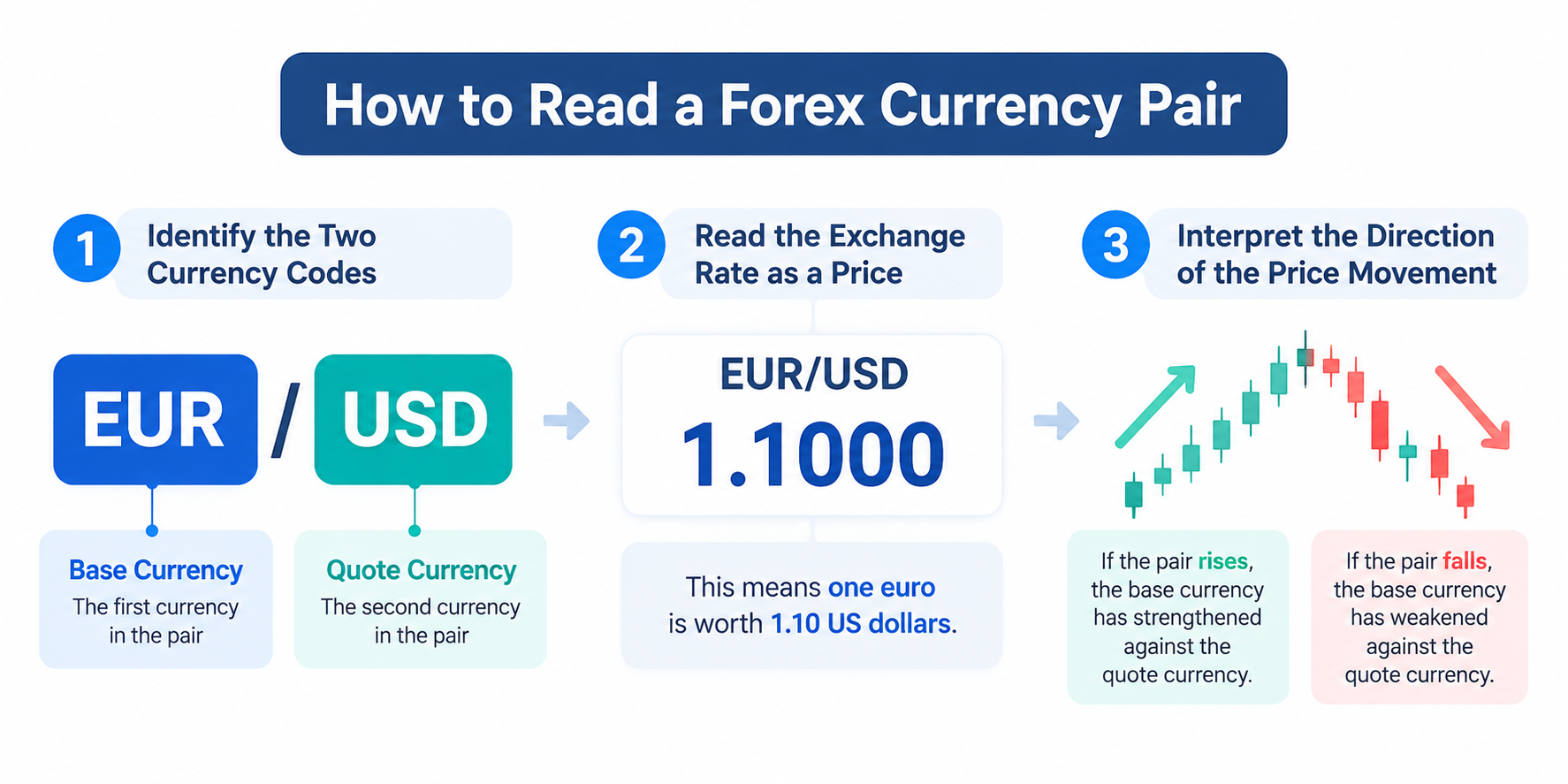
Reading a forex pair becomes straightforward when you follow three steps.
Step 1: Identify the Two Currency Codes
Look at the pair displayed on a quote screen. For example, GBP/USD contains GBP, the British pound, and USD, the US dollar. GBP is the base currency, while USD is the quote currency.
Step 2: Read the Exchange Rate as a Price
Suppose GBP/USD is quoted at 1.2700. This hypothetical rate means one British pound is worth 1.27 US dollars. It does not mean that one US dollar is worth 1.27 British pounds.
Step 3: Interpret the Direction of the Price Movement
If GBP/USD rises from 1.2700 to 1.2800, one pound buys more US dollars, indicating that the pound has appreciated against the dollar over that period. Conversely, if the pair falls from 1.2700 to 1.2600, the pound has weakened against the dollar.
These movements describe the relative value of the two currencies, not necessarily the absolute strength of either currency against every other currency. A currency can rise against one currency while falling against another.
Example: Understanding EUR/USD
Assume EUR/USD moves from 1.1000 to 1.1200.
At the initial rate, one euro is worth 1.10 US dollars. At the later rate, one euro is worth 1.12 US dollars. Therefore, the euro has appreciated against the US dollar over this hypothetical period.
The quoted exchange rate has increased by 0.0200 US dollars per euro, equivalent to approximately 1.82% of the initial rate.
Calculation:
(1.1200 − 1.1000) ÷ 1.1000 × 100 = 1.82%
This calculation describes the percentage change in the quoted exchange rate. However, it does not represent the return on a particular trade, because the result also depends on the trade’s direction, size, entry and exit prices, transaction costs, and applicable product terms.
Examples of Base and Quote Currencies in Major Forex Pairs
Different currency pairs use different currencies as their base and quote currencies. The following examples illustrate how to read common pairs.
|
Currency Pair |
Base Currency |
Quote Currency |
How to Interpret the Rate |
|
EUR/USD |
Euro (EUR) |
US dollar (USD) |
US dollars per euro |
|
GBP/USD |
British pound (GBP) |
US dollar (USD) |
US dollars per pound |
|
USD/JPY |
US dollar (USD) |
Japanese yen (JPY) |
Yen per US dollar |
|
USD/CHF |
US dollar (USD) |
Swiss franc (CHF) |
Swiss francs per US dollar |
|
AUD/USD |
Australian dollar (AUD) |
US dollar (USD) |
US dollars per Australian dollar |
|
USD/CAD |
US dollar (USD) |
Canadian dollar (CAD) |
Canadian dollars per US dollar |
|
EUR/GBP |
Euro (EUR) |
British pound (GBP) |
Pounds per euro |
The table highlights an important point: the US dollar does not always occupy the same position. It is the quote currency in EUR/USD and GBP/USD, but it is the base currency in USD/JPY and USD/CAD.
Therefore, do not assume that the first currency is always the US dollar or that the exchange rate always represents the value of a foreign currency in dollars. Instead, read each pair independently.
Explore account information
Review account details, terms, and risks on the official CPT website.
What Happens When a Forex Pair Rises or Falls?
A currency pair measures the value of the base currency relative to the quote currency. As a result, a price movement reflects a change in that relationship.
When a pair rises, one unit of the base currency buys more units of the quote currency than before. Conversely, when a pair falls, one unit of the base currency buys fewer units of the quote currency.
For example, if USD/JPY rises from 150.00 to 151.00, one US dollar buys more Japanese yen at the later rate. This indicates that the US dollar has strengthened against the yen in terms of the quoted rate, or equivalently, that the yen has weakened against the dollar.
A currency pair can rise because the base currency strengthens, the quote currency weakens, or both. Its movement alone does not establish how either currency is performing against other currencies.
Economic data, interest-rate expectations, central bank decisions, political developments, and changes in market sentiment can all influence currency values. Their effects depend on the circumstances and on how market participants interpret new information.
Does Buying a Forex Pair Mean Buying Both Currencies?
No. Conceptually, buying a forex pair represents a long position in the base currency relative to the quote currency, while selling it represents the opposite position. Whether the transaction involves exchanging currencies or obtaining price exposure through a derivative depends on the product.
For instance, buying EUR/USD represents a long position in the euro relative to the US dollar. The position benefits from a rise in the pair’s price, before costs and other product-specific adjustments. If the pair falls instead, the position may incur a loss.
The way this exposure is provided can vary. A spot currency exchange, a rolling spot forex product, and a contract for difference (CFD) may have different legal and contractual characteristics. Do not assume that every product involves physical delivery of both currencies.
For leveraged products, relatively small exchange-rate movements can have a disproportionately large effect on the funds committed to a position. Losses, costs, and other risks depend on the product and its terms.
How Base and Quote Currencies Affect Trading Calculations
Understanding the currency order also helps with basic forex calculations. In particular, it allows you to interpret pip movements and understand which currency expresses the price change.
A pip is a standardised unit used to measure changes in many forex exchange rates. For many pairs, one pip is 0.0001. For many Japanese yen pairs, one pip is 0.01. However, quoting conventions and instrument specifications can differ, so traders should check the relevant contract details.
For example, if EUR/USD moves from 1.1000 to 1.1005, the exchange rate has risen by five pips under the conventional four-decimal-place pip definition.
The monetary value of a pip depends on the position size, the currency pair’s exchange rate, and the account currency. The applicable contract specifications and conversion rates may also affect the calculation. Consequently, five pips do not represent the same monetary gain or loss for every position.
For further reading, explore the guide to understanding a pip in forex and the guide to forex lot sizes. These resources can help explain how price movements and position sizes relate to trading calculations.
Understanding the Inverse Exchange Rate
An inverse exchange rate reverses the currency order, expressing the value of the original quote currency in terms of the original base currency.
For example, if EUR/USD is 1.1000, its mathematical inverse is:
1 ÷ 1.1000 = approximately 0.9091
This means that one US dollar is equivalent to approximately 0.9091 euros at the same theoretical exchange rate.
The executable inverse quote may differ because of bid-ask spreads and market conditions. Transaction costs may also affect the overall cost of a trade, so the calculated inverse rate should not be treated as a guaranteed execution price.
Understanding inverse quotations can help you check calculations and avoid confusing the value of one currency with the value of the other.
Common Mistakes When Reading Currency Pairs

Beginners can avoid several common errors by applying the base-currency and quote-currency convention consistently.
Confusing the Order of the Currencies: EUR/USD and USD/EUR express opposite quotation conventions. Always identify the first currency before interpreting the price.
Assuming a Rising Pair Means Both Currencies Are Strengthening: A rising EUR/USD rate indicates that the euro is gaining value relative to the dollar in that quotation. It does not establish that both currencies are strengthening against other currencies.
Treating the Exchange Rate as a Guaranteed Transaction Price: A displayed reference rate may differ from the price available for execution. Bid and ask prices, spreads, liquidity, and product-specific conditions can affect the price of a transaction.
Assuming Exchange-Rate Movements Equal Trading Returns: A percentage change in a currency pair is not automatically the percentage profit or loss on a leveraged position. Position sizing, trade direction, costs, and the terms of the instrument all matter.
Ignoring Product-Specific Risks: Forex exposure through a CFD may differ from exchanging physical currencies. Leverage can amplify losses, while financing charges and other costs may apply depending on the product. Read the relevant documentation before considering a transaction.
The underlying principle is simple: identify the base currency, identify the quote currency, interpret the rate in the correct direction, and then consider the product’s terms before drawing conclusions about a trade.
Read Forex Pairs with Confidence
The base currency is the first currency in a forex pair, and the quote currency is the second. The exchange rate expresses how many units of the quote currency correspond to one unit of the base currency.
Once you understand this structure, you can interpret currency prices, recognise what rising and falling rates mean, and follow basic forex calculations more accurately. However, reading a currency pair is only one part of understanding the market. Trading decisions also involve price uncertainty, transaction costs, position sizing, and the risks associated with the financial product.
Before trading, make sure you understand the instrument, its terms, and the potential for loss. To familiarise yourself with trading platforms and practise your approach in a simulated environment, you can explore the CPT Markets Demo Account. However, educational resources and demo trading cannot eliminate market risk or guarantee results in a live trading environment.
Frequently Asked Questions
1. What Is the Difference Between a Base Currency and a Quote Currency?
The base currency is the first currency in a forex pair, while the quote currency is the second. The exchange rate shows how many units of the quote currency are equal to one unit of the base currency. For example, in EUR/USD at 1.1000, EUR is the base currency, and USD is the quote currency.
2. How Do You Know Which Currency Is the Base Currency?
Look at the order of the currency codes. The currency on the left is the base currency, and the currency on the right is the quote currency. For example, USD is the base currency in USD/JPY, whereas it is the quote currency in GBP/USD. Always check the order rather than assuming the US dollar occupies a particular position.
3. What Does EUR/USD Mean at 1.1000?
EUR/USD at 1.1000 means that one euro is worth 1.10 US dollars at the quoted exchange rate. The euro is the base currency, and the US dollar is the quote currency. However, the actual price available for a transaction may differ depending on the bid-ask spread, market conditions, and the terms of the financial product.
4. If a Forex Pair Rises, Which Currency Is Strengthening?
When a forex pair rises, the base currency is appreciating relative to the quote currency at the quoted rate. For example, if GBP/USD rises from 1.2700 to 1.2800, one British pound buys more US dollars. However, this does not necessarily mean that the pound is strengthening against every other currency.
5. Does Buying a Forex Pair Mean Buying Both Currencies?
No. Buying a forex pair conventionally means buying the base currency and selling the quote currency. Selling the pair reverses those positions. However, the legal and contractual structure depends on the product. Some forex products involve exchanging currencies, while others, such as CFDs, provide price exposure without requiring physical delivery of the currencies.
6. Why Is the Order of Currencies Important in Forex?
The order determines how to interpret the exchange rate. EUR/USD expresses the value of one euro in US dollars, while the inverse quotation expresses the value of one US dollar in euros. Confusing the order can lead to incorrect calculations and misunderstandings about price movements. Always identify the base and quote currencies before interpreting a rate.
Explore account information
Review account details, terms, and risks on the official CPT website.
Related articles
- Trading essentials
What Is a Trader? Types, Skills, and How Trading Works
A trader is an individual who buys and sells financial instruments or takes positions in financial products to seek profits from changes in market prices. Traders operate across markets such as foreign exchange (forex), shares, indices, commodities,
13 min read · estimated↗ - Digital assets
What Is Litecoin (LTC)? How It Works, Uses, and Risks
Litecoin (LTC) is a decentralised cryptocurrency designed to enable peer-to-peer transactions without requiring a central authority to process them. Launched in 2011, it uses a public blockchain and a proof-of-work consensus mechanism to record trans
12 min read · estimated↗ - Forex essentials
High-Value Currencies Compared: Exchange Rates Against the US Dollar
The highest-value currencies in the world are those that exchange for the greatest number of US dollars per unit. The Kuwaiti dinar, Bahraini dinar, and Omani rial typically lead this ranking, followed by currencies such as the Jordanian dinar and Br
14 min read · estimated↗