
Risk management
What is leverage in forex? - CPT Markets
If you are new to the Forex market, there is one term you will run into everywhere: leverage. It sounds technical at first, but the idea behind it is actually pretty straightforward. Once you get it, you will understand why leverage is one of the most powerful tools in Forex trading, and also why it needs to be handled with care. In this guide, CPT Markets will walk you through everything step by step, from the basics of what leverage is to how much you should realistically use as a beginner.

What Is Leverage in Forex?
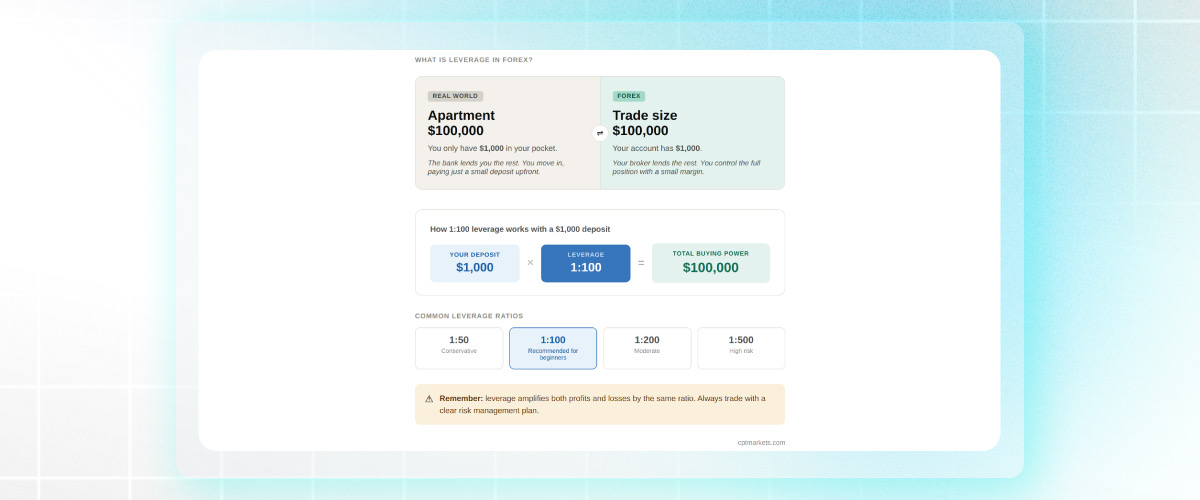
Think of it this way, you want to rent an apartment worth $100,000, but you only have $1,000 in your pocket. The bank agrees to lend you the rest, so you still get to move in while only putting down a small amount upfront. Forex leverage works in a very similar way.
Forex leverage is capital that your broker lends you to increase your buying power in the market, beyond what your actual account balance would allow. Leverage ratios are usually written as 1:50, 1:100, 1:500, and so on.
For a simplified mathematical example, a $100,000 position at 1:100 leverage requires $1,000 in margin. This is an illustration, not a recommendation or a statement of CPT Markets’ current trading conditions. The numerical examples below do not include all trading costs, and applicable leverage and margin requirements must be checked in the relevant account documentation.
Sounds exciting, right? But before you get carried away by the big numbers, there is one thing you need to keep in mind: both profits and losses are amplified by the same ratio. That is exactly why understanding how leverage works is the first thing you need to do before placing a single trade, and that is what we will cover next.
Let’s look at a real example using one of the most traded pairs, GBPUSD:
- No leverage: To open 1 standard lot (100,000 units), you would need to put up around $130,000 of your own money.
- With 1:100 leverage: You only need $1,300 as margin to control that same position.
- With 1:500 leverage: The required margin drops all the way down to $260.
This is why Forex is so accessible, even if you are starting with just a few hundred dollars, you can still participate in the market with meaningful position sizes.
That said, with 1:100 leverage, if the market moves just 1% against you, your entire margin can be wiped out. That is why choosing the right leverage level matters so much, and we will get into the specifics of that in the section below.
The Real Benefits of Using Leverage
When used the right way, leverage opens up some genuine advantages for traders, especially for beginners who are starting with limited capital.
· Significantly higher profit potential: With a $1,000 account and 1:100 leverage, a 1% move in the right direction could earn you $1,000 back, which is 100% of your starting capital from a single trade. That kind of return simply is not possible without leverage.
· More efficient use of your capital: Instead of tying up all your money in one position, leverage lets you allocate smaller amounts of margin across multiple trades at the same time. This helps you diversify your portfolio, reduce concentrated risk, and take advantage of more opportunities across different currency pairs.
· A low barrier to entry: This is probably the benefit beginners appreciate most. Before leverage became widely available, Forex was essentially a game reserved for large financial institutions. Today, at CPT Markets, you can open a real trading account and access global currency markets with as little as $50 to $100.
· Competitive trading costs: No collateral required, no bank loans, no high interest rates. The only cost you need to be aware of with leverage is the swap fee, which is a small overnight charge if you keep a position open past the daily rollover. For day traders who close everything before the end of the session, this cost is basically zero.
Leverage is clearly a powerful tool, but powerful does not mean risk-free. The next section covers the side of leverage that most beginners do not pay enough attention to.
The Risks of Leverage: What Beginners Often Overlook
Most beginner traders do not blow their accounts because the market is too hard. They do it because they did not fully understand the risks that come with leverage. Here are the most common traps.
· Losses are amplified just as much as profits: This is the truth that a lot of new traders prefer not to think about. Leverage does not care whether you are winning or losing; it multiplies both by the same amount. A small move in the wrong direction can wipe out your account in minutes if you do not have a Stop Loss in place.
· The “free money” psychological trap: When your $1,000 account suddenly has $100,000 in buying power, your brain can easily trick you into thinking you are managing a massive amount of capital. This leads to oversized positions, poor volume control, and ultimately blowing up the account faster than most beginners expect.
· Recovering from losses is harder than you think: A lot of people figure that if they use high leverage to lose money, they can just use high leverage to win it back quickly. It does not work like that. If you lose 50% of your account, you need a 100% gain on what is left just to break even. And because your buying power shrinks alongside your balance, you are forced to trade smaller volumes, which makes recovery even slower. It becomes a cycle that is very difficult to escape.
· Swap fees add up over time: If you prefer holding trades for days or weeks, the overnight swap fee gets automatically deducted from your account every day. With large position sizes and high leverage, this can eat into your overall profitability more than you might realize.
Understanding these risks is not meant to scare you off. It is meant to help you prepare properly. And the most important part of that preparation is choosing the right leverage level from day one.
How Much Leverage Should a Beginner Use in Forex?
There is no universally appropriate leverage ratio for every beginner. A more useful starting point is to understand position size, potential loss, margin requirements and effective leverage.
The maximum leverage available on an account is different from the effective leverage created by the positions actually opened. For educational purposes, effective leverage can be calculated as total market exposure divided by account equity.
Before trading, review the applicable product documentation, margin requirements, trading costs, close-out procedures and risk protections. Do not assume that a particular ratio is suitable solely because of your account balance.
Source: CPT Markets Academy: Forex Leverage Explained.
Key Terms You Need to Know Before Using Leverage
Leveraged trading comes with its own set of terminology. Do not skip this part because understanding these concepts will save you from a lot of confusing situations, like wondering why your trade closed on its own.
- Margin: The amount of money “locked” in your account as collateral when you open a position.
- Free Margin: The remaining capital in your account that you can use to open new trades or absorb market fluctuations. This is the number you want to keep an eye on at all times.
- Margin Level: The ratio between your Equity and your used Margin. The higher this number, the healthier your account is.
- Margin Call: A warning from your broker that your account is getting close to a dangerous threshold. When this happens, you either need to deposit more funds or close some positions right away.
- Stop Out: Insufficient funds to meet margin requirements may result in open positions being closed. Check the exact close-out rules for the applicable CPT Markets entity and account. Initial margin is not automatically the maximum possible loss; losses may exceed the initial deposit depending on the product, account terms, legal entity, jurisdiction and applicable client protections.
Once you are comfortable with these terms, the next step is building good trading habits from the start. That is exactly what the final section covers.
Explore account information
Review account details, terms, and risks on the official CPT website.
Safe Trading Practices When Using Leverage
No matter what leverage ratio you choose, these principles will act as a safety net for your account over the long run.
1. Never risk more than 1 to 2% of your account on a single trade. It sounds like a small amount, but this is the golden rule that most professional traders stick to. With this rule in place, even if you hit 10 losing trades in a row, the bulk of your account is still intact and you can keep going.
2. Always set a Stop Loss before you enter a trade. There is no such thing as a guaranteed win in trading, not even for the most experienced professionals. A Stop Loss is what keeps a small losing trade from turning into a catastrophe for your entire account.
3. Do not open too many positions at the same time. The combined risk from multiple open trades can quickly exceed what you can realistically manage, especially during periods of high market volatility.
4. Start with a demo account. At CPT Markets, you can practice completely free on a demo account that mirrors real market conditions. It is the best way to see firsthand how leverage affects your account before you put any real money on the line.
5. Keep a trading journal. Write down your reason for entering each trade, the outcome, and even how you were feeling at the time. This habit helps you spot repeated mistakes and sharpen your strategy over time. It is honestly one of the things that separates traders who improve from those who keep making the same errors.
Why Trade with Leverage at CPT Markets?
CPT Markets is built for both beginners and experienced traders, with a transparent trading environment, competitive conditions, and support that actually helps.
- Flexible leverage options: adjustable to match your experience level and trading strategy.
- Applicable client protections: whether losses can exceed your initial deposit depends on the product, account terms, legal entity, jurisdiction and protections that apply. Review the relevant risk disclosure before trading.
- Tight spreads and low trading fees: so your cost per trade stays competitive from the very first position you open.
- Stable and fast execution: even during high-impact news events when markets move quickly.
- Free demo account and educational resources: giving you the foundation you need before trading with real money.
Final Thoughts
Forex leverage is not something to be afraid of. It is a tool that gives you access to larger markets with smaller capital, improves how efficiently you can use your funds, and increases your profit potential. At the same time, it amplifies risk by the same ratio, and that is something you always need to keep in mind.
If you are just getting started, understand position size, potential loss, margin requirements and effective leverage before trading. There is no single ratio appropriate for every beginner. Review the applicable product documentation and risk disclosures rather than treating the highest available leverage as a target.
Smart trading does not start with finding the highest leverage available. It starts with understanding what you are doing and why. CPT Markets is here to support you every step of the way.
⚠️ Risk Warning: Forex trading with leverage carries a high level of risk and may not be suitable for all investors. Please make sure you fully understand the risks involved before you start trading.
FAQs
1. What is a good leverage in forex?
There is no universally appropriate leverage ratio for every trader or strategy. Consider position size, potential loss, margin requirements and effective leverage, and review the applicable product documentation and risk disclosures.
Higher leverage is not inherently better. It permits greater exposure with less margin, but larger positions relative to account equity make the account more sensitive to small price movements.
2. What is a 1:500 leverage in forex?
A 1:500 leverage means you can control $500 in the market for every $1 of your own capital. For example, with a $100 account, you can open positions worth up to $50,000.
While this significantly increases your buying power, it also means that even small market movements can have a much larger impact on your account balance. Proper position sizing and stop-loss orders are essential when trading with high leverage.
3. What leverage is good for $10?
A $10 account balance does not determine a suitable leverage ratio. Check the applicable margin requirements, position size, trading costs and potential loss rather than assuming that high leverage makes a trade appropriate.
Instead of focusing on the highest leverage available, prioritize trading the smallest lot size possible and limit your risk to a small percentage of your account on each trade. This helps reduce the chance of losing your capital quickly.
4. What does a 1/1000 leverage mean?
A 1:1000 leverage means that every $1 in your account can control up to $1,000 worth of currency. For example, a trader with $100 could open positions worth up to $100,000. This level of leverage offers maximum market exposure with minimal margin requirements, but it also carries substantial risk. A relatively small price movement against your position can lead to significant losses if risk is not carefully managed.
5. What is the best leverage for $100 in forex?
There is no single “best” leverage for a $100 forex account. The right choice depends on your trading experience and risk management. Regardless of the leverage you choose, using appropriate position sizes, setting stop-loss orders, and risking only a small portion of your account per trade are far more important than selecting the highest leverage available.
Explore account information
Review account details, terms, and risks on the official CPT website.
Related articles
- Forex essentials
Base Currency vs Quote Currency: How Forex Pairs Are Read
A currency pair shows the value of one currency relative to another. The base currency is the first currency in the pair, while the quote currency is the second. The exchange rate tells you how many units of the quote currency are needed to buy one u
12 min read · estimated↗ - Trading essentials
What Is a Trader? Types, Skills, and How Trading Works
A trader is an individual who buys and sells financial instruments or takes positions in financial products to seek profits from changes in market prices. Traders operate across markets such as foreign exchange (forex), shares, indices, commodities,
13 min read · estimated↗ - Digital assets
What Is Litecoin (LTC)? How It Works, Uses, and Risks
Litecoin (LTC) is a decentralised cryptocurrency designed to enable peer-to-peer transactions without requiring a central authority to process them. Launched in 2011, it uses a public blockchain and a proof-of-work consensus mechanism to record trans
12 min read · estimated↗