
Forex essentials
What Is Forex Trading? A Beginner's Guide to Forex

Forex trading is the buying and selling of currencies based on changes in their relative value. Currencies are traded in pairs, such as EUR/USD, because one currency is always valued against another. The forex market is used by banks, businesses and investors worldwide, while retail traders may also take positions on currency price movements.
The term forex is short for foreign exchange. At its broadest level, the foreign exchange market helps individuals, companies and financial institutions exchange one currency for another.
For example, a business may need to convert pounds into US dollars to pay an overseas supplier. Meanwhile, an investor or trader may take a position based on whether they expect one currency to strengthen or weaken against another. However, forex trading involves significant risk and losses are possible.
According to the Bank for International Settlements (BIS), global foreign exchange trading averaged approximately $9.5 trillion per day in April 2025, up 27% from 2022. That figure highlights the scale of the global currency market, although the forex market includes many different participants and transaction types beyond retail trading.
How Does Forex Trading Work?
Forex trading centres on the relationship between two currencies. These relationships are shown through currency pairs. One of the most widely recognised examples is:
EUR/USD – This pair compares the euro with the US dollar.
The first currency is called the base currency, while the second is the quote currency.
|
Currency pair |
Base currency |
Quote currency |
|
EUR/USD |
Euro (EUR) |
US dollar (USD) |
|
GBP/USD |
British pound (GBP) |
US dollar (USD) |
|
USD/JPY |
US dollar (USD) |
Japanese yen (JPY) |
An exchange rate shows how much of the quote currency is needed relative to one unit of the base currency.
For instance, if EUR/USD is quoted at 1.1000, this means one euro is worth 1.10 US dollars.
Exchange rates change constantly as market participants respond to economic data, interest-rate expectations, political developments and other factors affecting supply and demand.
Forex trading can also involve costs that vary depending on the product and provider. One common cost is the bid-ask spread, which is the difference between the price at which a currency pair can be bought and sold. Other applicable costs may also vary depending on the relevant product and trading terms.
What Does Buying and Selling a Currency Pair Mean?
When trading forex, taking a position involves having a view on how one currency may move relative to another.
Buying a currency pair
Buying EUR/USD generally reflects the expectation that the euro may strengthen against the US dollar, or that the US dollar may weaken against the euro.
Selling a currency pair
Selling EUR/USD generally reflects the opposite view: that the euro may weaken against the US dollar, or that the US dollar may strengthen against the euro.
However, market expectations can be wrong. If the exchange rate moves against a position, the trade can result in a loss.
Hypothetical example: A trader buys a currency pair because they expect its price to rise. If the market subsequently moves higher, the position may benefit. However, if the price falls instead, the position may incur a loss.
This two-sided nature of forex trading is an important concept for beginners. Understanding whether a position is long or short is only the starting point; traders also need to understand position size, risk and how quickly currency prices can change.
What Are Currency Pairs?
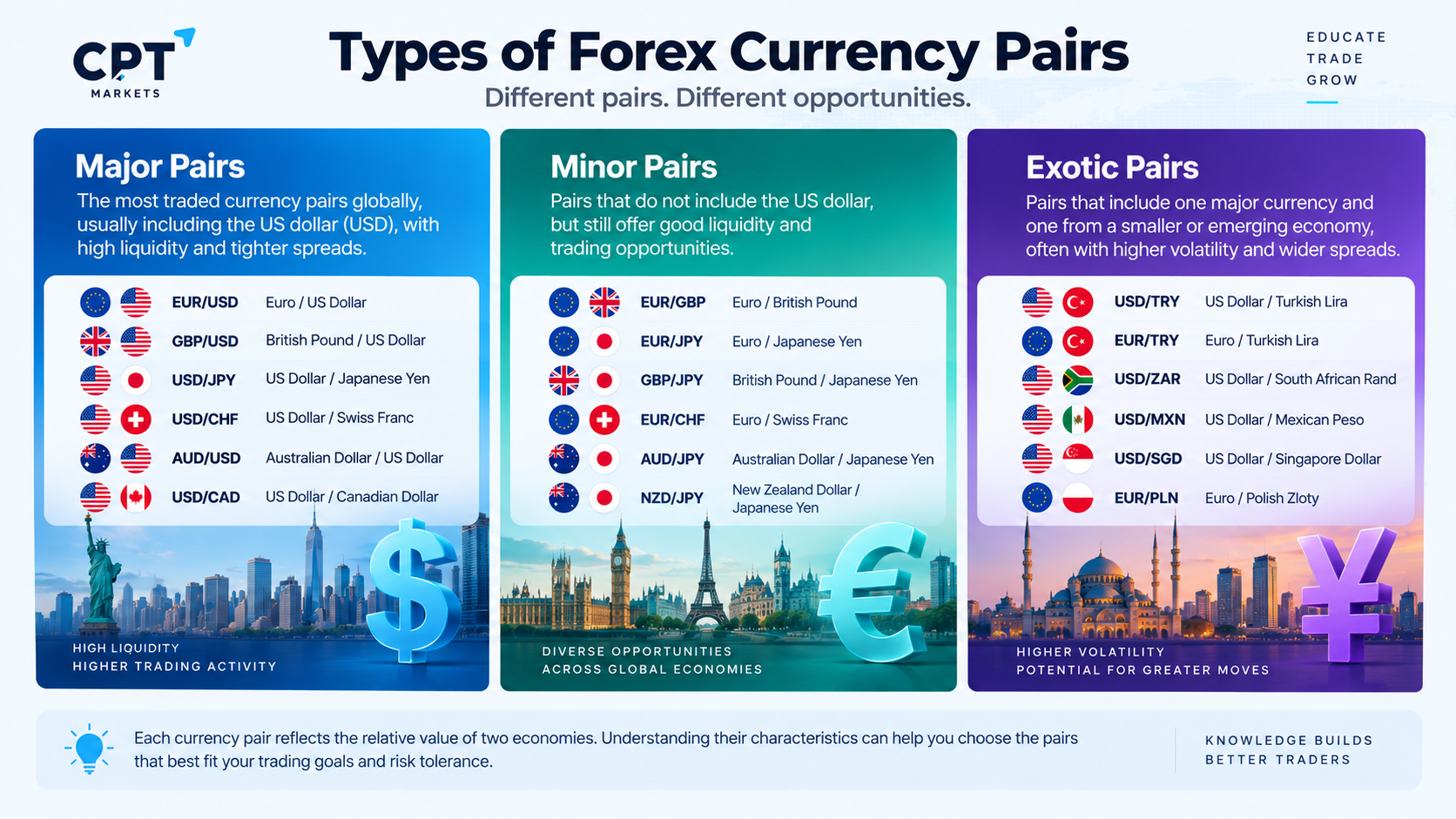
Currency pairs are often grouped into broad categories.
Major currency pairs
Major pairs generally involve the US dollar and another widely traded currency.
Examples include:
- EUR/USD
- GBP/USD
- USD/JPY
- USD/CHF
Minor or cross currency pairs
Minor, or cross, pairs generally involve major currencies without the US dollar.
Examples include:
- EUR/GBP
- EUR/JPY
- GBP/JPY
Exotic currency pairs
Exotic currency pairs generally combine a major currency with the currency of a smaller or emerging economy. They can have different market characteristics from major and minor pairs and may experience lower liquidity or wider price movements under certain market conditions.
Examples may include:
- USD/TRY
- USD/MXN
- EUR/TRY
For beginners, it is useful to remember that each currency pair has its own price behaviour and can respond differently to economic and political developments.
Before learning more advanced trading concepts, it can also help to understand how trade size is measured. CPT Markets Academy provides a guide to understanding forex lot sizes and their role in determining the size of a trading position.
What Makes Exchange Rates Move?
Currency values are influenced by a combination of economic, financial and political factors. Markets also respond to expectations, meaning that the outcome of an event can matter differently depending on what investors had already anticipated. Some of the main influences include:
1. Interest rates and monetary policy
Central bank decisions can affect how investors view a currency. Changes in interest rates, as well as expectations about future monetary policy, are therefore closely watched in forex markets.
2. Inflation and economic data
Inflation reports, employment figures, economic growth and other data can influence expectations about a country’s economy and monetary policy.
3. Political and geopolitical developments
Elections, trade policy, geopolitical tensions and other major developments can also affect market sentiment and currency prices.
4. Market sentiment
At times, currencies can move because investors are becoming more willing, or less willing, to take financial risk. As a result, broader market conditions can influence exchange rates even when no major domestic economic data has been released.
No single factor determines currency prices all the time. Instead, forex markets reflect the interaction of many different expectations and market participants.
Who Uses the Forex Market?
The forex market is much broader than retail trading.
Participants can include:
- Central banks
- Commercial and investment banks
- Governments
- Multinational companies
- Institutional investors
- Other financial institutions
- Individual traders
Businesses may use foreign exchange markets to manage currency exposure created by international trade. Financial institutions may trade currencies for clients or manage their own exposures. Meanwhile, central banks can participate in currency markets as part of broader monetary or foreign exchange operations.
Retail traders represent only one part of this wider market.
The BIS survey provides one of the most comprehensive views of global OTC foreign exchange activity and shows the significant role played by financial institutions and dealers in global FX trading.
Explore account information
Review account details, terms, and risks on the official CPT website.
When Is the Forex Market Open?
The global forex market operates across major financial centres in different time zones.
As one major market session becomes less active, trading activity may continue elsewhere. This creates a market that generally operates around the clock during the working week.
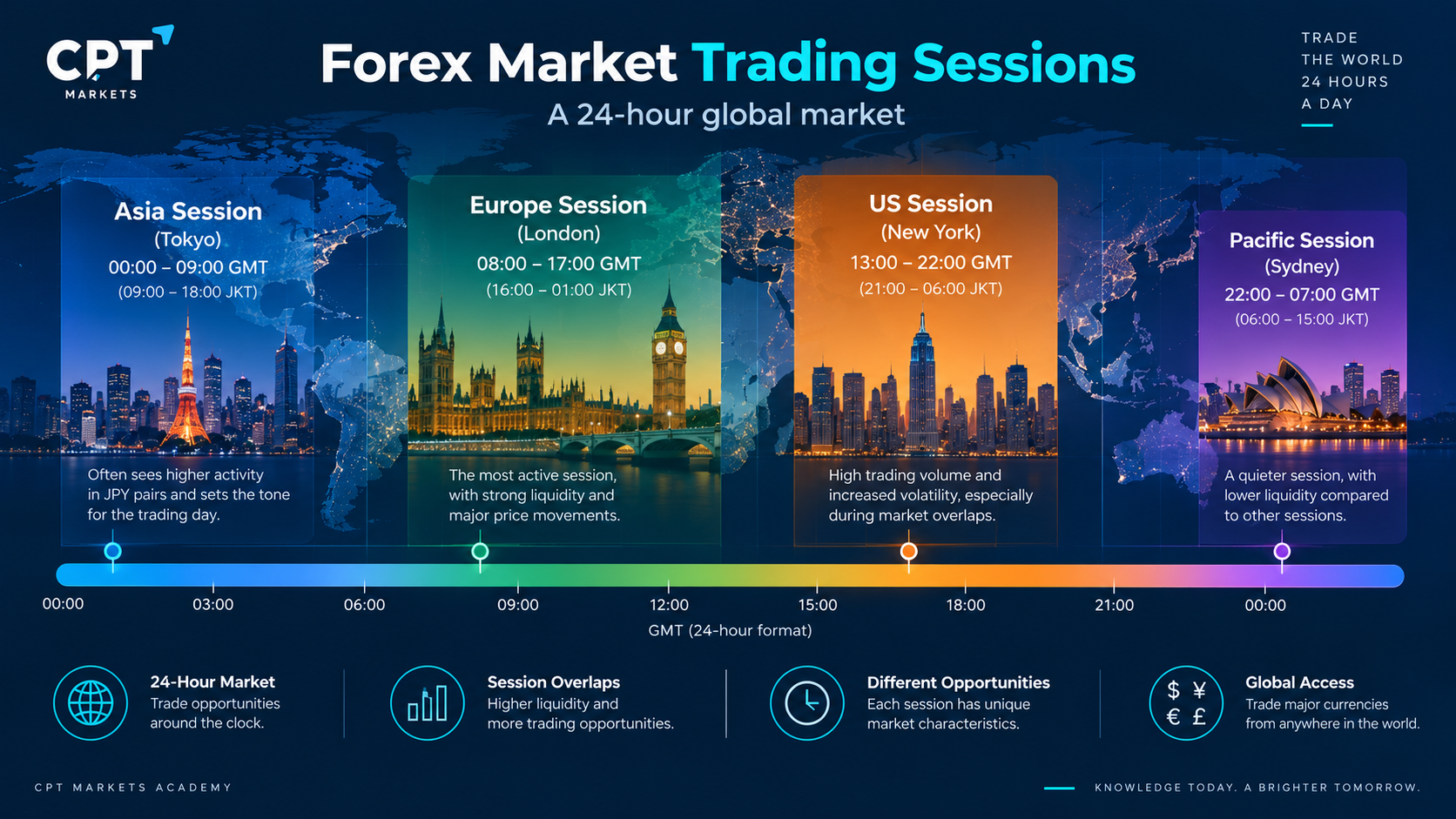
Major Forex Trading Sessions – Session times may vary depending on daylight saving time.
Trading hours can vary depending on the instrument, provider and market conditions. Therefore, traders should check the specific trading hours and product terms that apply to them rather than assuming that every forex product is available continuously.
Different trading sessions can also see different levels of market activity. For that reason, the time of day may influence market conditions, although it does not determine whether a particular trade will be profitable or unprofitable.
What Are the Main Risks of Forex Trading?
Forex trading can offer access to a global market, but it also involves significant risk.
Market risk
Exchange rates can move quickly and unpredictably. Economic releases, central bank decisions and unexpected political developments can all lead to sharp price movements.
Leverage and margin risk
Some forex trading products use leverage or margin. Where leverage is available, it can increase exposure to market movements, which means it can magnify losses as well as potential gains.
The specific leverage available can vary by product, entity and jurisdiction. Traders should therefore check the relevant product documentation and terms rather than relying on general assumptions.
Volatility risk
Periods of heightened market volatility can lead to larger and faster price movements. As a result, traders may face greater uncertainty during major economic or geopolitical events.
In forex trading, these movements are commonly measured in pips. A pip is a standard unit used to describe small changes in a currency pair’s exchange rate, helping traders measure how far a price has moved.
Risk of inadequate knowledge or planning
Beginners may also take unnecessary risks when they do not fully understand how forex trading works. Common issues can include trading positions that are too large, failing to understand leverage, or entering the market without a clear understanding of potential losses.
Learning about risk does not remove it, but it can help traders make more informed decisions about the markets and products they are considering.
How Can Beginners Start Learning About Forex?
Forex can seem complex at first because many concepts are interconnected. However, beginners can build their understanding step by step.
A practical learning path might include:
- Learn how currency pairs work: Understand the difference between the base and quote currency.
- Understand exchange rates: Learn what causes currency values to change.
- Learn about position size: Understand lots and how position size affects market exposure.
- Study pips and price movements: Learn how changes in a currency pair are commonly measured.
- Understand leverage and margin: Learn how leveraged trading can increase both potential gains and potential losses.
- Focus on risk: Before considering any trading decision, understand the possible downside as well as the potential opportunity.
CPT Markets provides further educational resources through the CPT Markets Academy, where readers can explore additional trading concepts and market topics.
The Bottom Line
Forex trading involves taking positions on the relative value of one currency against another. Currency pairs, exchange rates and changing market expectations are central to understanding how the forex market works.
For beginners, a useful starting point is to focus on the fundamentals: how currency pairs work, what moves exchange rates, how pips measure price movements and how position size can affect market exposure. Understanding these concepts can provide a clearer foundation before exploring more advanced aspects of forex trading.
The forex market is global and highly active, but that does not make trading outcomes predictable. Currency prices can move quickly, and leveraged products can increase financial risk. Therefore, building knowledge before making trading decisions is an important part of developing a responsible approach to the market.
To learn more about currency markets and available forex-related products, readers can explore Forex Trading with CPT Markets.
FAQs
What is forex trading in simple terms?
Forex trading involves taking positions on changes in the relative value of one currency against another. Currencies are quoted in pairs, such as EUR/USD. A trader may buy or sell a pair depending on their view of how the exchange rate could move, although market movements can result in losses.
How does forex trading work?
Forex trading works through currency pairs. The first currency is the base currency, while the second is the quote currency. The exchange rate shows their relative value. Traders can take positions based on whether they expect that relationship to rise or fall, depending on the product and trading method used.
What are the most common currency pairs?
Commonly traded pairs include EUR/USD, GBP/USD and USD/JPY. These pairs involve some of the world’s most widely traded currencies. However, currency pairs can have different market characteristics and may respond differently to economic data, monetary policy and changes in market sentiment.
Is forex trading risky?
Yes. Forex trading involves market risk because exchange rates can move unpredictably. Where leverage is used, it can increase exposure to market movements and magnify losses as well as potential gains. Beginners should understand the relevant product, trading costs and potential risks before considering any trading activity.
Can beginners learn forex trading?
Yes. Beginners can start by learning the fundamentals, including currency pairs, exchange rates, pips, position sizes and leverage. It is also important to understand risk before moving on to more advanced topics. A strong foundation can help beginners better understand how the market works and the risks involved.
Explore account information
Review account details, terms, and risks on the official CPT website.
Related articles
- Forex essentials
Base Currency vs Quote Currency: How Forex Pairs Are Read
A currency pair shows the value of one currency relative to another. The base currency is the first currency in the pair, while the quote currency is the second. The exchange rate tells you how many units of the quote currency are needed to buy one u
12 min read · estimated↗ - Trading essentials
What Is a Trader? Types, Skills, and How Trading Works
A trader is an individual who buys and sells financial instruments or takes positions in financial products to seek profits from changes in market prices. Traders operate across markets such as foreign exchange (forex), shares, indices, commodities,
13 min read · estimated↗ - Digital assets
What Is Litecoin (LTC)? How It Works, Uses, and Risks
Litecoin (LTC) is a decentralised cryptocurrency designed to enable peer-to-peer transactions without requiring a central authority to process them. Launched in 2011, it uses a public blockchain and a proof-of-work consensus mechanism to record trans
12 min read · estimated↗