

Risk management
What Is Leverage in Forex? Meaning, Examples & Risks
What is leverage in forex?
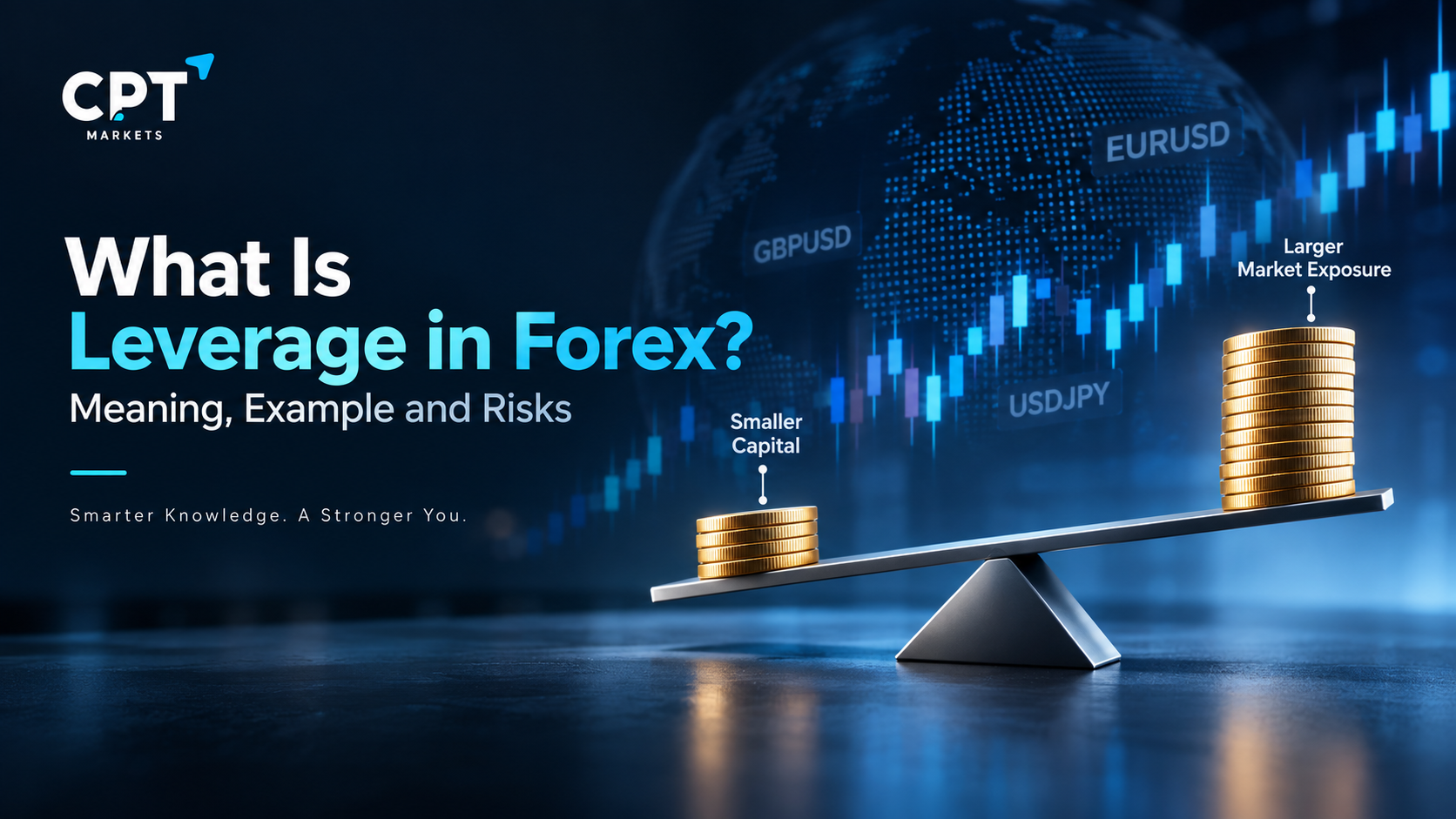
Forex leverage allows a trader to control a larger market position with a smaller amount of capital required as margin.
For example, 1:100 leverage means a hypothetical $1,000 margin could provide exposure of up to $100,000.
However, leverage does not reduce the underlying market risk: profits and losses are calculated from the full position exposure, so relatively small price movements can have a significant effect on account equity.
How does forex leverage work?
Leverage is expressed as a ratio, such as 1:10, 1:50 or 1:100. It shows the relationship between a position’s value and the margin required to open it.
Leverage = Position value ÷ Required margin
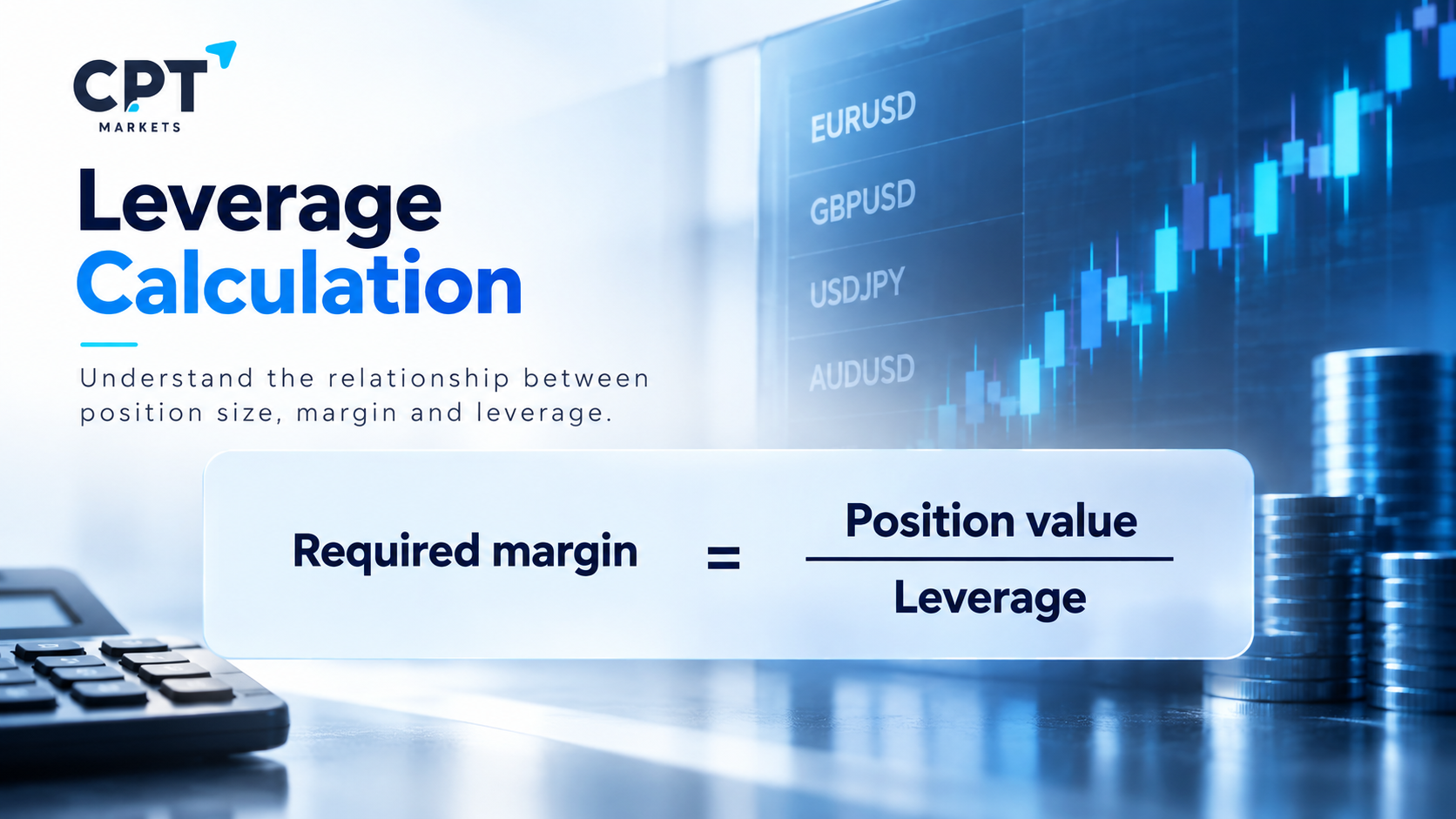
For example, suppose a trader wants to open a hypothetical EUR/USD position with a notional value of $100,000 and the applicable leverage is 1:100.
Required margin = $100,000 ÷ 100 = $1,000
In this simplified example, $1,000 of margin provides exposure to a $100,000 position.
Importantly, the $1,000 is not the maximum amount the trader can lose simply because it is the margin. The position remains exposed to movements in the full $100,000 notional value. Consequently, an adverse price movement can reduce account equity quickly.
Actual margin requirements can also vary according to the trading product, account, position size, applicable entity, jurisdiction and other conditions. Traders should therefore check the specific contract and account terms before opening a position.
What is the difference between leverage and margin?
Leverage and margin describe two sides of the same mechanism.
Leverage describes how much market exposure can be controlled relative to the capital required as margin. Margin is the amount of capital required to open and maintain a leveraged position.
Consider the following simplified examples:
|
Leverage |
Hypothetical position value |
Approx. required margin |
|
1:10 |
$100,000 |
$10,000 |
|
1:50 |
$100,000 |
$2,000 |
|
1:100 |
$100,000 |
$1,000 |
|
1:200 |
$100,000 |
$500 |
These figures are mathematical examples rather than a statement of CPT Markets’ current trading conditions.
As leverage increases, the margin required to establish the same position decreases. However, the underlying exposure does not automatically become smaller. Therefore, higher leverage can make it easier to take a position that is large relative to the account.
Understanding the relationship between leverage and margin makes it easier to see how the same position can require different amounts of capital.
Forex Leverage Example: How Gains and Losses Are Magnified
Consider a hypothetical trader with $5,000 in account equity who opens a $100,000 EUR/USD position using 1:50 leverage. The simplified margin requirement would be $2,000.
The simplified margin calculation is:
$100,000 ÷ 50 = $2,000
In this example, $2,000 of the trader’s $5,000 account equity is used as the illustrative margin requirement. If EUR/USD moves against the position, the account’s equity falls as the unrealised loss increases.
For illustration, a 1% adverse movement in the $100,000 position would represent a hypothetical $1,000 loss, before spreads, commissions, financing or other applicable costs.
The same calculation works in the other direction: a favourable 1% movement would produce a hypothetical $1,000 gain before costs.
This example also shows why leverage affects both sides of a trade, not just its potential return.
Does leverage increase forex profits?
Leverage can increase the potential return on the capital committed as margin because it allows a trader to control a larger position. However, it also increases the effect of adverse price movements on the trader’s capital.
For example, suppose a trader commits $1,000 of margin to a hypothetical $100,000 position. A 0.5% favourable movement would represent a $500 gain before trading costs, while a 0.5% adverse movement would represent a $500 loss.
Therefore, leverage does not create a separate source of profit. The underlying market movement determines the gain or loss, while leverage determines how large that exposure is relative to the capital committed.
The same relationship becomes particularly important when considering the risks of leveraged trading.
Explore account information
Review account details, terms, and risks on the official CPT website.
What are the risks of forex leverage?

Leverage can make relatively small market movements financially significant. Consequently, understanding the risks is at least as important as understanding the potential benefits.
Larger losses from small price movements
A leveraged position provides greater market exposure relative to the capital used as margin. As a result, an adverse market movement can have a larger effect on account equity than a smaller position funded with the same amount of capital.
The precise impact depends on the position size, currency pair, account equity, leverage, entry price and other trading costs.
Margin requirements can become important quickly
When an open position moves against a trader, available equity can decline. If the account no longer meets the applicable margin requirements, the broker may require additional funds or close positions according to its terms.
CPT Markets’ published risk disclosures state that insufficient funds to meet margin requirements may result in open positions being closed. The exact margin and close-out rules should be checked against the applicable CPT Markets entity and account documentation before trading.
Higher leverage can encourage oversized positions
A high leverage limit does not mean that a trader should use the maximum available exposure.
For example, if a platform permits a trader to control a large position with relatively little margin, that can make the position appear affordable even though the potential loss remains linked to the full exposure.
Position size should therefore be considered separately from the maximum leverage available.
Market volatility can increase the impact
Currency prices can move quickly around economic releases, central-bank decisions, geopolitical developments and other market events.
During volatile conditions, a leveraged position can experience larger unrealised gains or losses over a short period. Execution conditions and trading costs can also vary, depending on the product and market environment.
Losses may exceed the initial margin
Initial margin should not automatically be treated as the maximum possible loss. Whether losses can exceed the initial deposit depends on the product, account terms, legal entity and applicable client protections.
Accordingly, traders should read the applicable risk disclosure and account terms rather than assuming that a particular protection applies to every CPT Markets client.
Is higher forex leverage better?
Not necessarily. Higher leverage provides greater potential exposure with a smaller margin requirement, but it also makes it easier to take positions that are large relative to account equity.
Using higher leverage does not make it more likely that a trader will correctly predict whether EUR/USD will rise or fall. The difference is primarily in how much exposure can be taken relative to the capital required.
For educational purposes, it is also useful to distinguish between available leverage and effective leverage. A simplified way to calculate effective leverage is:
Effective leverage = Total market exposure ÷ Account equity
For example, a trader with $2,000 in equity who holds $20,000 of market exposure has effective leverage of:
$20,000 ÷ $2,000 = 10:1
Even if the trading account technically permits much higher maximum leverage, the trader’s actual exposure is 10 times account equity.
This distinction is important because risk management depends on the position actually taken, not simply on the maximum leverage displayed by the account.
How to use leverage more responsibly
There is no single leverage ratio that is appropriate for every trader or strategy. A more useful approach is to understand how the position, margin and potential market movement work together before entering a leveraged trade.

A practical way to assess a leveraged position is to:
- Understand the product:
Start by identifying the instrument and the terms that apply to it. - Check the applicable leverage and margin requirements:
These can vary by entity, jurisdiction, instrument and account type. - Calculate the potential loss:
Think about how the position would affect account equity if the market moved against it. - Consider position size separately from available leverage:
The fact that a platform permits a particular position does not mean that the position is appropriate for the account. - Allow for trading costs:
Spreads, commissions, financing or other applicable charges can affect the final result. - Understand margin and close-out rules:
Know what happens if account equity falls below the relevant requirements. - Review the risk disclosure:
Product-specific protections and restrictions can vary by jurisdiction and legal entity.
For beginners, a demo trading account can provide a practical way to explore how margin, position size and price movements interact before considering live trading. However, simulated trading does not remove the financial risks associated with real-money trading.
Key takeaways
Forex leverage allows traders to obtain larger market exposure relative to the margin required to open a position. While this reduces the amount of margin required for a given position size, it also increases the effect of market movements on account equity.
The most important distinction is between maximum available leverage and actual exposure. A high leverage limit does not require a trader to take a large position, and using more leverage does not make a trade more likely to succeed.
Before using leveraged forex products, understand the applicable margin requirements, position size, trading costs, close-out procedures and risk protections. Most importantly, treat leverage as a mechanism for managing market exposure—not as a shortcut to higher returns.
FAQs
1. What is leverage in forex?
Forex leverage allows a trader to control a larger market position using a smaller amount of capital as margin. It is commonly expressed as a ratio, such as 1:50 or 1:100. For example, 1:100 leverage means a hypothetical $1,000 margin could provide $100,000 of market exposure. However, losses are also calculated against the larger position exposure.
2. How is forex leverage calculated?
Forex leverage is calculated by dividing the total position value by the required margin. The formula is Leverage = Position value ÷ Margin. For example, a hypothetical $100,000 position requiring $2,000 of margin represents 50:1 leverage. Actual margin requirements can vary by instrument, account, legal entity and jurisdiction.
3. Is higher leverage better for forex trading?
Higher leverage is not inherently better. It allows a trader to obtain greater exposure with less margin, but it can also make account equity more sensitive to relatively small price movements. The maximum leverage available on an account should therefore be distinguished from the effective leverage created by the actual position size.
4. What is the difference between leverage and margin?
Leverage measures the relationship between market exposure and the capital required as margin. Margin is the amount of capital required to open or maintain a leveraged position under the applicable trading terms. In simple terms, higher leverage generally means less margin is required for the same position size, although the underlying market exposure remains unchanged.
5. Can you lose more than your initial margin with forex leverage?
Potentially, depending on the product, account terms, legal entity, jurisdiction and applicable client protections. Initial margin should not automatically be treated as the maximum possible loss. CPT Markets’ general risk disclosure warns that losses can exceed the initial deposit for certain FX and CFD contracts, so traders should review the applicable risk disclosure before trading.
6. What leverage should a beginner use in forex?
There is no universally appropriate leverage ratio for every beginner. A more useful starting point is to understand position size, potential loss, margin requirements and effective leverage. Beginners should also review the applicable product documentation and risk disclosures rather than assuming that the highest available leverage is appropriate.
Explore account information
Review account details, terms, and risks on the official CPT website.
Related articles
- Forex essentials
Base Currency vs Quote Currency: How Forex Pairs Are Read
A currency pair shows the value of one currency relative to another. The base currency is the first currency in the pair, while the quote currency is the second. The exchange rate tells you how many units of the quote currency are needed to buy one u
12 min read · estimated↗ - Trading essentials
What Is a Trader? Types, Skills, and How Trading Works
A trader is an individual who buys and sells financial instruments or takes positions in financial products to seek profits from changes in market prices. Traders operate across markets such as foreign exchange (forex), shares, indices, commodities,
13 min read · estimated↗ - Digital assets
What Is Litecoin (LTC)? How It Works, Uses, and Risks
Litecoin (LTC) is a decentralised cryptocurrency designed to enable peer-to-peer transactions without requiring a central authority to process them. Launched in 2011, it uses a public blockchain and a proof-of-work consensus mechanism to record trans
12 min read · estimated↗