
Risk management
Why Forex Beginners Lose Money: 5 Common Mistakes to Avoid
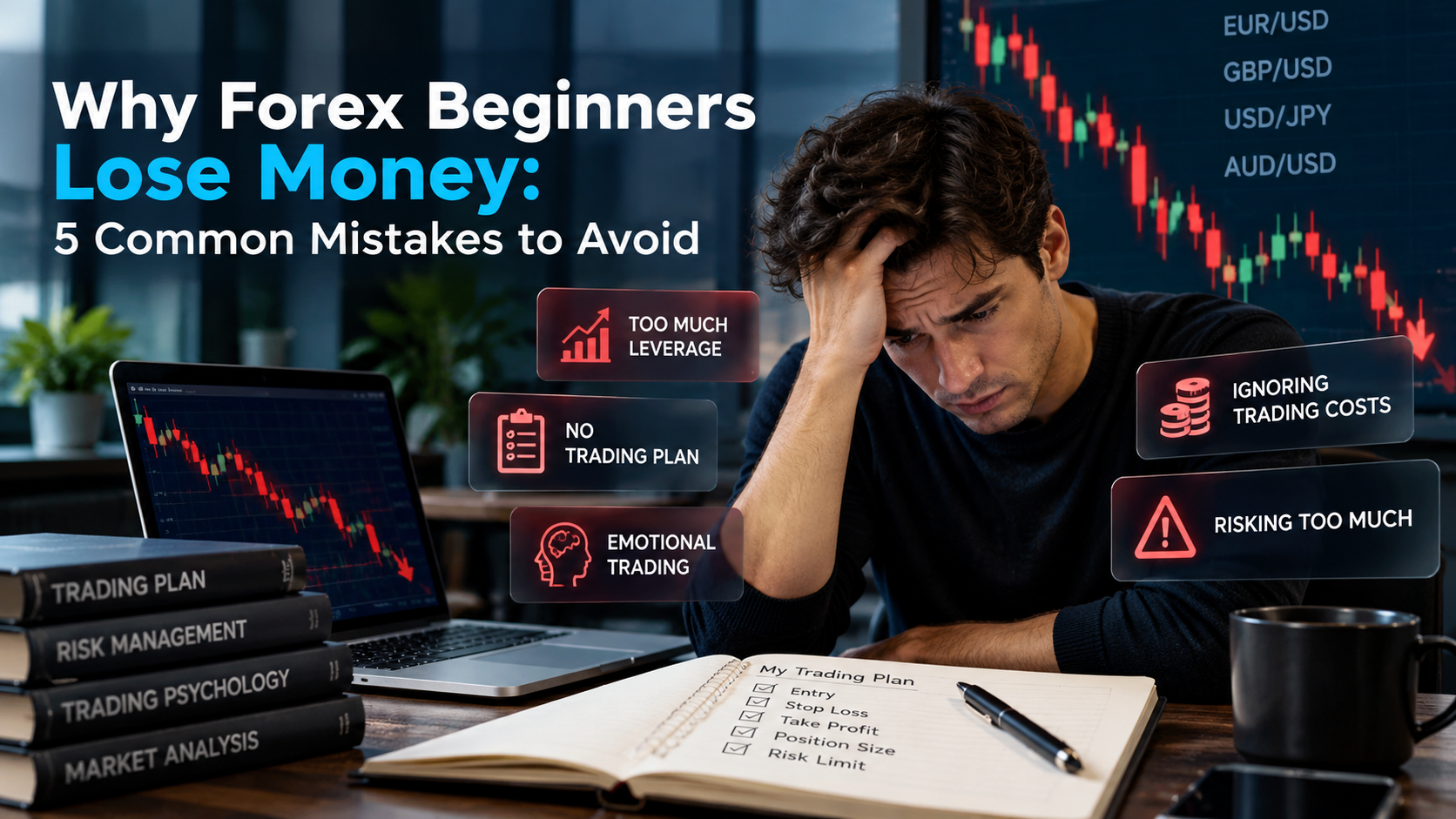
Forex trading involves buying one currency while selling another, with the aim of benefiting from changes in the exchange rate. However, a correct market prediction does not automatically produce a profit. Position size, transaction costs, leverage, and trade management can all affect the outcome.
Forex beginners may lose money because they take excessive risks, trade without a clear plan, react emotionally to price movements, overlook trading costs, or rely on strategies they have not tested. These mistakes can compound when traders use leverage, which magnifies the effect of market movements on account equity. Understanding these risks can help beginners make more informed decisions, although no method can eliminate trading losses.
Why Do Forex Beginners Lose Money?
Learning to interpret currency charts is only one part of forex trading. Beginners also need to understand how orders work, calculate potential losses, and recognise when market conditions differ from their expectations.
For example, a trader might correctly anticipate that EUR/USD will rise but open a position that is too large for their account. If the exchange rate initially moves against the position, the resulting loss could be substantial before the expected move occurs. Trading costs may also reduce the final result.
The US Commodity Futures Trading Commission (CFTC) warns that retail off-exchange forex trading carries significant risks, including leverage-related losses, dealer-related risks, and potential fraud. Its guidance advises prospective customers to research dealers carefully and understand the terms of an account before depositing money. These points describe the US regulatory context and should not be interpreted as a statement about the regulatory status of a provider in another jurisdiction.
Rather than treating every loss as evidence of a bad strategy, beginners should examine the decisions behind each trade. The following five mistakes provide a practical starting point for reviewing trading behaviour.
1. Using Too Much Leverage
Leverage allows traders to control a position with a value greater than the margin they commit. Although it can increase market exposure without requiring the full position value upfront, it also magnifies losses when prices move against a trade.
Consider a hypothetical trader with $1,000 in account equity who opens a position with a notional value of $20,000. The notional exposure is 20 times the account equity, giving an exposure-to-equity ratio of 20:1.
For illustration, assume that an adverse market movement produces a loss equal to 1% of the $20,000 notional position value. Under that simplified assumption, the loss would be $200 before trading costs, equivalent to 20% of the starting account equity.
This calculation illustrates the potential impact of leveraged exposure. It is not a universal forex profit-and-loss formula. Actual results depend on the currency pair, trade direction, contract specifications, price movements, currency conversion, and execution.
How to Avoid This Mistake
· Understand exposure before opening a trade: Calculate the position’s notional value and its relationship to your account equity.
· Set a maximum acceptable loss: Estimate how much you could lose if the trade reaches its planned exit level.
· Avoid using the maximum available leverage by default: Available leverage is not a measure of how much risk a trader should take.
· Check margin requirements: Understand how much margin a position requires and the circumstances in which the provider may close it.
Regulatory requirements vary by jurisdiction and product. For example, the UK Financial Conduct Authority (FCA) imposes leverage restrictions and other measures on certain contracts for difference (CFDs) offered to retail clients, including relevant rolling spot forex products. These requirements should not be assumed to apply to every forex product, provider, or account worldwide.
The central lesson is straightforward: assess the potential loss before considering the potential return.
2. Trading without a Clear Plan
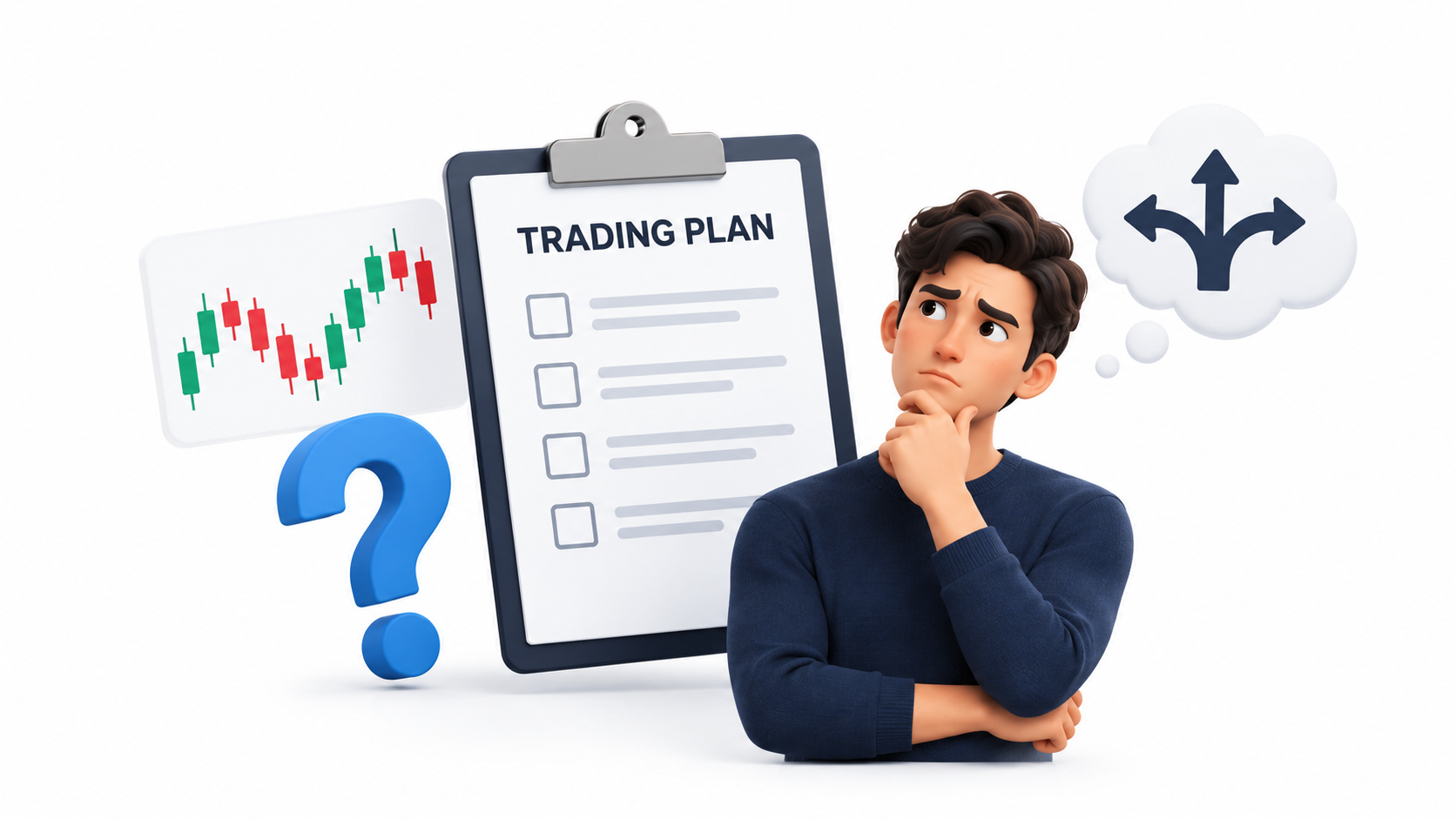
Entering a trade because a currency pair appears to be moving in one direction is not the same as following a defined trading strategy. Without a plan, beginners may change their decisions repeatedly as new candles appear, headlines emerge, or prices approach important levels.
A trading plan establishes the conditions under which a trader will enter, manage, and exit a position. It also helps distinguish a deliberate decision from an impulsive reaction.
A basic plan should address the following questions:
|
Planning Element |
Question to Answer |
|
Market Conditions |
What conditions must be present before entering? |
|
Entry Criteria |
What specific signal or setup justifies the trade? |
|
Exit Conditions |
At what price or under what circumstances will the position close? |
|
Position Size |
How much exposure is appropriate for the planned risk? |
|
Risk Limit |
What is the maximum acceptable loss for the trade? |
|
Review Process |
How will the trader evaluate the decision afterwards? |
These elements do not guarantee a profitable outcome. Instead, they provide a consistent framework for making and reviewing decisions.
How to Avoid This Mistake
Before entering a position, write down the reason for the trade, the planned entry, the level at which the trading idea would no longer be valid, and the intended exit conditions. Then calculate the potential loss using the proposed position size.
If the setup no longer meets the original criteria, reconsider the trade rather than inventing a new justification to enter.
After closing the position, review whether you followed the plan. A losing trade can still reflect disciplined execution, while a profitable trade can result from poor risk management. Evaluating the decision process, rather than profit alone, provides a more useful basis for improvement.
3. Letting Emotions Drive Trading Decisions
Forex markets can move quickly when economic data, central bank announcements, or unexpected events affect currency demand. For beginners, these movements can create pressure to act immediately.
Two common emotional responses are fear of missing out (FOMO) and attempts to recover losses quickly.
FOMO may lead a trader to enter after a currency pair has already made a substantial move. Meanwhile, a trader facing a loss might hold a position beyond its planned exit because they hope the market will reverse. Another trader may increase position size after losing money in an attempt to recover the loss with fewer trades.
These responses can weaken an otherwise sensible trading process. They also make it harder to distinguish evidence-based decisions from emotional reactions.
How to Avoid This Mistake
Use predefined rules to reduce the influence of short-term emotions.
· Wait for the entry conditions in your plan rather than chasing a sudden price movement.
· Set exit rules before opening a position, and avoid widening a stop-loss simply to postpone a loss.
· Establish a daily or weekly risk limit and stop trading when you reach it.
· Keep a trading journal that records the reason for each decision and your emotional state at the time.
· Take a break after an unusually stressful trade instead of immediately opening another position.
A trading journal can help identify recurring patterns, such as entering too early, closing profitable positions too quickly, or increasing exposure after a loss. Over time, this information can support more consistent decision-making.
However, discipline does not make a strategy profitable by itself. A well-controlled strategy can still lose money, particularly when market conditions change or its underlying assumptions prove incorrect.
Explore account information
Review account details, terms, and risks on the official CPT website.
4. Ignoring Trading Costs and Execution Risks
A trade’s outcome depends on more than the direction of the exchange rate. Spreads, applicable commissions, overnight financing charges, and execution differences can all affect the final result.
The spread is the difference between the bid price, at which a trader can sell, and the ask price, at which a trader can buy. A trader opening and closing positions therefore needs to account for the available prices and any other applicable charges.
For example, frequent trading can increase cumulative costs because each transaction may involve a spread and, depending on the account, a commission. Overnight positions may also incur financing charges. Consequently, a strategy that appears profitable before costs may produce a smaller profit or a loss after costs.
Execution introduces additional uncertainty. A stop order may execute at a different price from its trigger level during fast-moving or gapping markets, depending on the order type and execution arrangements. A stop-loss can help define an exit plan, but it does not necessarily guarantee the exact exit price.
The CFTC’s guidance on US off-exchange forex trading highlights transaction costs and dealer-related risks as factors that prospective customers should understand before participating in the market.
How to Avoid This Mistake
Before trading, review the relevant product and account documentation. Check:
· The spread and whether it may vary with market conditions.
· Any applicable commission or other transaction charge.
· Overnight financing or swap charges for positions held beyond the provider’s daily cutoff.
· Minimum trade sizes, contract specifications, and margin requirements.
· How stop orders work and whether slippage may occur.
· The provider’s execution terms and arrangements for handling orders.
Next, include relevant costs in your trading review. Compare the gross trading result with the net result after charges, where the information is available.
This distinction matters particularly for strategies that target small price movements. Even when a market view is correct, costs can materially affect the outcome.
5. Risking Too Much and Failing to Learn From Losses
Some beginners focus on finding winning trades without first deciding how much they can afford to lose on each position. Others assume that a stop-loss order alone makes a trade safe, regardless of position size.
A stop-loss is an order instruction designed to close a position when a specified trigger condition is met. It can help implement a risk-management plan, but it does not eliminate market risk or guarantee an execution price in all circumstances.
Position sizing is therefore essential. It connects the planned loss at the exit level to the quantity traded.
A Hypothetical Position-Sizing Example
Suppose a trader has $2,000 in account equity and sets an illustrative risk budget of 0.5% of equity for one trade.
The calculation is:
Risk budget = $2,000 × 0.005 = $10
The trader then estimates that the planned exit level is 25 pips away from the entry price. Before deciding the position size, they must determine the monetary value of one pip for the specific instrument and position.
For illustration, if each pip is worth $0.40, the estimated price-movement loss at the planned exit would be:
25 × $0.40 = $10
This example excludes spreads, commissions, slippage, and other applicable costs. It also assumes that the trade closes at the planned exit price. Actual losses may differ.
The 0.5% figure is an illustrative assumption, not a universal recommendation or a guarantee of safety. A trader’s appropriate risk limit depends on their circumstances, the product, and the overall trading plan.
How to Avoid This Mistake
· Calculate the potential loss before opening the position.
· Choose position size based on the planned exit and the instrument’s contract specifications.
· Avoid concentrating too much exposure in positions that respond to similar market drivers.
· Keep a record of both winning and losing trades.
· Review whether losses resulted from poor execution, excessive exposure, trading costs, or a strategy that needs further testing.
Importantly, do not increase risk simply because several trades have lost money. A previous loss does not make a profitable next trade more likely.
Learning from losses means identifying what the evidence actually shows. One losing trade does not necessarily invalidate a strategy, just as one winning trade does not prove that it works. A broader sample of consistently recorded results provides a more useful basis for evaluation.
How Beginners Can Build Better Trading Habits

Avoiding these mistakes starts with preparation, but the process should continue after trading begins. Beginners can use a structured routine to check whether their decisions remain consistent with their plan.
1. Learn the Mechanics
Understand currency pairs, pips, lots, margin, leverage, order types, and trading costs before using real money.
2. Practise a Defined Process
Use a Demo Account, where available, to practise order placement and record hypothetical trades without risking real trading capital. Demo results do not fully reproduce the financial and psychological pressures of live trading.
3. Calculate Exposure Before Entry
Check position size, potential loss, margin requirements, and applicable costs before placing an order.
4. Review a Consistent Record
Record entries, exits, costs, and reasons for each trade. Review a meaningful sample of trades rather than drawing conclusions from one result.
Beginners should also check the regulatory status of any provider, understand the terms of the account, and remain sceptical of claims promising guaranteed profits or unusually high returns with little risk. The CFTC advises prospective US forex customers to research dealers and be cautious of fraud-related warning signs.
Final Thoughts
Forex beginners do not need to predict every market move to develop a more disciplined approach. They need to understand the risks they are taking, establish clear trading rules, and evaluate their decisions honestly.
Excessive leverage, an undefined strategy, emotional trading, overlooked costs, and weak risk controls can each undermine trading results. In combination, they can make losses more difficult to manage.
A structured process can help traders identify avoidable mistakes, but it cannot remove uncertainty or ensure profits. Forex trading, particularly when leveraged, can result in the loss of some or all of the capital committed. Beginners should therefore understand the product and its risks before deciding whether to trade.
Frequently Asked Questions
1. Why Do Beginner Forex Traders Lose Money?
Beginners may lose money because they use excessive leverage, trade without a defined strategy, make emotional decisions, or underestimate transaction costs. Poor position sizing can also turn a relatively small price movement into a substantial account loss. These factors can compound, although individual outcomes vary and no single mistake explains every trading loss.
2. How Can Beginners Reduce the Risk of Losing Money in Forex?
Beginners can develop a structured approach by learning how forex products work, calculating potential losses before entering trades, using appropriate position sizes, and accounting for trading costs. A written trading plan and trading journal can help maintain consistency. However, these practices cannot eliminate market risk or guarantee profitable results.
3. Does Leverage Increase the Risk of Forex Trading?
Yes. Leverage increases market exposure relative to the capital committed as margin, so a given price movement can have a larger effect on account equity. It magnifies losses as well as potential gains. The impact depends on position size, price movements, applicable costs, and the account’s contractual and regulatory arrangements.
4. Can a Demo Account Help Forex Beginners?
A demo account can help beginners practise order placement, explore platform features, and test a trading process without risking real trading capital. However, simulated results may differ from live trading because execution conditions, costs, and emotional pressures can vary. A profitable demo result does not establish that a strategy will remain profitable in live markets.
5. Is a Stop-Loss Order Enough to Prevent Large Trading Losses?
No. A stop-loss order can help implement an exit plan, but it does not eliminate risk or necessarily guarantee execution at the specified price. Fast markets, price gaps, and slippage can affect the final outcome. Traders should also consider position size, leverage, margin requirements, and other potential costs when assessing the risk of a position.
6. Should Beginners Trade Forex with Real Money Immediately?
Beginners should first make sure they understand the instrument, its costs, and the risks involved. Demo trading can provide a practical way to learn the mechanics, although it cannot fully reproduce live trading conditions. Whether to proceed with real money is an individual decision, and traders should recognise that they could lose the capital committed.
Explore account information
Review account details, terms, and risks on the official CPT website.
Related articles
- Forex essentials
Base Currency vs Quote Currency: How Forex Pairs Are Read
A currency pair shows the value of one currency relative to another. The base currency is the first currency in the pair, while the quote currency is the second. The exchange rate tells you how many units of the quote currency are needed to buy one u
12 min read · estimated↗ - Trading essentials
What Is a Trader? Types, Skills, and How Trading Works
A trader is an individual who buys and sells financial instruments or takes positions in financial products to seek profits from changes in market prices. Traders operate across markets such as foreign exchange (forex), shares, indices, commodities,
13 min read · estimated↗ - Digital assets
What Is Litecoin (LTC)? How It Works, Uses, and Risks
Litecoin (LTC) is a decentralised cryptocurrency designed to enable peer-to-peer transactions without requiring a central authority to process them. Launched in 2011, it uses a public blockchain and a proof-of-work consensus mechanism to record trans
12 min read · estimated↗