

Trading strategies
Forex Day Trading Strategies for Beginners: 5 Methods Explained

Forex day trading involves opening and closing currency positions within the same trading day to take advantage of short-term price movements. Beginners can learn five common approaches: trend trading, breakout trading, pullback trading, range trading, and momentum trading. Each method uses different market conditions and entry signals, but none guarantees a profit. Understanding position sizing, trading costs, and risk management is essential before applying any strategy to a live account.
Day trading can appear straightforward when reduced to identifying chart patterns and entry signals. However, short-term price movements are uncertain, and frequent trading can increase the effect of spreads, commissions, and execution costs. Therefore, beginners should focus on understanding how a strategy works, when it may be unsuitable, and how much they could lose before considering a trade.
What Is Forex Day Trading?
Forex day trading involves opening and closing a currency position within the same trading day, rather than holding it overnight. Traders attempt to benefit from short-term exchange-rate movements, often using five-minute, 15-minute, or one-hour chart time frames.
For example, a trader analysing EUR/USD might look for a short-term upward trend and consider buying if the price meets a predefined entry condition. The trader would also establish an exit plan, including a level at which the trade thesis would no longer hold.
Unlike swing trading, which may involve holding positions for several days or weeks, day trading generally avoids carrying positions overnight. Nevertheless, closing trades within the day does not eliminate risk. Sudden price movements, spreads, slippage, and trading costs can still affect results.
Before exploring individual strategies, beginners should understand that technical indicators and chart patterns describe historical or current price behaviour. They do not predict future prices with certainty.
5 Forex Day Trading Strategies for Beginners
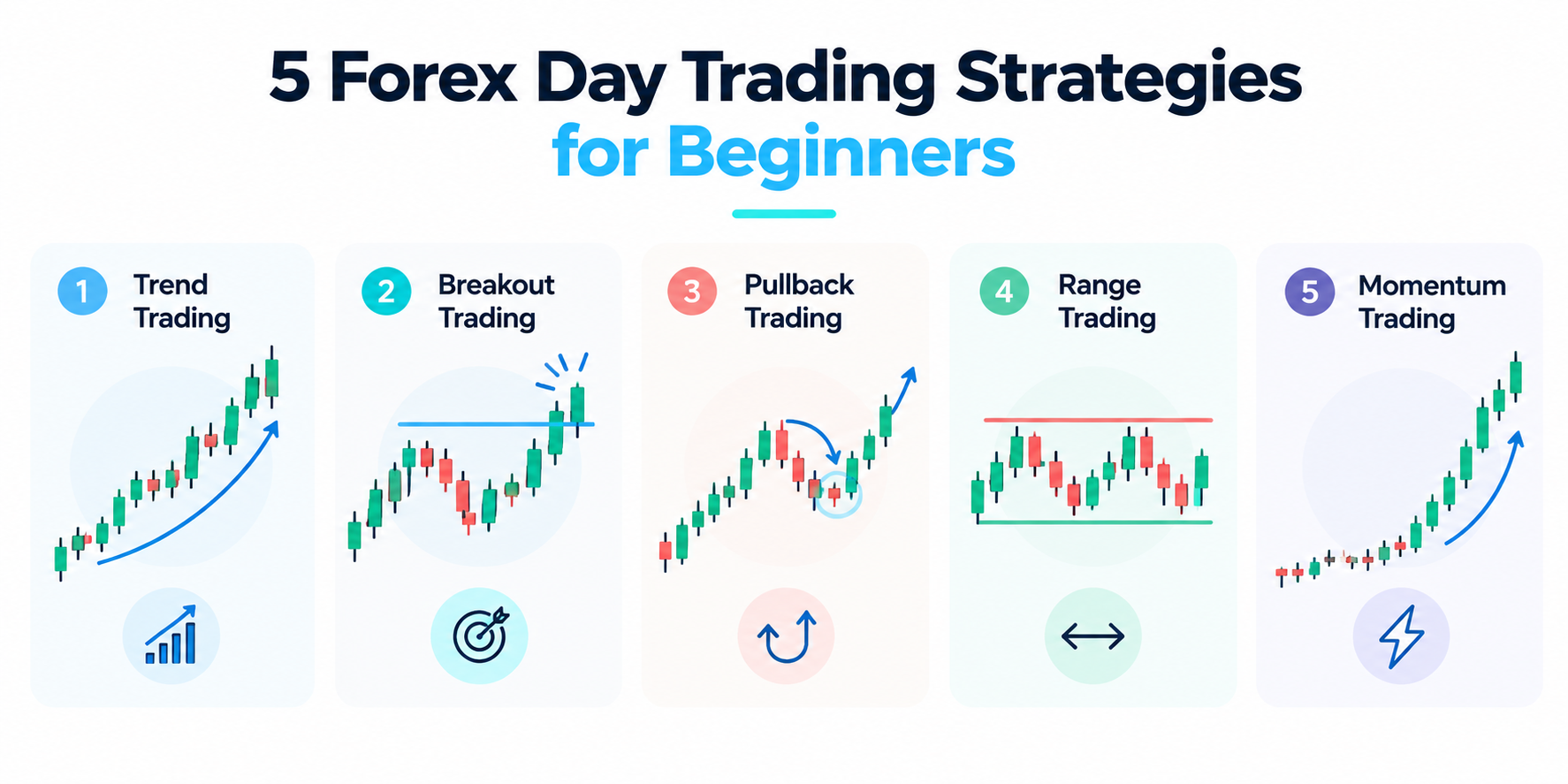
The following methods provide different ways to interpret market behaviour. Rather than combining every indicator or switching strategies after each losing trade, beginners can study one approach at a time and assess its rules using historical data and a demo environment.
1. Trend Trading
Trend trading attempts to identify a market moving consistently in one direction and trade in line with that movement. In an upward trend, prices generally form higher highs and higher lows. Conversely, a downward trend tends to produce lower highs and lower lows.
How It Works:
1. Identify the broader direction using a price chart.
2. Look for evidence that the trend remains intact.
3. Define a potential entry point and the conditions that would invalidate the setup.
4. Set an exit plan before entering a position.
Some traders use moving averages to help identify trends. For instance, a 20-period simple moving average (SMA) calculates the average closing price over the 20 most recent candles on the selected chart. A rising SMA may support the view that prices have been moving upwards, although it does not establish that the trend will continue.
Hypothetical example: The EUR/USD price rises from 1.1000 to 1.1050, forming a series of higher highs and higher lows. A trader waits for a predefined entry signal before considering a long position, with an exit level below a relevant market structure point.
The example illustrates the process, not a forecast. Trends can reverse abruptly, and moving averages often react after prices have already moved.
Main risk: A trend can weaken or reverse, producing a false signal. Beginners should avoid assuming that a market will continue moving in the same direction simply because it has risen or fallen recently.
2. Breakout Trading
Breakout trading focuses on price movements beyond established support or resistance levels.
Support is a price area where buying interest has previously helped limit declines. Resistance is an area where selling interest has previously limited advances. These levels are not fixed barriers, and prices can move through them without continuing in the same direction.
How It Works:
1. Identify a clearly defined trading range or important price level.
2. Wait for the price to move beyond that level.
3. Check whether the breakout meets predefined confirmation criteria.
4. Establish the trade’s invalidation point and exit conditions.
Some traders look for a candle to close beyond support or resistance rather than entering immediately when the price briefly crosses either level. Others examine trading activity or wait for a retest of the broken level. These are alternative confirmation methods, not guarantees of a successful trade.
Hypothetical example: EUR/USD repeatedly encounters resistance near 1.1050. Later, a candle closes above that area. A trader studying breakout methods records the signal and assesses whether the setup meets their rules before considering an entry.
Main risk: False breakouts occur when the price moves beyond a level and then returns to the previous range. Entering too early can expose a trader to a rapid reversal, while entering after a large move may leave less room for the trade to develop.
3. Pullback Trading
Pullback trading looks for a temporary move against an established trend before the trend potentially resumes. It differs from breakout trading because the trader waits for a retracement rather than focusing on the initial move through a price level.
How It Works:
1. Identify a potential upward or downward trend.
2. Wait for the price to move temporarily against that trend.
3. Look for evidence that the pullback may be ending.
4. Define an entry, invalidation level, and exit plan.
Traders may examine previous support or resistance areas, moving averages, or price-action patterns when studying pullbacks. However, a retracement can develop into a complete trend reversal, so the trader needs explicit conditions for abandoning the setup.
Hypothetical example: GBP/USD rises from 1.2700 to 1.2750 before declining to 1.2725. A trader monitoring an upward trend waits for evidence of renewed buying interest rather than automatically buying as soon as the price falls.
The figures illustrate a possible chart sequence, not a recommended entry.
Main risk: What looks like a temporary pullback may signal a weakening trend. Entering before the market shows the conditions required by the strategy can result in a losing position.
4. Range Trading
Range trading attempts to identify periods when a currency pair moves between relatively stable support and resistance areas without a clear directional trend.
During a range, traders may look for potential buying opportunities near support or selling opportunities near resistance. Some use oscillators such as the Relative Strength Index (RSI) to assess recent price momentum.
The RSI typically ranges from 0 to 100. Readings above 70 are often described as overbought, while readings below 30 are considered oversold. However, these readings do not automatically signal that a reversal will occur. Strong trends can remain overbought or oversold for extended periods.
How It Works:
1. Identify a reasonably clear price range.
2. Mark the areas where the price has repeatedly turned.
3. Define the conditions required for a potential entry near one boundary.
4. Plan an exit before the opposite boundary or another predefined level.
5. Reassess the setup if the price breaks out of the range.
Hypothetical example: EUR/USD moves repeatedly between 1.1000 and 1.1050. A trader studying range trading waits for a predefined signal near one boundary instead of entering randomly in the middle of the range.
Main risk: A range can break either upwards or downwards, invalidating the original assumption. In addition, repeated small price movements may not cover trading costs, particularly when entries and exits are frequent.
5. Momentum Trading
Momentum trading attempts to identify strong price movements and enter trades while the momentum persists. Unlike trend trading, which can focus on a broader directional structure, momentum trading often concentrates on the speed and strength of more recent price changes.
Traders may examine candle size, successive price movements, or indicators such as the RSI. They may also monitor scheduled economic releases, although news-driven price movements can be unpredictable.
How It Works:
1. Identify a notable increase in directional price movement.
2. Check whether the move meets predefined momentum criteria.
3. Assess the distance already travelled and the potential exit levels.
4. Enter only if the setup satisfies the strategy’s risk parameters.
5. Close or manage the position according to the original plan.
Hypothetical example: Following an economic announcement, EUR/USD moves sharply upwards. A trader studying momentum waits for the price action to meet predefined criteria and evaluates the remaining potential movement against the risk of a reversal.
Main risk: Momentum can fade quickly. Traders who enter after most of a move has already occurred may face a reversal before the market reaches their intended exit.
Comparing the Five Strategies
|
Strategy |
Market Condition |
Common Analytical Tools |
Main Risk |
|
Trend Trading |
Directional market |
Price structure, moving averages |
Trend reversal |
|
Breakout Trading |
Price moving beyond a defined support or resistance level |
Support and resistance, candle closes |
False breakout |
|
Pullback Trading |
Temporary retracement within a potential trend |
Price structure, moving averages |
Retracement becomes a reversal |
|
Range Trading |
Sideways market |
Support and resistance, RSI |
Range breaks |
|
Momentum Trading |
Strong or accelerating price movement |
Price action, momentum indicators |
Momentum fades |
No strategy is universally suitable for every currency pair or market environment. For example, a range-based approach may struggle when prices begin trending, while a trend-following method may produce repeated false signals in sideways conditions.
Consequently, beginners should learn to identify the conditions a method requires rather than treating its signals as instructions to enter a trade.
Explore account information
Review account details, terms, and risks on the official CPT website.
How Beginners Can Practise a Day Trading Strategy

Learning a strategy involves more than recognising a pattern. Traders also need consistent rules, a method for reviewing decisions, and an understanding of the costs associated with each position.
Step 1: Define the Rules
Write down the market conditions, entry criteria, invalidation point, and exit rules. Avoid vague instructions such as “buy when the chart looks strong”. Instead, establish observable conditions that can be checked consistently.
Step 2: Study Historical Charts
Review historical price data to identify situations that met the strategy’s rules. Record both favourable and unfavourable outcomes, including examples where a seemingly convincing signal failed.
Historical testing has limitations. A strategy that performs well on past data may not work under different market conditions, and excessive adjustments can make the results misleading.
Step 3: Use a Demo Environment
A Demo Account can help beginners practise reading charts, placing orders, and following predefined rules without risking real trading funds. However, simulated trading may not reproduce every aspect of live execution, including the emotional impact of financial losses and the full range of real-market trading conditions.
Step 4: Keep a Trading Journal
Record the currency pair, market conditions, entry rationale, planned exit, outcome, and any deviation from the rules. Over time, this record can help distinguish a poorly executed trade from a weakness in the strategy itself.
Step 5: Review Results After Costs
A strategy should not be assessed solely by the percentage of winning trades. Trading costs, average gains, average losses, and the consistency of execution also affect the overall result.
For related educational material, see the CPT Markets guides to forex trading, pips in forex, and lot size in forex.
Risk Management for Forex Day Trading
A trading strategy identifies potential opportunities, while risk management helps traders manage their exposure to potential losses when a trade does not perform as expected. Even a carefully defined setup can lose money.
· Position sizing: The volume of a position affects how much each price movement changes the account balance. Beginners should understand the relationship between position size, stop-loss distance, and potential loss before placing an order.
· Stop-loss orders: A stop-loss can help define an intended exit if the market moves against a position. Nevertheless, the final execution price may differ from the specified level during price gaps or periods of rapid market movement. A stop-loss does not guarantee a particular maximum loss in every circumstance.
· Leverage and margin: Leverage allows a trader to control a larger position relative to the funds committed. It can magnify losses as well as gains, and margin requirements and protections vary by product, provider, and jurisdiction.
· Trading costs: Spreads, commissions, overnight financing where applicable, and slippage can affect results. Frequent trading makes it particularly important to understand the applicable costs and how they influence a strategy.
· Economic announcements: Interest-rate decisions, inflation releases, and employment data can cause sharp price movements. Beginners should understand the event risk before deciding whether their strategy is appropriate for those conditions.
Forex day trading cannot guarantee income. Beginners should never trade with money they cannot afford to lose or assume that a successful demo result will translate into live profits.
Build Consistency Before Increasing Complexity
Trend, breakout, pullback, range, and momentum trading offer five different frameworks for analysing short-term currency movements. Each depends on particular market conditions, and each can produce losing trades when those conditions change.
For beginners, the priority should be to understand one method, define its rules, practise in a demo environment, and review results with trading costs in mind. Combining several indicators or increasing position size does not automatically improve a strategy.
The objective is not to find a method that wins every time. Instead, it is to understand the conditions behind each trading decision and recognise the financial risks before committing real funds.
Frequently Asked Questions
1. What Is the Best Forex Day Trading Strategy for Beginners?
There is no single best forex day trading strategy for every beginner. Trend trading, breakout trading, pullback trading, range trading, and momentum trading each rely on different market conditions. The appropriate method to study depends on how clearly the trader understands its rules, risks, and limitations. Historical testing and demo practice can help beginners evaluate a strategy without risking real funds.
2. How Much Money Do You Need to Start Forex Day Trading?
There is no universal starting amount. Requirements depend on the trading product, minimum position size, margin rules, account currency, and provider’s terms. However, having enough money to open a position does not mean the position carries an appropriate level of risk. Beginners should review the full trading costs and potential losses before deciding whether to trade.
3. Which Indicators Are Useful for Forex Day Trading?
Commonly studied indicators include moving averages for assessing trends and the Relative Strength Index for examining recent momentum. Traders may also use support and resistance levels, price action, and volatility measures. No indicator predicts price movements with certainty, so beginners should understand what each tool measures and test predefined rules rather than relying on isolated signals.
4. Is Forex Day Trading Risky for Beginners?
Yes. Short-term trading involves uncertain price movements, and leverage can magnify losses relative to the capital committed. Frequent trades can also increase the effect of spreads, commissions, and slippage. A stop-loss may help define an intended exit, but it cannot guarantee execution at the specified price in every market condition. Education and demo practice do not eliminate these risks.
5. Can You Make Money with Forex Day Trading Every Day?
No strategy can guarantee daily profits. Currency prices can move unpredictably, and a strategy may perform differently across trending, ranging, and volatile markets. Even traders who follow predefined rules can experience losing periods. Beginners should avoid treating day trading as guaranteed income and should assess results over a meaningful sample of trades, including trading costs and losses.
6. How Can Beginners Practise Forex Day Trading without Risking Real Money?
A demo account allows beginners to practise chart analysis, order placement, and strategy rules using simulated funds. They can also review historical charts and keep a trading journal. However, demo trading does not reproduce every live-market condition or the emotional pressure of losing real money. It is a learning tool, not proof that a strategy will be profitable in a live account.
Explore account information
Review account details, terms, and risks on the official CPT website.
Related articles
- Forex essentials
Base Currency vs Quote Currency: How Forex Pairs Are Read
A currency pair shows the value of one currency relative to another. The base currency is the first currency in the pair, while the quote currency is the second. The exchange rate tells you how many units of the quote currency are needed to buy one u
12 min read · estimated↗ - Trading essentials
What Is a Trader? Types, Skills, and How Trading Works
A trader is an individual who buys and sells financial instruments or takes positions in financial products to seek profits from changes in market prices. Traders operate across markets such as foreign exchange (forex), shares, indices, commodities,
13 min read · estimated↗ - Digital assets
What Is Litecoin (LTC)? How It Works, Uses, and Risks
Litecoin (LTC) is a decentralised cryptocurrency designed to enable peer-to-peer transactions without requiring a central authority to process them. Launched in 2011, it uses a public blockchain and a proof-of-work consensus mechanism to record trans
12 min read · estimated↗