
Digital assets
What Is Litecoin (LTC)? How It Works, Uses, and Risks
Litecoin (LTC) is a decentralised cryptocurrency designed to enable peer-to-peer transactions without requiring a central authority to process them. Launched in 2011, it uses a public blockchain and a proof-of-work consensus mechanism to record transactions and issue new coins. Litecoin shares several design features with Bitcoin, but it has a different mining algorithm, a shorter target block time, and a higher maximum supply. However, these technical differences do not guarantee lower transaction costs, faster final settlement, or higher market value.
What Is Litecoin (LTC)?
Litecoin is a cryptocurrency that operates on its own blockchain, a distributed digital ledger maintained by a network of participating computers. Its native asset, LTC, can be transferred between compatible wallets and used where individuals or businesses accept it.
Former Google engineer Charlie Lee introduced Litecoin in October 2011. The project drew inspiration from Bitcoin but adjusted several technical parameters to create an alternative peer-to-peer payment network. As a result, Litecoin is often compared with Bitcoin, although the two cryptocurrencies operate on separate blockchains.
Litecoin does not rely on a single company or bank to approve transactions. Instead, participating network nodes follow the protocol rules to validate transactions and maintain a shared transaction history. This decentralised design removes the need for one central transaction processor, but it does not eliminate operational, security, or market risks.
How Does Litecoin Work?
Litecoin uses blockchain technology and proof-of-work mining to process transactions and establish consensus on their order.
1. Transactions and the Blockchain
When someone sends LTC, their wallet creates a transaction and signs it using the relevant private key. The transaction is then broadcast to the Litecoin network, where nodes check whether it meets the protocol’s requirements.
Valid transactions can enter a block alongside other transactions. Miners compete to produce a valid block, and other network participants verify the result. Once a block is accepted by the network, the transaction is recorded on the blockchain. Subsequent confirmations provide additional assurance that the transaction will remain part of the accepted transaction history.
However, a transaction appearing in a block does not mean that every recipient or service provider will immediately treat it as final. The number of confirmations required can vary according to the transaction’s value, the recipient’s policies, and its tolerance for risk.
2. Proof-of-Work Mining
Litecoin uses proof of work (PoW), a consensus mechanism in which miners expend computational resources to produce valid blocks. Litecoin’s mining algorithm is called Scrypt, which differs from Bitcoin’s SHA-256 algorithm.
Mining serves two principal purposes. First, it helps the network agree on the transaction history. Second, it introduces new LTC through block subsidies, while miners can also collect transaction fees.
Mining requires specialised equipment, electricity, and ongoing operating expenditure. Receiving block rewards does not guarantee profitability. Net returns depend on factors such as the block reward, LTC’s market price, mining difficulty, equipment efficiency, electricity costs, and any mining pool fee. Revenue may not cover total operating and equipment costs.
3. Block Times and Coin Supply
Litecoin targets an average block interval of approximately 2.5 minutes, compared with Bitcoin’s target of approximately 10 minutes. Its protocol also sets a maximum supply of 84 million LTC, four times Bitcoin’s 21-million-coin limit.
|
Feature |
Litecoin |
Bitcoin |
|
Native Asset |
LTC |
BTC |
|
Target Block Interval |
Approximately 2.5 minutes |
Approximately 10 minutes |
|
Maximum Supply |
84 million LTC |
21 million BTC |
|
Consensus Mechanism |
Proof of work |
Proof of work |
|
Mining Algorithm |
Scrypt |
SHA-256 |
Sources: Litecoin’s official learning resources and Bitcoin.org. Technical parameters checked on 21 October 2026.
These differences help explain Litecoin’s design, but they should not be confused with guarantees about real-world performance. For example, a shorter target block interval does not mean every transaction completes within 2.5 minutes. Network congestion, block production variability, confirmation requirements, and service-provider policies can all affect the time needed to treat a payment as settled.
Litecoin also reduces its block reward periodically through an event known as a halving. Under the protocol’s intended schedule, the reward halves every 840,000 blocks, or approximately every four years. This reduces the rate at which new LTC enters circulation. Nevertheless, a limited maximum supply does not guarantee that demand will rise or that the coin’s price will appreciate.
What Is Litecoin Used For?
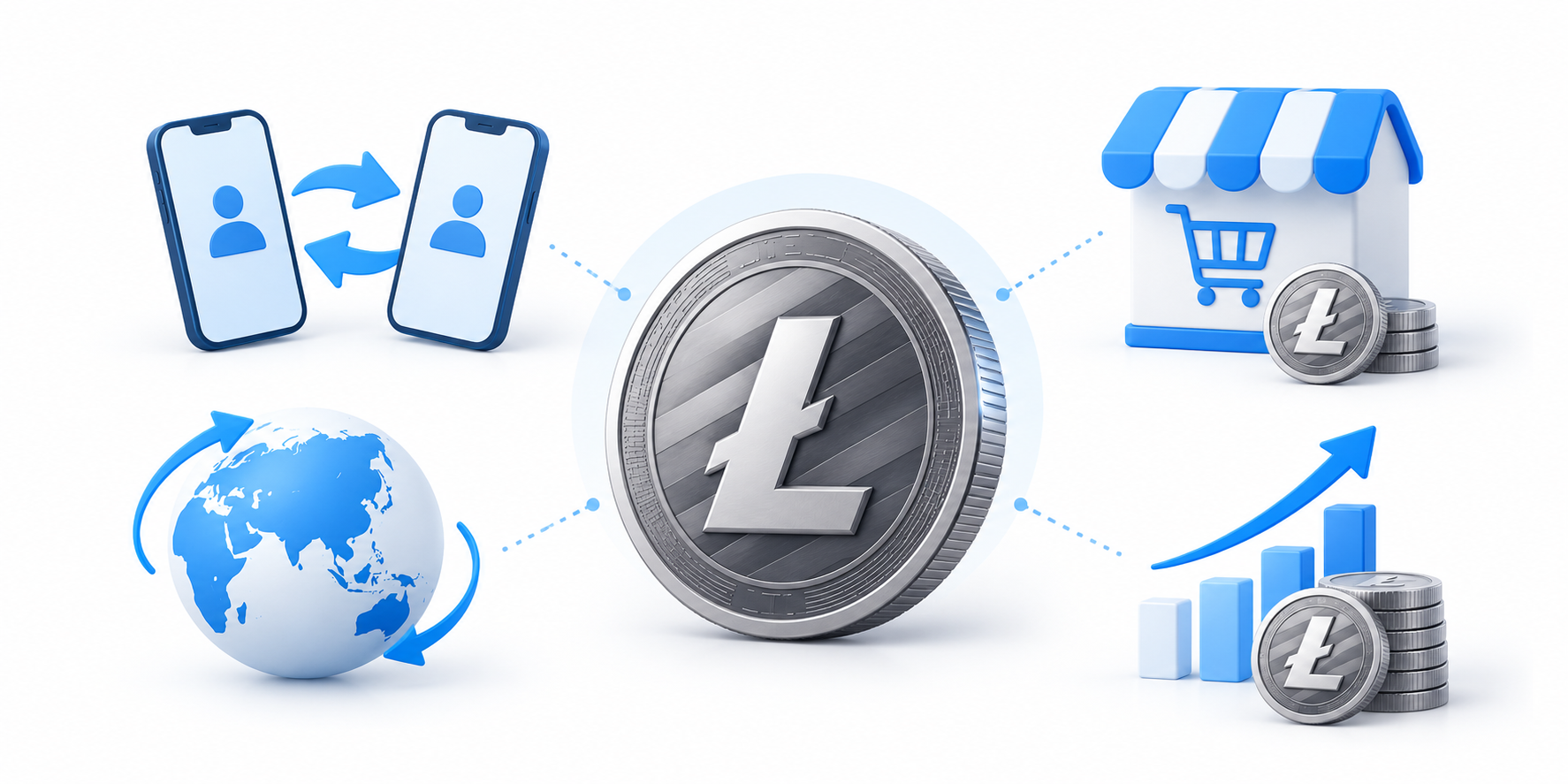
Litecoin has several potential uses, although their practicality depends on market conditions, wallet support, merchant acceptance, and the costs of completing a transaction.
Peer-to-Peer Payments
Users can send LTC directly to compatible wallets without asking a central payment processor to execute the transfer. This can be useful for people who want to transfer cryptocurrency between supported services or individuals.
However, both parties need to understand how wallet addresses, network fees, and transaction confirmations work. Sending LTC to an incompatible address or selecting the wrong network can result in lost funds.
Cross-Border Transfers
Litecoin can transfer digital value across borders when both parties have access to compatible wallets or services. However, completing the transfer may require additional steps, such as converting LTC into local currency or using a service that supports withdrawals in the recipient’s jurisdiction.
Even so, a blockchain transfer is not automatically cheaper or more convenient than a bank transfer or established remittance service. Exchange charges, conversion spreads, withdrawal fees, local restrictions, and the recipient’s access to an appropriate service can affect the total cost.
Trading and Portfolio Exposure
Some market participants buy or sell LTC in an attempt to benefit from price movements. Others hold it because they want exposure to a cryptocurrency with a long operating history and a different technical design from Bitcoin.
However, Litecoin’s price can move sharply in response to market sentiment, liquidity conditions, regulatory developments, and broader cryptocurrency trends. Its historical presence does not guarantee future demand or protect holders against losses.
Buying the actual cryptocurrency also differs from trading a contract for difference (CFD). Someone who buys LTC may hold it directly in a wallet or through a custodial service, depending on the arrangement. By contrast, an LTC CFD allows a trader to speculate on price movements without owning the underlying cryptocurrency. The rights, costs, and protections associated with either arrangement depend on the relevant service, product terms, and jurisdiction.
Explore account information
Review account details, terms, and risks on the official CPT website.
Litecoin vs Bitcoin: What Are the Main Differences?
Litecoin and Bitcoin share a proof-of-work model, public blockchain records, and a finite protocol-defined maximum supply. However, they differ in several important technical respects.
Litecoin’s shorter target block interval may allow an initial confirmation sooner, while its Scrypt mining algorithm and higher maximum supply distinguish its network design from Bitcoin’s. These differences do not establish that either cryptocurrency is inherently superior.
A cryptocurrency’s usefulness depends on its intended purpose, network adoption, available services, liquidity, security considerations, and user requirements. Actual confirmation times depend on network conditions and the recipient’s requirements.
Both assets can experience substantial price fluctuations in response to changes in investor sentiment, liquidity, and adoption. Neither a shorter target block interval nor a higher maximum supply establishes which cryptocurrency will deliver better investment performance.
To learn more about cryptocurrency markets, explore our Cryptocurrency CFD Trading offering and discover the key features available at CPT Markets.
What Are the Risks of Litecoin?
Litecoin’s established blockchain and peer-to-peer design do not make LTC a low-risk asset. Anyone considering buying, holding, or trading it should understand the following risks.
Price Volatility
LTC’s market price can rise or fall significantly over short periods. Changes in demand, wider cryptocurrency market conditions, investor sentiment, and regulatory developments can all affect its value.
Consequently, a buyer may receive less than the original purchase price when selling. A long operating history or a finite supply does not prevent substantial losses.
Wallet and Cybersecurity Risks
Users who control their own wallets must protect their private keys and recovery phrases. If these credentials are lost, stolen, or disclosed, the owner may lose control of the associated funds.
Custodial services introduce different risks, including cyber-attacks, operational failures, withdrawal restrictions, and provider insolvency. A wallet’s security features and a provider’s safeguards should therefore be assessed separately from the security of the Litecoin protocol itself.
Irreversible Transfers and Operational Errors
Blockchain transactions generally cannot be reversed through a central authority after they have been sufficiently confirmed. Sending funds to the wrong address, choosing an incompatible network, or falling victim to a fraudulent request can therefore lead to losses.
Before transferring LTC, users should verify the recipient’s address, confirm network compatibility, and consider sending a small test transaction when appropriate.
Liquidity and Market Access
The ability to buy or sell LTC at a desired price depends on market liquidity, trading venue availability, and prevailing conditions. During periods of market stress, spreads may widen and execution may become less favourable.
Availability can also vary between countries and service providers. A cryptocurrency’s existence does not guarantee that a user can legally access it, convert it into local currency, or withdraw funds through a particular platform.
Regulatory and Counterparty Risks
Cryptocurrency rules differ between jurisdictions and can change over time. Restrictions may affect access to trading services, advertising, transfers, or particular financial products.
Furthermore, any protection available to a customer depends on the relevant provider, product, and jurisdiction. Users should not assume that holding LTC or trading a cryptocurrency-linked derivative provides the same safeguards as holding money in a bank account.
Mining and Network Risks
Proof of work requires ongoing participation from miners. Changes in mining economics, concentration of mining power, software vulnerabilities, or other network-level problems can affect the system’s operation and security.
The Litecoin network’s technical design reduces reliance on a single transaction processor, but decentralisation does not mean that attacks, software defects, or service interruptions are impossible.
Understanding market risk is essential when evaluating volatile assets. Read our guide to forex risk management and learn more about managing trading risk.
How Can You Evaluate Litecoin Before Using It?
A structured review can help you understand the asset and the service through which you intend to access it.
1. Understand the purpose: Decide whether you are researching blockchain technology, making a payment, holding LTC, or considering price speculation. Each activity has different requirements and risks.
2. Check the service: Confirm that the wallet, exchange, or other provider supports Litecoin on the intended network. Review its fees, withdrawal rules, security arrangements, and applicable terms.
3. Review the costs: Consider network transaction fees as well as any exchange, conversion, deposit, or withdrawal charges. These costs may change with market and service conditions.
4. Assess your security arrangements: Protect your private keys and recovery phrase, enable available account security controls, and verify the recipient’s address and network before authorising a transfer. Never share recovery credentials with another person or enter them into an unverified website or application.
5. Understand the financial risk: If you are considering buying LTC or trading a related derivative, recognise that prices can move against you, and that losses may be substantial. Do not assume that historical performance or technical characteristics predict future returns.
For further foundational reading, explore more educational resources in the CPT Markets Academy.
Final Thoughts on Litecoin (LTC)
Litecoin offers an alternative blockchain network for peer-to-peer transfers, but its suitability depends on users’ transaction needs, available services, and tolerance for operational and financial risk.
Litecoin may be useful for supported transfers and may attract market participants seeking cryptocurrency exposure. However, price volatility, wallet security, operational errors, liquidity constraints, and regulatory uncertainty remain important considerations. Understanding how the network works is a starting point, not a guarantee of safety or profitability.
Frequently Asked Questions
1. What Is Litecoin (LTC) Used for?
Litecoin can be used to transfer digital value between compatible wallets, make payments where merchants accept it, and access cryptocurrency markets through supported services. Some people also hold LTC or trade its price. However, acceptance varies, transaction costs can change, and using or owning Litecoin involves market, operational, and cybersecurity risks.
2. How Is Litecoin Different From Bitcoin?
Litecoin differs from Bitcoin in its target block interval, maximum coin supply, and proof-of-work algorithm. These technical differences affect how the networks are designed, but they do not determine which cryptocurrency will deliver better market performance. See our Litecoin versus Bitcoin comparison above for more detail.
3. Is Litecoin Mining Profitable?
Litecoin mining profitability depends on factors such as the LTC price, block reward, mining difficulty, electricity costs, equipment efficiency, and operating expenses. Miners also face competition and potential changes in network conditions. Although mining can generate rewards, there is no guarantee that revenue will cover costs or produce a profit.
4. Is Litecoin a Safe Cryptocurrency?
Litecoin uses a decentralised proof-of-work blockchain, but this does not eliminate risk. Its market price can fluctuate substantially, and users can lose funds through scams, stolen credentials, incorrect transfers, or failures at service providers. Safety depends on several factors, including wallet security, transaction practices, service-provider reliability, and the user’s understanding of the risks.
5. Can Litecoin Transactions Be Reversed?
Litecoin does not have a central authority that can routinely reverse confirmed blockchain transactions. Consequently, sending LTC to an incorrect address or a fraudulent recipient may result in a permanent loss. Before authorising a transfer, check the destination address, confirm that the recipient supports Litecoin, and understand the service’s confirmation requirements.
6. Can I Trade Litecoin Through a CFD Broker?
Some CFD providers may offer contracts linked to Litecoin, but availability depends on the provider, legal entity, and jurisdiction. An LTC CFD generally allows a trader to speculate on price movements without owning the underlying cryptocurrency. CFDs involve separate costs and risks, and applicable protections vary. Confirm the provider’s official product terms and regulatory status before considering such a service.
Explore account information
Review account details, terms, and risks on the official CPT website.
Related articles
- Forex essentials
Base Currency vs Quote Currency: How Forex Pairs Are Read
A currency pair shows the value of one currency relative to another. The base currency is the first currency in the pair, while the quote currency is the second. The exchange rate tells you how many units of the quote currency are needed to buy one u
12 min read · estimated↗ - Trading essentials
What Is a Trader? Types, Skills, and How Trading Works
A trader is an individual who buys and sells financial instruments or takes positions in financial products to seek profits from changes in market prices. Traders operate across markets such as foreign exchange (forex), shares, indices, commodities,
13 min read · estimated↗ - Forex essentials
High-Value Currencies Compared: Exchange Rates Against the US Dollar
The highest-value currencies in the world are those that exchange for the greatest number of US dollars per unit. The Kuwaiti dinar, Bahraini dinar, and Omani rial typically lead this ranking, followed by currencies such as the Jordanian dinar and Br
14 min read · estimated↗